
Your BATNA, or Best Alternative to a Negotiated Agreement, is the single most important number you bring to any negotiation. The decision rule is simple: accept a deal only if it beats your BATNA. If it doesn't, walk away.
A well-formed BATNA has three components:
- A realistic option you can actually pursue, not a hypothetical you're hoping materializes
- A concrete value estimate in comparable terms (dollars, timeline, or risk-adjusted equivalent)
- Immediate actionability — meaning you could execute it today if the current deal falls apart
Pro Tip: If the offer on the table is worse than your BATNA, declare impasse and pivot to your alternative. Staying at the table past that point costs you leverage and, often, money.
Why BATNA is the core source of power in any negotiation
Leverage doesn't come from being bigger, louder, or more experienced. It comes from having somewhere credible to go if the deal dies. That's the entire logic of BATNA as a negotiation strategy.
When you have a strong alternative, you can make concessions selectively, hold firm on what matters, and walk away without panic. When you don't, every concession the other side demands feels like a cliff edge. The primary source of power in negotiation is often alternatives rather than apparent size or reputation — a dominant party can have a weak BATNA, and a smaller party with stronger alternatives may prevail.
Your BATNA directly shapes three negotiation outcomes:
- Accept/reject decisions — your BATNA is the floor below which no deal is worth taking
- Concession behavior — a strong BATNA lets you give less and hold longer
- Timing — knowing your alternative gives you the patience to wait for a better offer
Behavioral research also shows a consistent bias toward reaching agreement even when impasse would yield a better outcome. People accept suboptimal deals to avoid the discomfort of walking away. Treating impasse as a deliberate, disciplined choice — not a failure — is one of the most underused negotiation tactics available.
How to determine your BATNA in 4 steps
The process to identify your BATNA is repeatable and works before any negotiation, from a salary discussion to a creator-brand contract.
-
List every realistic alternative. Write down every option you could actually pursue if this deal collapses. Not wishful thinking — real options you could act on this week. A freelancer might list three other brands they've already pitched. A job candidate lists two other open roles they're actively interviewing for.
-
Evaluate each alternative on objective criteria. Score each option by value (how much is it worth?), timing (how long to close?), cost (what does pursuing it require?), and likelihood (how probable is a positive outcome?). Factors like relationship value and counterparty reliability belong here too.
-
Select the single best, most actionable option. This is your BATNA. Convert it into a concrete expected-value estimate — not a range, a number. If your best alternative is a brand deal worth $8,000 that has a 70% chance of closing, your risk-adjusted BATNA value is $5,600.
-
Translate that value into a walk-away threshold. This is your reservation point for the current negotiation. If the deal on the table can't beat $5,600 in comparable terms, you walk.
Pre-negotiation BATNA checklist:
- Have I listed at least three realistic alternatives?
- Have I scored each one for value, timing, and likelihood?
- Have I selected one as my primary BATNA?
- Have I converted it to a single reservation-point number?
- Have I stress-tested whether that alternative would actually materialize?
Pro Tip: Your BATNA is not a set-it-and-forget-it calculation. HBS guidance is explicit: update your BATNA as new information arrives during the negotiation. A counteroffer, a market shift, or a new option can change your reservation point mid-table.
How BATNA, reservation value, and ZOPA connect
These three concepts are related but distinct, and confusing them is one of the most common errors negotiators make.
- BATNA is your best outside option — what you do if no deal is reached.
- Reservation value (also called reservation point) is the translated monetary or nonmonetary value of your BATNA applied to the current deal, adjusted for timing, risk, and transaction costs.
- ZOPA (Zone of Possible Agreement) is the range between your reservation point and the other side's reservation point. A deal is only possible inside that zone.
The conversion chain looks like this:
BATNA → assign comparable value → adjust for risk and timing → reservation point → defines your edge of the ZOPA
Visualize it as a number line. Your reservation point sits at one end; the counterpart's sits at the other. If those two points overlap, a ZOPA exists and a deal is theoretically possible. If they don't overlap, no deal should happen — and knowing that early saves everyone time.
The practical rule: don't confuse your BATNA with your reservation point. Your BATNA is a real-world option. Your reservation point is a calculated threshold. You need both, and they're not the same number.
| Concept | What it is | How you use it |
|---|---|---|
| BATNA | Your best outside alternative | Determines whether to accept or reject |
| Reservation value | BATNA converted to deal-comparable terms | Sets your walk-away threshold |
| ZOPA | Overlap between both sides' reservation points | Defines where a deal is possible |
How to strengthen your BATNA before and during a negotiation
A weak BATNA is not a fixed condition. You can build better alternatives before you sit down, and you can probe the other side's alternatives once you're at the table.
Before the negotiation:
- Develop parallel options simultaneously. Don't wait for one deal to fall through before pursuing the next. Creative freelancers who build multiple client pipelines at once enter every negotiation with genuine leverage.
- Gather objective market data. Know what comparable deals look like. If you're a creator negotiating a brand deal, benchmark rates for your niche and audience size before the call.
- Create time pressure for the counterpart. A competing offer with a deadline shifts urgency to their side.
- Build coalitions where relevant. Multiple parties aligned with your position strengthen your collective BATNA.
During the negotiation:
- Test the counterpart's alternatives with open questions. "What happens on your end if we don't reach an agreement?" is a legitimate, non-aggressive probe.
- Use MESOs (multiple equivalent simultaneous offers) to probe the ZOPA. Offer two or three packages of equal value to you but structured differently. Their preference reveals what they actually care about.
- Signal a strong BATNA selectively. You don't need to disclose specifics — a calm, unhurried tone and a willingness to let silence sit often communicates strength more effectively than announcing a competing offer.
Pro Tip: Revealing your BATNA is a high-stakes move. PON research is clear: disclose only when your BATNA is strong, credible, and immediately verifiable. A weak or uncertain BATNA disclosed under pressure invites the other side to push harder.
How to assess the other side's BATNA
You can't negotiate well if you only know your own position. Estimating the counterpart's alternatives is just as important as clarifying your own.

Start with publicly available information: their market position, recent deals, stated timelines, and any signals of urgency. A brand that has been pitching the same creator for three months has a weaker BATNA than one with five alternatives lined up. A buyer who mentions a deadline repeatedly is often signaling that their alternative is worse than they're letting on.
Questions that surface BATNA signals:
- "What's your timeline for making a decision?"
- "Are you evaluating other options at the same time?"
- "What happens if this particular arrangement doesn't come together?"
When their BATNA is strong: narrow the gap by improving your offer on dimensions they value most, or by introducing terms they can't get elsewhere (exclusivity, speed, a unique capability).
When their BATNA is weak: hold your position. Don't make concessions out of social pressure when the math is in your favor.
Red flags that their BATNA is likely a phantom:
- They claim a competing offer but can't name specifics
- They become evasive when you ask about timeline or terms
- They show visible urgency while claiming they have options
- Their stated alternative requires conditions that seem unlikely to hold
Common mistakes negotiators make with BATNA
Most BATNA errors fall into a small number of predictable traps. Knowing them in advance is the fastest way to avoid them.
Phantom BATNAs. This is the most dangerous mistake. Behavioral research shows that negotiators act more aggressively when they believe they have another offer — even when that offer is uncertain or unlikely to materialize. The fix: score every alternative for probability before you treat it as your BATNA.
Treating BATNA as static. Conditions change. A BATNA you calculated two weeks ago may be obsolete by the time you're at the table. Reassess whenever new information arrives.
Confusing BATNA with reservation point. Your BATNA is an option; your reservation point is a number. You need to do the conversion math, not just name the alternative.
Revealing a weak BATNA. Disclosing that your best alternative is poor hands the other side a roadmap for how hard to push. Stay quiet and signal confidence through behavior instead.
Sunk-cost bias. Time and effort already invested in a negotiation are not reasons to accept a deal that falls below your reservation point. The only relevant question is whether the current offer beats your BATNA.
Pro Tip: Before any high-stakes negotiation, write your reservation point on paper and commit to it. Research on agreement bias shows that people override their own walk-away threshold under social and emotional pressure. A written commitment makes that harder to do.
Real-world BATNA examples that show how it works
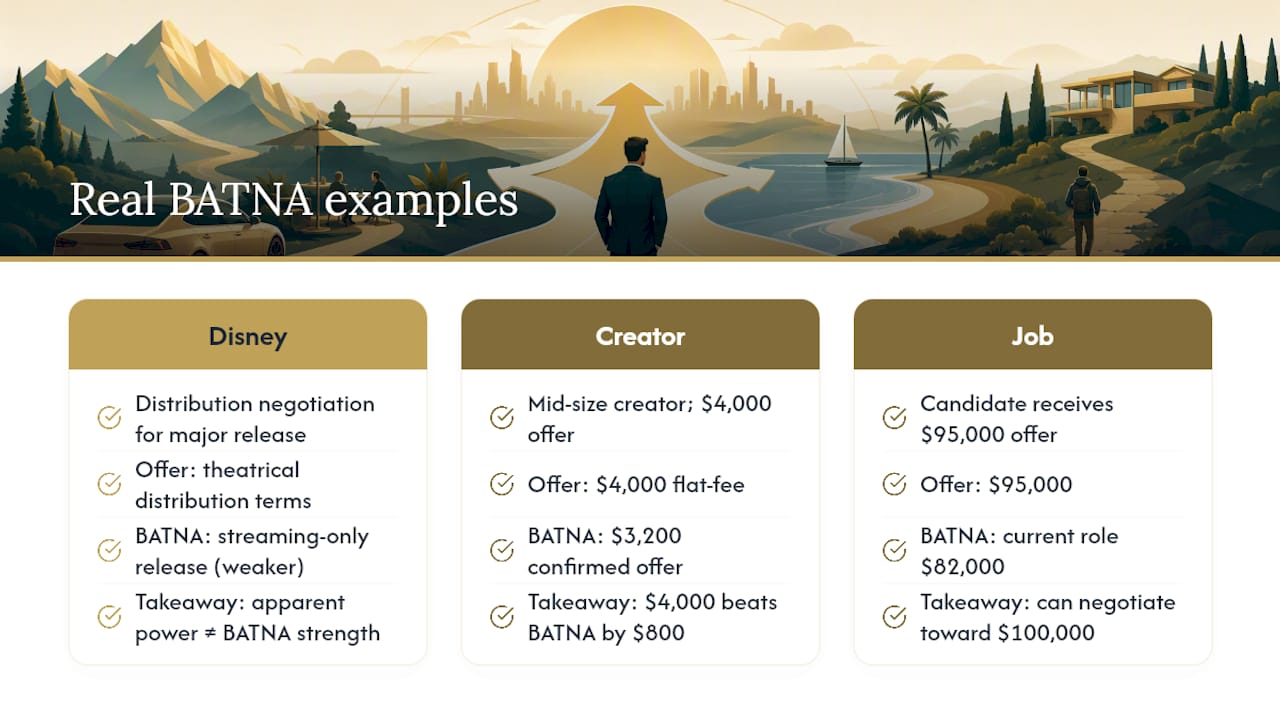
Case 1: Disney vs. theater owners
When Disney negotiated distribution terms for a major release, it appeared to hold all the power. But a PON case analysis showed that Disney's BATNA — streaming-only release — was weaker than it looked at the time, because theatrical revenue still mattered significantly to the studio's economics. Theater owners who recognized this interdependence held firmer than their apparent size suggested they could. The lesson: apparent power and actual BATNA strength are not the same thing.
Case 2: A creator negotiating a brand deal
A mid-size creator receives a $4,000 flat-fee offer from a brand. The risk-adjusted value of the third option is $3,850. Their true BATNA is the $3,200 confirmed offer. The $4,000 offer beats it, but only by $800 — not enough to accept unfavorable exclusivity terms. Knowing the number lets the creator push back on the exclusivity clause with confidence rather than guessing.
Case 3: A job offer negotiation
A candidate receives a $95,000 offer. Their BATNA is their current role at $82,000, which they'd prefer to leave. Their real BATNA is $82,000. That means the $95,000 offer clears the bar, but they can still negotiate toward $100,000 by signaling the pending offer without overstating its certainty.
The tactical lesson across all three: knowing your BATNA converts a vague sense of "I have options" into a specific number that tells you exactly when to push and when to close.
Your one-page BATNA prep template and checklist
Use this in the 24 hours before any significant negotiation.
BATNA prep checklist:
- List all realistic alternatives (minimum three)
- Score each for value, timing, cost, and likelihood
- Identify the single best option as your BATNA
- Convert it to a reservation-point number in deal-comparable terms
- Set your walk-away line and write it down
- Stress-test: call or tentatively confirm the alternative is still available
Mini template (fill in before the negotiation):
| Field | Your answer |
|---|---|
| Current negotiation | [Deal description] |
| Alternative 1 | [Option, estimated value, likelihood %] |
| Alternative 2 | [Option, estimated value, likelihood %] |
| Best alternative (BATNA) | [Name the option] |
| BATNA value (risk-adjusted) | [$X or equivalent] |
| Reservation point | [Walk-away threshold for this deal] |
| Their likely BATNA | [Your best estimate] |
| ZOPA estimate | [Range where a deal is possible] |
Script snippets for signaling or testing BATNA:
- Signaling strength (without disclosing specifics): "We're in conversations with a few other partners, so I want to make sure we can reach terms that work for both sides before those move forward."
- Testing their alternatives: "What does your timeline look like if this particular arrangement takes longer than expected?"
- Setting a deadline: "I need to give the other party an answer by Thursday, so I'd like to close this out before then if we can."
Pro Tip: Stress-test your BATNA by actually contacting your alternative before the negotiation. A tentative confirmation that the option is still live changes your psychology at the table. You'll negotiate differently when you know the exit door is open.
| Action | Effect on leverage |
|---|---|
| Develop three or more real alternatives | Raises your reservation point |
| Score alternatives by probability | Eliminates phantom BATNAs |
| Write down your reservation point | Prevents agreement bias |
| Confirm your BATNA is still available | Strengthens your walk-away credibility |
| Estimate the counterpart's BATNA | Reveals true ZOPA and pressure points |
What experienced negotiators actually do differently
The gap between knowing BATNA theory and using it under pressure is wider than most people expect.
The single habit that separates experienced negotiators from everyone else: they always translate their BATNA into a specific number before they walk into the room. Not a range. A number. "My walk-away is $47,500" is a decision rule. "I want something around $45K–$50K" is a wish.
Two tactics that show up repeatedly in high-stakes negotiations: MESOs and coalition-building. MESOs work because they reveal what the counterpart actually values without requiring them to say it directly. If you offer three packages and they gravitate toward the one with faster payment terms, you've learned something worth more than any opening statement. Coalition-building works because it changes the counterpart's BATNA, not just yours. When multiple parties align, the other side's outside options shrink.
The other move worth naming: sometimes the right call is to let impasse happen. Not every negotiation should close. When the counterpart's best offer sits below your reservation point and their BATNA is genuinely strong, walking away and executing your alternative is the correct outcome. Experienced negotiators don't treat that as a loss. They planned for it.
Sources
- BATNA (HBS Online)
- BATNA in Negotiation: A Key Source of Power - PON - Program on Negotiation at Harvard Law School
FAQ
What is the difference between BATNA and ZOPA?
BATNA is your best outside option if no deal is reached. ZOPA (Zone of Possible Agreement) is the range between your reservation point and the counterpart's reservation point — the space where a deal is actually possible. Your BATNA determines where your edge of the ZOPA sits.
What are BATNA and WATNA in negotiation?
BATNA is your Best Alternative to a Negotiated Agreement — the best outcome you can achieve without a deal. WATNA is your Worst Alternative to a Negotiated Agreement — the worst realistic outcome if negotiations fail. Knowing both gives you the full range of your no-deal scenario.
How do you calculate your BATNA?
List all realistic alternatives, score each by value and probability, and multiply to get a risk-adjusted expected value for each option. Your BATNA is the highest-value, most actionable result. Then convert that figure into a reservation point by adjusting for timing, risk, and transaction costs specific to the current deal.
What is a phantom BATNA?
A phantom BATNA is an alternative that feels real but is unlikely to materialize. The fix is to assign an honest probability to every alternative before treating it as your BATNA.
When should you reveal your BATNA to the other side?
Reveal your BATNA only when it is strong, credible, and immediately verifiable. Disclosing a weak or uncertain alternative signals desperation and invites the counterpart to push harder. When in doubt, signal confidence through tone and patience rather than explicit disclosure.