
Brand deal contract negotiation is the process by which creators define compensation, usage rights, exclusivity, and legal protections with brand partners before any content is produced. Most creators treat it as a formality. The ones earning the most treat it as the highest-leverage moment in any partnership. Creators leave 20 to 40% of potential earnings on the table by accepting default contract clauses without pushback. That gap is not a negotiation skill problem. It is a knowledge problem, and this guide closes it.
What key contract terms do creators need to know and negotiate?
Brand deal contract negotiation starts with understanding the clauses that actually move money. Most brand-issued contracts are written to protect the brand, not you. Knowing which terms to challenge is the difference between a fair deal and an expensive mistake.
Usage rights: the most underpriced clause in creator contracts
Usage rights define where and how a brand can use your content after delivery. The pricing standard in 2026 is clear: 30-day paid amplification adds 30 to 50% on top of your base fee, while perpetuity usage adds 100 to 150%. A brand running your content as a paid ad for six months is generating revenue from your creative work. Price it accordingly. Many creators hand over perpetual rights for free simply because the contract language is vague and they do not ask.

Exclusivity clauses and what they actually cost you
Exclusivity stops you from working with competing brands during a set window. Standard surcharges run 20% for 30 days, 35% for 60 days, and 50% for 90 days. A beauty brand asking for 90-day exclusivity across all skincare categories is effectively blocking three months of competing income. That cost must be reflected in the contract. If a brand wants exclusivity without paying the premium, counter with a narrower category definition or a shorter window.
Payment terms, kill fees, and FTC provisions
62% of creators sign brand deals without negotiating payment timelines or penalties. The professional standard for deals over $3,000 is a 50% upfront payment. For deals over $10,000, a three-part split works best: 33% at signing, 33% at content approval, and 34% at posting. Net-30 is acceptable. Net-90 is not. Build in a 1.5% monthly interest clause on late payments, and include a kill fee of 25 to 50% of the total contract value if the brand cancels after content is created.
FTC compliance provisions are now standard in 2026 contracts. AI transparency clauses are increasingly added to avoid violations related to synthetic content and undisclosed AI usage. Failing to disclose AI-generated voice or likeness can trigger contract termination and legal penalties. Read every compliance clause carefully before signing.
| Contract Term | What to Negotiate |
|---|---|
| Usage rights | Add 30 to 150% to base fee depending on scope and duration |
| Exclusivity | Charge 20 to 50% surcharge based on window length |
| Payment schedule | Require 50% upfront; Net-30 maximum for final payment |
| Deliverables | Define exact formats, revision limits, and approval timelines |
| Kill fee | Set at 25 to 50% of total contract value if brand cancels |
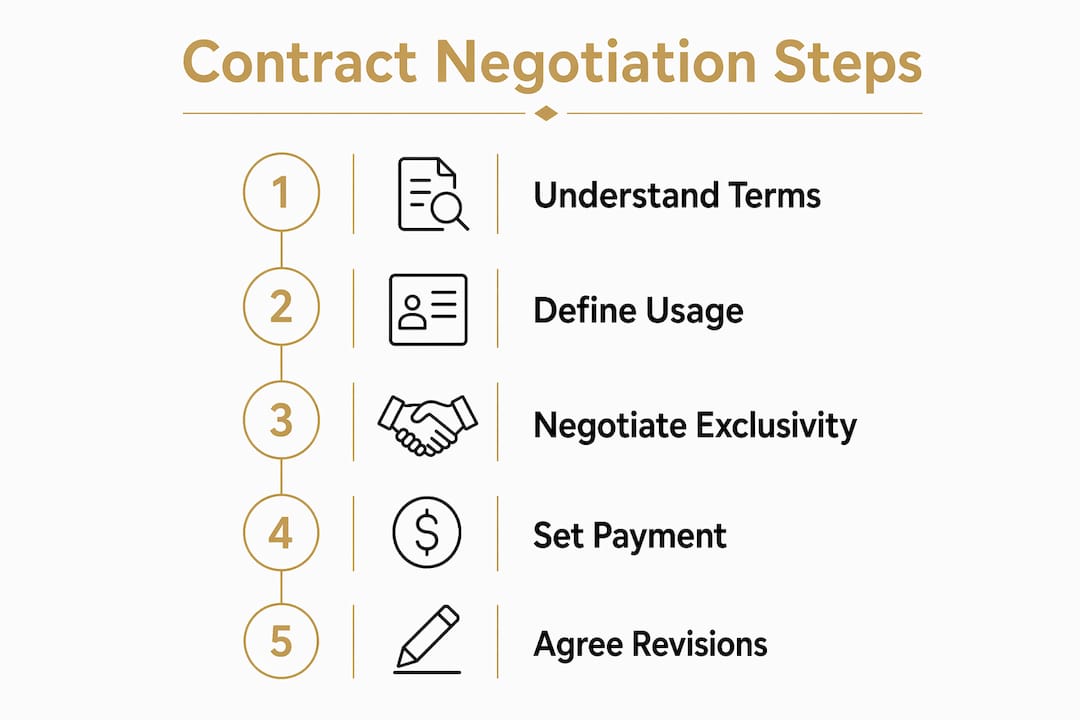
Pro Tip: Always define "revision" in writing. Limit revisions to two rounds with a clear scope. Unlimited revision language is one of the most common sources of scope creep in brand collaboration agreements.
Review the influencer contract clauses on Blackx for a full breakdown of standard and non-standard terms before your next negotiation.
How to use negotiation frameworks and tactics to boost brand deal value
A structured approach to negotiating brand partnerships can increase average deal value by up to 62% when using a five-step framework. That number reflects what happens when creators stop improvising and start negotiating with a repeatable system. Here is how to apply it.
-
Never quote your rate first. Ask the brand for their budget range before you name a number. This reveals their ceiling and prevents you from anchoring below it. A simple response works: "To make sure I put together the right package, could you share the budget range you're working with?"
-
Anchor with bundled packages. Present two or three tiered options rather than a single deliverable. A brand offered a choice between a $3,000 single-post package and a $7,500 three-post package with usage rights will often move up. Bundling reframes the conversation from price to value.
-
Price usage rights and exclusivity separately. Never fold these into your base rate. List them as line items on your rate card. This makes the value of each element visible and gives you room to negotiate each independently. Pricing usage rights separately can increase deal value by 30 to 50% on its own.
-
Lock in payment terms before content creation begins. Once you start producing content, your leverage drops. Confirm the payment schedule, invoice dates, and late payment penalties in writing before you open a camera app.
-
Counter with data, not emotion. When a brand pushes back on your rate, respond with engagement metrics, audience demographics, and past campaign performance. A creator with a 6.2% engagement rate on Instagram has a stronger counter than one who simply says "I think I'm worth more." Frame your value in the language brands use internally.
Pro Tip: When a brand says their budget is fixed, ask what they can add instead of what they can pay. Extended usage rights, product gifting, affiliate commission structures, or performance bonuses are all negotiable even when the base fee is not.
How can creators troubleshoot common negotiation challenges and red flags?
Even experienced creators run into deals that feel off. Knowing the warning signs early saves time, protects income, and keeps your reputation intact.
Red flags to watch for before signing:
- Net-90 payment terms with no late payment penalty clause
- Vague deliverable language such as "content as agreed" or "posts to be determined"
- Perpetual, worldwide usage rights buried in boilerplate without additional compensation
- Exclusivity clauses that cover broad categories without a defined end date
- No kill fee provision if the brand cancels after content is produced
Exclusivity demands deserve special attention. A brand asking for 90-day exclusivity across "all food and beverage" categories for a $1,500 deal is asking you to forfeit far more than the contract is worth. Counter by narrowing the exclusivity category to their direct product line, or by shortening the window to 30 days. Both moves protect your ability to take other work.
Approval delays are another common pressure point. Brands that take three weeks to approve a draft are effectively extending your exclusivity window without paying for it. Build a clause that specifies approval within five to seven business days, with content deemed approved if no feedback is received by the deadline.
"Strategic partnerships succeed when both parties clearly align objectives, timelines, and platforms before discussion of fees. Lack of strategic clarity often causes deals to collapse or underperform." Storyboard18
AI transparency is now a live compliance issue. New FTC enforcement in 2026 requires creators to disclose AI-generated content, which directly affects contract language and creator liability. If a contract requires you to use AI-generated voiceover or likeness without disclosure, that clause puts you at legal risk. Push for explicit disclosure language that protects both parties.
Knowing when to walk away is a skill. If a brand refuses a kill fee, demands perpetual rights at base rate, and insists on Net-90 payment, the deal is not worth saving. Walking away professionally, with a clear explanation of your standard terms, often brings brands back with better offers.
What tools and resources support creators in negotiating better brand deals?
The right infrastructure makes brand deal contract negotiation faster, cleaner, and more defensible. Here is what to use at each stage.
| Tool or Resource | Best Used For |
|---|---|
| Legal counsel | Any deal over $10,000; reviewing non-standard clauses |
| Blackx platform | Structuring, tracking, and protecting deal terms end-to-end |
| Contract templates | Establishing baseline terms before brand sends their draft |
| Analytics dashboards | Building data-backed rate cards and countering lowball offers |
| Creator communities | Benchmarking rates and sharing negotiation experiences |
Legal counsel is non-negotiable for contracts over $10,000. An entertainment or media attorney can identify indemnification clauses, IP ownership traps, and liability provisions that most creators miss. The cost of a one-hour review is a fraction of what a bad clause can cost you.
Blackx functions as the contract intelligence layer for the creator economy, giving creators a structured workflow to manage deal terms, track approvals, and protect their agreements from ambiguity. Rather than managing contracts through email threads and Google Docs, Blackx centralizes the process so nothing falls through the gaps.
Analytics tools like native platform dashboards, Sprout Social, or Creator.co give you the data to defend your rates. Brands respond to numbers. Showing a brand that your last three sponsored posts averaged a 5.8% engagement rate and 40,000 impressions is more persuasive than any verbal argument. Build a one-page media kit that includes these figures and update it before every negotiation.
Creator communities on platforms like Slack groups, Discord servers, and forums such as Reddit's r/PartneredYouTube are underused resources for benchmarking brand partnership rates. Knowing that creators in your niche with similar audiences are charging $4,000 for a single sponsored YouTube video gives you a concrete anchor for your own negotiations.
What I've learned from negotiating brand deals the hard way
I spent the first two years of my creator career treating every brand deal as a gift. I accepted whatever rate was offered, signed contracts I barely read, and delivered content before any payment cleared. The result was predictable: late payments, scope creep, and one brand that used my content in paid ads for 18 months without any additional compensation because I had signed away perpetual rights without realizing it.
The shift happened when I started treating negotiation as a relationship-building phase rather than a confrontation. Elite negotiators approach contracts as a way to expand the Zone of Possible Agreement with long-term goals in mind. That framing changed everything for me. Instead of fighting over price, I started asking brands about their campaign objectives, their timelines, and their internal approval processes. That information told me exactly where I had leverage and where I needed to be flexible.
The best deals I have closed were not the highest-paying ones upfront. They were the ones where the brand and I were genuinely aligned on goals, where the contract was specific enough to prevent disputes, and where the relationship led to renewals at higher rates. One partnership that started at $2,500 per post grew to $8,000 per post over 18 months because I invested time in the relationship and delivered results the brand could measure.
My honest advice: spend as much time on the contract as you spend on the content. The content gets you the deal. The contract determines what the deal is actually worth.
— Brian
How Blackx helps you negotiate and protect every brand deal
Blackx is built specifically for creators who are done losing money to vague contracts and slow payment cycles. The platform gives you a structured environment to define deliverables, lock in payment terms, and track every approval milestone from first draft to final post.

Whether you are negotiating your first five-figure deal or managing ten active brand collaboration agreements at once, Blackx removes the guesswork. The creator deal infrastructure includes contract templates, term tracking, and a clear four-step workflow that protects your rights before content creation begins. Stop leaving money on the table because a contract was ambiguous. Start every deal with the clarity that Blackx provides.
FAQ
What is brand deal contract negotiation?
Brand deal contract negotiation is the process where a creator and brand agree on compensation, usage rights, exclusivity, deliverables, and payment terms before content is produced. It is the primary mechanism through which creators protect their earnings and intellectual property.
How much should creators charge for usage rights?
Standard pricing adds 30 to 50% to the base fee for 30-day paid amplification and 100 to 150% for perpetuity usage rights. These figures reflect 2026 industry benchmarks and should be listed as separate line items in every contract.
What payment terms should creators require?
Creators should require at least 50% upfront for new brand partners, with Net-30 as the maximum for final payment. Deals over $10,000 work best with a three-part split: 33% at signing, 33% at approval, and 34% at posting.
What are the biggest red flags in a brand deal contract?
Net-90 payment terms, vague deliverable language, perpetual usage rights without additional compensation, and the absence of a kill fee clause are the most common red flags. Any contract missing these protections should be countered before signing.
Do creators need a lawyer for brand deals?
Legal counsel is recommended for any brand deal over $10,000. An entertainment attorney can identify IP ownership clauses, indemnification risks, and liability provisions that standard contract templates do not address.
Key takeaways
Effective brand deal contract negotiation requires separating base fees from usage rights, exclusivity premiums, and payment terms, then defending each with data and structured counteroffers.
| Point | Details |
|---|---|
| Price usage rights separately | Add 30 to 150% to your base fee depending on scope, duration, and amplification type. |
| Require upfront payment | Demand at least 50% before production begins; use a three-part split for deals over $10,000. |
| Charge for exclusivity | Apply a 20 to 50% surcharge based on the length of the exclusivity window requested. |
| Counter with engagement data | Use platform analytics and past campaign results to justify your rate in every negotiation. |
| Know your red flags | Walk away from Net-90 terms, vague deliverables, and contracts with no kill fee provision. |