
A content creator equity deal is a partnership where a creator receives an ownership stake in a business or intellectual property entity, not just a one-time payment for content. This structure lets you share in the long-term financial success of a brand or product you help build. Jay Shetty's $100M deal with Netflix and Spotify and Alix Earle's brand ownership arrangements show how top creators are moving beyond flat fees into real equity participation. Understanding the content creator equity deal explained in full, including vesting, dilution, and tax exposure, is the difference between a deal that builds wealth and one that just looks good on paper.
What is a content creator equity deal, and how does it compare to other models?
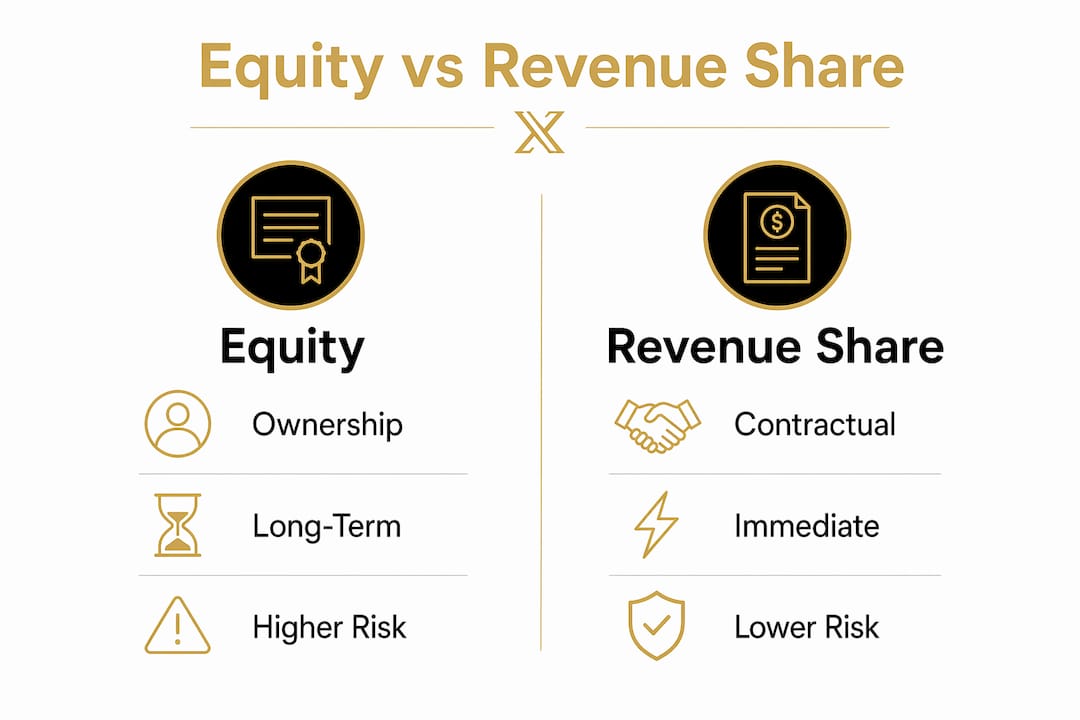
A content creator equity deal gives you an ownership stake in a company or IP entity, meaning your financial return grows as the business grows. This is fundamentally different from a revenue share deal, where you receive a contractual percentage of income streams regardless of company performance, or a profit share deal, where you only get paid after expenses are deducted. Equity aligns creators to enterprise upside but adds complexity around valuation, dilution, governance, and exits. Revenue share tends to be more predictable and easier to audit.
Here is how the three main models compare:
| Model | How you get paid | Upside potential | Risk level |
|---|---|---|---|
| Equity | Ownership stake, paid on exit or dividends | Highest | Highest |
| Revenue share | Percentage of gross or net revenue | Moderate | Moderate |
| Profit share | Percentage of net profit after deductions | Low to moderate | High (dispute-prone) |
Profit share is the most creator-unfavorable structure because brands control expense definitions. A company can load costs onto the books and legally reduce your payout to near zero. Revenue share is cleaner because it ties to a defined top-line number. Equity is the most powerful long-term vehicle, but it requires you to think like a business owner, not a content producer.
Many deals today are hybrid cash plus equity, where you receive immediate payment alongside earned equity that vests over time. Digiday reports that creators face real stress shifting from immediate payment to long-term upside, especially when deal terms remain undisclosed. That opacity is exactly why you need to understand the mechanics before signing.
What key contract terms do creators need to understand?
Vesting is the mechanism by which you earn your ownership over time or after hitting specific milestones. A four-year vesting schedule with a one-year cliff means you own nothing until month 13, then earn equity incrementally after that. Vesting and dilution terms are the two most misunderstood elements in creator equity contracts, and both directly affect what your stake is actually worth.

Dilution happens when a company issues new shares to investors. If you own 5% of a company and it raises a funding round, your 5% can shrink to 3% or less without any breach of contract. Anti-dilution protections exist but are rarely offered to creators by default. You have to ask for them.
Other terms that matter:
- Revenue definition: What counts as revenue? Gross sales, net of returns, net of platform fees? Every deduction reduces your check.
- Audit rights: Can you independently verify the numbers the brand reports to you? Without this, you are trusting their accounting.
- Termination triggers: What happens to your equity if the deal ends early? Does unvested equity disappear, or does it accelerate?
- Exclusivity and noncompete clauses: These are business constraints limiting creator flexibility, not just legal boilerplate. A 12-month exclusivity window can block you from six-figure sponsorships in the same category.
Pro Tip: Before signing, map every active and pipeline sponsorship against the exclusivity clause. A deal that pays you 2% equity in a startup is not worth losing three confirmed brand deals in the same vertical.
Waterfalls and caps also appear in more sophisticated structures. A waterfall defines the order in which different stakeholders get paid on exit. If you are at the bottom of the waterfall, a $50M acquisition might pay investors in full before you see a dollar. Ask where you sit in the payout order.
How do taxes work on equity and non-cash creator compensation?
Tax treatment is where many creators get blindsided. Gifted products and barter arrangements are taxable income at fair market value for self-employed creators, regardless of whether a 1099 is issued. The IRS applies Section 61 broadly: if you receive something of value in exchange for promotion, it is compensation.
The Duberstein test is the IRS framework for distinguishing a true gift from compensation. If a brand sends you a $2,000 camera with the expectation that you will post about it, that camera is taxable income at its retail value. There is no de minimis exemption for self-employed creators, unlike employees who can receive small employer gifts tax-free.
Equity compensation carries its own tax timeline. Depending on how the equity is structured, you may owe taxes when shares vest, not when you sell them. This creates a cash-flow problem: you own equity on paper but owe the IRS real money now.
Practical steps to stay compliant:
- Track the fair market value of every gifted product at the time of receipt, using retail price receipts or brand invoices.
- Set aside estimated taxes quarterly, not annually, to avoid underpayment penalties.
- Track product FMV and set aside taxes as a standard operating procedure, not an afterthought.
- Consult a CPA who specializes in creator or self-employment income before signing any equity deal with a vesting schedule.
Tax planning is not optional when you move into equity territory. The headline percentage on a deal means nothing if a surprise tax bill consumes the cash you needed to cover it.
What are the strategic benefits and risks of equity deals?
The core benefit of equity is durability. Equity deals provide revenue beyond peak production volume, meaning your financial return does not stop when you stop posting. A creator who owns 3% of a brand they helped scale to a $20M acquisition earns $600,000 regardless of their content output in year three. That is a fundamentally different income model than a $15,000 sponsorship post.
The risks are equally real:
- Valuation uncertainty: Early-stage company equity can be worth nothing if the business fails.
- Illiquidity: You cannot sell equity in a private company the way you cash a sponsorship check. Your money is locked until an exit event.
- Legal complexity: Shifts from cash to equity deals introduce contract risks that require careful legal counsel. Most creators do not have that counsel in place.
- Audience trust risk: Promoting a brand you own equity in without disclosure violates FTC guidelines and erodes audience trust.
"The creator economy is maturing, moving from flat fees to longer-term equity ownership deals similar to sports and entertainment endorsements." — Rethinking deal structures in the creator economy
There are situations where a cash deal is simply better. If a brand is pre-revenue, has no clear exit path, and is offering equity instead of cash because they cannot afford to pay you, that is a red flag. Equity is not a substitute for fair compensation. It is an addition to it. Demand for creator equity deals is growing, with founders screening creators for financial health and growth potential before investing. That screening works both ways. You should be evaluating them just as rigorously.
How can creators negotiate and structure effective equity deals?
Negotiation starts before the term sheet. The questions you ask in early conversations signal your sophistication and set the tone for the entire deal.
- Ask about the cap table. How many shares are outstanding? Who else owns equity? Where do you sit in the waterfall?
- Define revenue clearly. Get the revenue definition in writing before you discuss percentages. A clear contract specifying percentage and revenue definition is the single most effective way to prevent future disputes.
- Negotiate audit rights. You need the contractual right to verify reported numbers with an independent accountant at least once per year.
- Evaluate the exclusivity window. Map your current and projected sponsorship pipeline against the proposed exclusivity period. Calculate the revenue you would forgo and factor that into your equity ask.
- Request acceleration on termination. If the brand ends the deal early, your unvested equity should accelerate, not disappear.
- Engage a creator-focused attorney. General contract lawyers often miss equity-specific terms like anti-dilution provisions and exit waterfalls. The cost of specialized counsel is far less than the cost of a bad deal.
Pro Tip: Ask for podcast product endorsement and non-cash compensation terms to be explicitly addressed in the contract. Brands often assume gifted products are outside the deal scope. They are not, and the IRS agrees.
Platforms built for creator deal infrastructure, like Blackx, are designed to bring this kind of contract clarity to every deal, not just the ones where creators can afford a full legal team. The goal is to make audit rights, revenue definitions, and reporting formats standard, not negotiated extras.
Key takeaways
Equity deals give creators ownership and long-term upside, but only when the contract terms are clear, the tax implications are planned for, and the deal structure is evaluated with the same rigor a business investor would apply.
| Point | Details |
|---|---|
| Equity vs. revenue share | Equity offers higher upside but adds valuation, dilution, and exit complexity that revenue share avoids. |
| Vesting and dilution | Understand your vesting schedule and ask for anti-dilution protections before signing any equity deal. |
| Tax on non-cash income | Gifted products and equity compensation are taxable at fair market value; set aside quarterly estimated taxes. |
| Contract clarity | Define revenue, audit rights, and termination triggers in plain language to prevent payment disputes. |
| Exclusivity risk | Map every exclusivity clause against your sponsorship pipeline before agreeing to any restriction period. |
Why most creators are still leaving money on the table
I have reviewed hundreds of creator contracts over the years, and the pattern is consistent. Creators focus on the headline number and ignore the architecture underneath it. A 5% equity stake sounds meaningful until you see a cap table with 40 other stakeholders, a liquidation preference that pays investors 2x before anyone else, and a noncompete that covers your entire content category for 18 months.
The creator economy is genuinely maturing. The deals available today, including real equity participation, revenue share hybrids, and multi-platform distribution arrangements, were not accessible to most creators five years ago. That is real progress. But the legal and financial complexity has scaled faster than creator literacy around these structures.
What I tell every creator I work with: treat an equity deal like a business investment, because that is exactly what it is. You are not just lending your audience to a brand. You are becoming a stakeholder in their outcome. That requires you to ask harder questions, read the full contract, and understand what happens in the scenarios the brand does not want to discuss, like a down round, an acqui-hire, or an early termination.
The creators who build lasting wealth from equity deals are not necessarily the ones with the biggest audiences. They are the ones who understood the deal before they signed it.
— Brian
How Blackx helps creators take control of their deals
Blackx is the contract intelligence layer built specifically for the creator economy, and it exists because most creators should not need a $500-per-hour attorney to understand what they are signing.

The Blackx creator platform gives you deal infrastructure that makes equity terms, revenue definitions, audit rights, and reporting formats readable and enforceable from day one. Whether you are negotiating your first equity deal or managing a portfolio of brand partnerships, Blackx brings the same contract clarity that enterprise deals have always had. You can also explore deal structure trends to benchmark your terms against what other creators are actually signing. Stop guessing what your deal means. Start knowing.
FAQ
What is a content creator equity deal?
A content creator equity deal is a partnership where a creator receives an ownership stake in a company or IP entity in exchange for content, promotion, or distribution work. Unlike a flat sponsorship fee, equity ties the creator's financial return to the long-term success of the business.
How is equity different from revenue share for creators?
Equity means you own part of the business and benefit from its growth or sale. Revenue share is a contractual right to a percentage of income streams, which is more predictable but does not give you ownership or exit upside.
Are gifted products taxable income for creators?
Yes. The IRS treats gifted products sent with an expectation of promotion as taxable compensation at fair market value, with no de minimis exemption for self-employed creators. Track retail values and report them as income.
What is vesting in a creator equity deal?
Vesting is the schedule by which you earn your equity over time or after hitting milestones. A common structure is a four-year vest with a one-year cliff, meaning you own nothing until month 13 and earn incrementally after that.
When is a cash deal better than an equity deal?
A cash deal is preferable when a brand is pre-revenue, has no clear exit path, or is offering equity as a substitute for fair payment rather than an addition to it. Equity only creates value if the business succeeds and reaches a liquidity event.