Content creator IP ownership is defined as the automatic legal right creators hold over original works the moment those works are fixed in a tangible form, including videos, photos, scripts, and music. Under 17 U.S.C. § 106, copyright protection vests at creation without registration. The problem is that most creators sign away significant portions of that ownership without realizing it. Brand deals, platform terms of service, and poorly worded contracts routinely strip creators of rights they legally hold. This article covers content creator IP ownership explained in full: what you own, what you can lose, and how to protect it.
What does it mean to own your IP as a content creator?
Intellectual property for creators begins with copyright, the most immediate and automatic form of legal protection available. The moment you record a video, write a script, compose a track, or photograph a subject, copyright attaches to that work. You do not need to register with the U.S. Copyright Office to own it. Registration matters later if you need to sue for infringement, but ownership itself is instant.
Copyright covers original works fixed in a tangible medium. That includes YouTube videos, Instagram Reels, podcast episodes, blog posts, digital illustrations, and brand photography. The key word is original: the work must reflect your creative expression, not just a mechanical reproduction of facts.
Creators often confuse copyright with other IP types. Here is how the main categories break down:
- Copyright protects original creative expression: videos, photos, written content, music, and scripts.
- Trademark protects brand identity: your channel name, logo, slogan, or signature catchphrase.
- Trade secrets protect confidential business information, such as proprietary editing workflows or audience data.
- Patents protect inventions and are rarely relevant to content creators unless you build a product.
Two major exceptions can override automatic ownership. First, the work made for hire doctrine applies when you create content as an employee within the scope of your job. In that case, your employer owns the copyright. Second, a written agreement can designate a commissioned work as work made for hire in specific categories defined by law. If you freelance and sign a contract with that language, the client may own what you create.
Pro Tip: Read every contract for the phrase "work made for hire" before you sign. If it appears and you are a freelancer, you are likely signing away full copyright ownership, not just a license.
How do licenses differ from ownership transfers?
Licenses grant permission to use your content under defined conditions, while you retain ownership. Assignments and work-for-hire arrangements transfer full copyright to another party. This distinction is the single most consequential legal difference in creator contracts, and most creators do not understand it until they have already lost rights they cannot recover.
A license is a set of permissions. You tell a brand: "You may use this video for six months on your Instagram page." You still own the video. You can license it to other brands, post it yourself, and include it in your portfolio. An assignment says the opposite: "You now own this video." Once assigned, you have no legal right to reuse your own work without the new owner's permission.
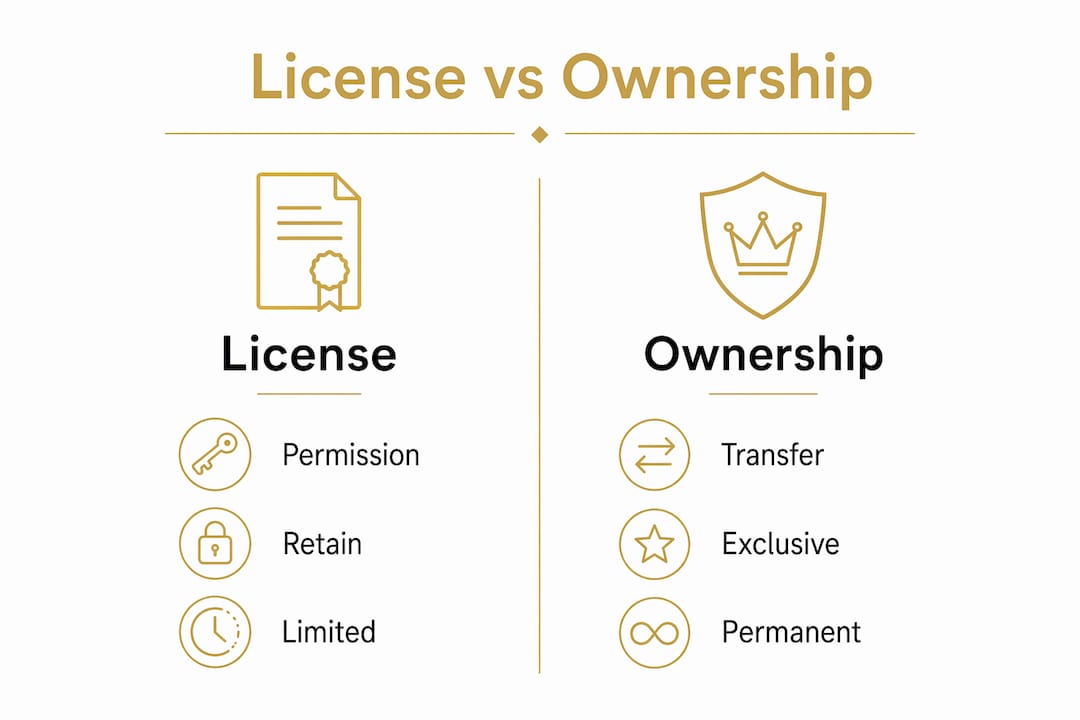
| Feature | License | Assignment |
|---|---|---|
| Ownership retained | Yes, creator keeps copyright | No, ownership transfers to client |
| Reuse by creator | Permitted unless exclusive | Not permitted without new agreement |
| Duration | Defined in contract | Permanent |
| Typical use case | Brand campaign, sponsored post | Full buyout, agency-produced content |
| Negotiability | Highly negotiable | Often presented as non-negotiable |
Common contract language signals which you are dealing with. Words like "license to use," "permission to display," and "right to publish" typically indicate a license. Phrases like "all rights," "full buyout," "assigns all rights," and "work made for hire" permanently transfer ownership and should be negotiated carefully before you sign.
The practical stakes are real. A creator who licenses a product video retains the right to use that footage in a portfolio reel or pitch deck. A creator who assigns the same video cannot legally include it in their own showreel without written permission from the brand that now owns it.
Pro Tip: When a brand asks for a "full buyout," counter with a time-limited exclusive license instead. You get paid similarly, and you keep long-term control of the asset.
What are common IP pitfalls in creator contracts and brand deals?
Broad IP assignment clauses granting brands sweeping usage rights for years without additional payments appear in a significant share of creator contracts. Most creators sign them without flagging the language because the deal looks straightforward on the surface.
The four words that should trigger immediate scrutiny in any contract are:
- Exclusive: The brand is the only party allowed to use the content. You cannot license the same work to anyone else, including yourself in some cases.
- Worldwide: The usage rights apply in every country, which dramatically increases the commercial value you are giving away.
- Sublicensable: The brand can grant your content to third parties, including competitors, without asking you again.
- Irrevocable: You cannot take the rights back, even if the brand misuses your content or the relationship sours.
Contracts with these four terms can strip creators of control and future monetization opportunities. A single brand deal with all four terms present is effectively a permanent, global transfer of control over that content.
Payment does not change this equation. Paying a creator does not automatically convey copyright to the brand. Ownership only transfers when the contract explicitly says so. This cuts both ways: if you are paid and the contract is silent on ownership, you likely still own the work. But if the contract includes an assignment clause buried in paragraph 14, you have transferred ownership regardless of whether you noticed it.
Whitelisting agreements add another layer of complexity. When a brand whitelists your social account, they gain the ability to run paid ads from your profile. That is an advertising license, not a content license. Creators sometimes sign whitelisting agreements that also include broad content rights language, giving brands far more than ad access.
Brand tags and social mentions do not grant usage rights. A brand reposting your content without a written license is technically infringing your copyright, even if you tagged them and they credited you.
How can content creators protect their IP rights effectively?
Protecting your content ownership rights starts before you create anything for a brand. The creators who retain the most control are the ones who treat IP management as a business practice, not an afterthought.
-
Build an IP inventory. List every copyrightable asset you own: videos, photos, music, scripts, brand elements, and course materials. Knowing what you own is the foundation of protecting it. Tools like Airtable or Notion work well for this.
-
Use written agreements for every collaboration. Verbal agreements are unenforceable for copyright transfers under U.S. law. Every brand deal, collab, and commissioned piece needs a written contract specifying the license scope, duration, territory, and exclusivity terms. Blackx provides contract infrastructure built specifically for creator-brand deals.
-
Negotiate license scope down, not up. Start with the narrowest possible license: non-exclusive, limited territory, short duration, specific platform. Let the brand negotiate upward. Non-exclusive licenses allow you to retain usage rights and license the same content to others, which is a significant monetization advantage.
-
Clarify third-party asset rights. If your content includes licensed stock footage, music from a library, or fonts with commercial restrictions, third-party asset provenance can limit effective ownership of the final deliverable. Specify in contracts which elements are licensed versus owned outright.
-
Retain portfolio rights explicitly. Many creator contracts are silent on whether you can display the work in your portfolio. Add a clause stating you retain the right to display the content for self-promotional purposes, regardless of exclusivity terms.
Pro Tip: Before signing any brand deal, run the contract through Blackx's deal verification layer to flag ownership-transfer language before it costs you rights you cannot recover.
How do copyright and trademark protections differ for creators?
Copyright protects creative expression; trademarks protect brand identity. Creators who understand only one of these two systems leave significant protection and monetization on the table.
Copyright covers what you make: the specific video, the written post, the photograph. It does not protect your channel name, your logo, or your signature sign-off phrase. Those are brand elements, and trademark law is what protects them. A competitor could legally name their channel something nearly identical to yours if you have not registered a trademark, because copyright gives you no claim over a name.
Here is how the two systems compare across the dimensions that matter most to creators:
| Dimension | Copyright | Trademark |
|---|---|---|
| What it protects | Original creative works | Brand names, logos, slogans |
| How it arises | Automatically at creation | Through use in commerce; registration strengthens it |
| Duration | Life of creator plus 70 years | Indefinitely, with renewal |
| Registration required | No, but recommended for litigation | No, but strongly recommended |
| Enforcement | Infringement claims, DMCA takedowns | Opposition, cancellation, infringement suits |
Segmenting IP into copyright and trademark enables creators to maximize protection and monetization across distinct asset classes. A creator who registers their channel name as a trademark can license that brand to merchandise partners, block imitators, and build a business asset that appreciates independently of any single piece of content.
The practical starting point for trademark protection is using your brand name consistently in commerce, then filing a federal trademark application with the U.S. Patent and Trademark Office. The process takes roughly 12 to 18 months, but the priority date runs from your filing date, not your approval date.
Key takeaways
Creators own their intellectual property automatically at creation, but retaining that ownership through brand deals and contracts requires understanding the difference between licenses, assignments, and work-for-hire terms.
| Point | Details |
|---|---|
| Automatic copyright | Copyright vests at creation under U.S. law; registration is not required to own your work. |
| License vs. assignment | A license lets brands use your content while you keep ownership; an assignment transfers ownership permanently. |
| Four contract red flags | Exclusive, worldwide, sublicensable, and irrevocable terms can strip creators of long-term control. |
| Trademark fills the gap | Copyright does not protect your channel name or logo; trademark registration does. |
| Written agreements protect you | Every brand deal needs a written contract specifying license scope, duration, and territory. |
Why most creators learn this lesson too late
I have reviewed hundreds of creator contracts, and the pattern is consistent. Creators who are early in their careers treat the contract as a formality. They focus on the payment number, skim the deliverables section, and sign. The IP clauses sit in the middle of the document, written in dense legal language, and nobody reads them until something goes wrong.
The uncomfortable reality is that creators' IP is their most valuable asset, more valuable than follower count or engagement rate. A catalog of owned content compounds in value over time. A catalog of assigned content is someone else's asset that you happened to produce.
What I find most frustrating is that the fix is not complicated. You do not need a law degree to spot "irrevocable worldwide assignment of all rights" in a contract. You need to know what to look for and have the confidence to push back. Most brands will accept a time-limited license when a creator asks clearly. They include the aggressive language because nobody challenges it.
Reviewing contract terms carefully before signing saves far more than it costs. The creators I have seen build durable businesses are the ones who treated their contracts with the same seriousness they gave their content. Start that practice now, not after you have signed away your best work.
— Brian
Protect your IP before the next brand deal
Every brand deal you sign without reviewing the IP terms is a bet that the contract is fair. Most are not written with your interests in mind.

Blackx is the contract intelligence layer built for the creator economy. It gives you the infrastructure to review, negotiate, and finalize brand deals with full visibility into ownership and licensing terms before you sign. Creators using Blackx know exactly what rights they are granting, what they are keeping, and what their content is worth. If you are serious about protecting your content ownership rights in 2026, explore Blackx for creators and stop leaving IP control to chance.
FAQ
What is content creator IP ownership?
Content creator IP ownership is the automatic copyright a creator holds over original works fixed in a tangible form, such as videos, photos, and scripts. Under U.S. law, this protection vests at creation without registration.
Does getting paid for content mean the brand owns it?
No. Payment alone does not transfer copyright. Ownership only transfers when the contract includes explicit assignment or work-for-hire language.
What is the difference between a license and an assignment?
A license gives a brand permission to use your content under defined conditions while you retain ownership. An assignment permanently transfers copyright to the brand.
How do I protect my channel name and logo?
Copyright does not protect brand names or logos. You need to register a federal trademark with the U.S. Patent and Trademark Office to protect those brand elements.
Which contract terms should creators watch out for?
Watch for the words exclusive, worldwide, sublicensable, irrevocable, "all rights," "full buyout," and "work made for hire." These terms significantly expand what a brand can do with your content and often reduce or eliminate your future control over it.