
A content creator rate card is a structured pricing document that lists your services and associated fees, giving brands a clear starting point for negotiations without the awkward back-and-forth. Most creators treat pricing as a conversation to be had later. The ones earning the most treat it as a document to be sent first. This guide breaks down the content creator rate card explained in full, covering how to calculate base rates, separate usage rights, structure your layout, and avoid the undercharging traps that quietly drain creator income every year.
What is a content creator rate card?
A content creator rate card is your professional pricing framework. It tells brands exactly what you offer, what it costs, and what is included or excluded. Think of it as a menu, not a contract. Rate cards act as sales tools that eliminate guesswork for brand managers and signal that you run a real business. That signal alone changes how brands treat your inbox.
Rate cards are typically built in tools like Canva, Notion, or Google Slides and shared as PDFs. The format matters less than the clarity. A well-organized one-pager beats a cluttered five-page deck every time. The goal is to make a brand manager's job easier, not to impress them with design.
One critical distinction: a rate card is an offer document, not a signed agreement. Kill fees, scope protections, and legal terms belong in a separate contract. Mixing the two creates confusion and weakens both documents.
How do you calculate your base rates?
Base rates are the foundation of your entire pricing structure. The standard formula used across the industry is: Rate = (Follower Count × $0.01–$0.05) × Engagement Multiplier. The engagement multiplier ranges from 0.5 to 2.0 depending on how actively your audience interacts with your content. A creator with 20,000 followers and a 5% engagement rate might start at roughly $30 per post base, then adjust upward for effort, platform, and usage.

Follower count alone is a weak pricing signal. Engagement rate is the real currency brands care about, and it can shift your rate by 20–50% in either direction.
Here is how influencer rates break down by tier as of 2026:
| Tier | Follower Range | Typical Rate Per Post |
|---|---|---|
| Nano | 1K–10K | $10–$100 |
| Micro | 10K–100K | $100–$1,000 |
| Mid-Tier | 100K–500K | $1,000–$5,000 |
| Macro | 500K–1M | $5,000–$15,000 |
| Mega | 1M+ | $15,000–$50,000+ |
Platform also matters. Instagram Reels and TikTok typically command higher rates than static posts due to production effort. YouTube integrations carry a premium over short-form video because of longer viewer attention and production time.
Pro Tip: Round your rates to clean numbers like $500, $1,500, or $3,000. Rounded figures read as confident and considered. Oddly specific numbers like $487 signal that you are guessing, not pricing.
Brand deal pricing in 2026 resembles freelance consulting more than fixed retail. Build your rates around creative effort and time invested, not just follower count.
Should usage rights be priced separately?
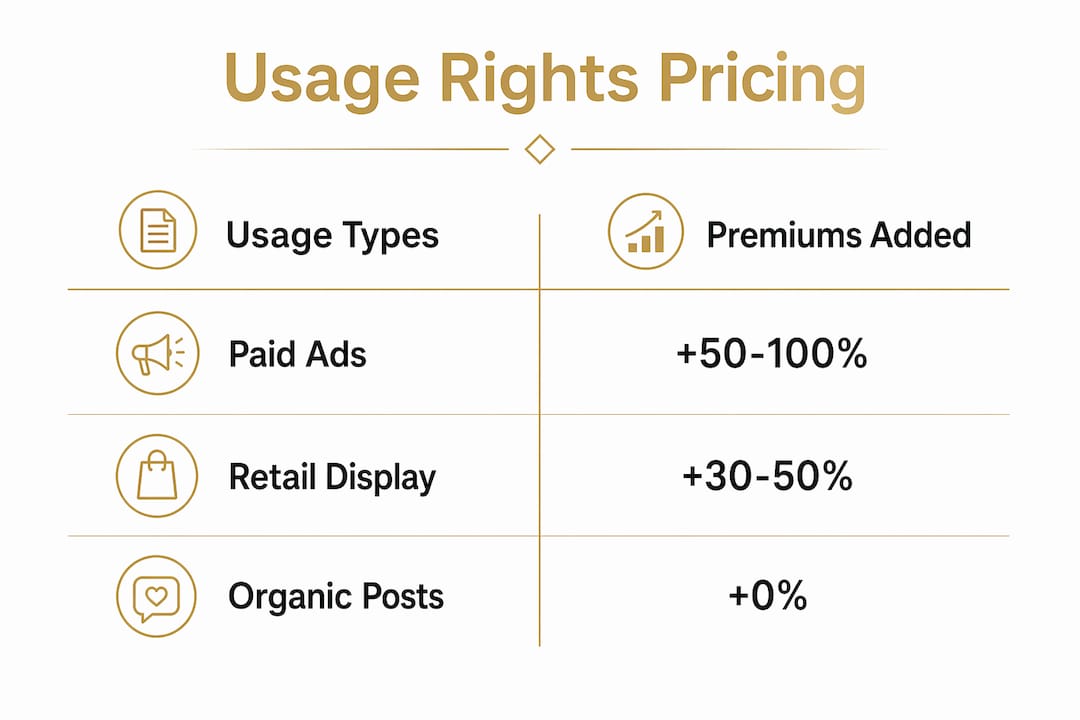
Usage rights are the most underpriced line item in creator deals. They define where and how long a brand can use your content after delivery. Listing usage rights as explicit line items rather than bundling them silently is the single most effective way to protect your income. Brands often assume perpetual rights are included unless you specify otherwise.
Here is what the standard usage fee premiums look like by type and duration:
| Usage Type | Premium Added to Base Rate |
|---|---|
| Paid social ads | +50–100% |
| Retail or in-store display | +100–200% |
| Website use | +20–30% |
| Exclusivity (category) | +20–50% |
| Exclusivity (full) | +50–100% |
A brand running your content as a paid ad on Meta is getting media value far beyond a single organic post. That value should be reflected in your fee. If you charge $1,000 for a post and the brand runs it as a paid ad for six months, you have effectively given away thousands of dollars in media value.
Pro Tip: When a brand asks for usage rights after you have already quoted a base rate, treat it as a separate negotiation. Say: "My base rate covers organic posting. Paid amplification is an add-on, and I can send you those figures." This keeps the conversation professional and protects your original quote.
Exclusivity fees deserve the same treatment. If a brand asks you not to work with competitors for 90 days, that restriction has real cost. Price it accordingly.
What should a rate card actually include?
A well-structured rate card covers six core areas. Each one reduces negotiation friction and protects your time.
- Services offered: List each content type separately. Instagram Reels, TikTok videos, YouTube integrations, blog posts, and email features all carry different production demands and should be priced individually.
- Pricing model: Specify whether you charge per post, per package, or per hour. Most creators use per-post pricing for social content and package pricing for campaigns.
- Add-ons: Rush fees, extra revisions, raw file delivery, and whitelisting permissions are all billable. List them with prices.
- Revision policy: State how many rounds of revisions are included. Including revision and approval policies in your rate card protects your time and prevents scope creep before a project even starts.
- Usage rights: As covered above, list these as separate line items with clear durations.
- Payment terms: Net 15 or Net 30, deposit requirements, and late fees belong here.
One distinction that prevents underpricing is separating sponsored content pricing from user-generated content pricing. Sponsored content charges for audience access. UGC charges for creative production. Mixing the two leads to inconsistent quotes and income loss. A brand paying for a sponsored post is buying reach. A brand paying for UGC is buying creative assets. Those are different products with different price tags.
What mistakes lead to undercharging?
Creators undercharge by 30–50% on average because they fail to separate production costs from media value or ignore usage and exclusivity add-ons entirely. That gap compounds over a full year of brand deals.
The most common mistakes fall into four categories:
- Ignoring production costs: Scripting, filming, editing, and reshooting take real time. If a video takes six hours to produce, your rate needs to reflect that labor, not just your follower count.
- Bundling usage rights silently: Delivering content without specifying usage terms means brands can use it however they want. You lose the ability to charge for paid ads or extended use after the fact.
- Mixing pricing models: Quoting a flat rate for a campaign that includes multiple deliverables, revisions, and usage rights creates confusion. Break it down line by line.
- Skipping revision limits: Unlimited revisions are not a selling point. They are a liability. Brands will use them.
A professional rate card signals seriousness to brands and removes the emotional difficulty of price negotiations. When your rates are written down, you are not defending a number. You are presenting a document.
Pro Tip: Build a 10–20% negotiation buffer into your rates. Quote slightly above your floor so you have room to offer a "discount" without actually losing income. Brands feel like they won. You get paid what you wanted.
Understanding how publishers price ad inventory gives useful context here. Media buyers think in CPMs and placement value, not just follower counts. Knowing that framework helps you speak their language and justify your rates with confidence.
Key takeaways
A creator rate card works because it separates your services, usage rights, and terms into clear line items that protect your income and remove guesswork from every brand negotiation.
| Point | Details |
|---|---|
| Rate card is an offer document | It frames the negotiation; legal protections belong in a signed contract. |
| Base rates use a formula | Multiply follower count by $0.01–$0.05, then apply an engagement multiplier of 0.5–2.0. |
| Usage rights are separate fees | Paid social ads add 50–100% to base rate; retail display adds 100–200%. |
| Separate sponsored content from UGC | Each product type has different value and should carry a distinct price. |
| Undercharging is a structural problem | Creators miss 30–50% of potential income by ignoring production costs and usage add-ons. |
Why most rate cards leave money on the table
I have reviewed hundreds of creator rate cards over the years, and the pattern is almost always the same. The creator lists a price per post, maybe a package option, and that is it. No usage rights. No revision limits. No distinction between a sponsored post and a UGC deliverable. The card looks clean, but it is quietly giving away income on every deal.
The shift that changed things for me was treating usage rights as a product, not a footnote. The moment I started listing paid social amplification as a separate line item with a clear percentage premium, brand managers stopped pushing back on it. It was already on the document. It was already expected. The negotiation moved to scope and timeline instead.
The other thing I stopped doing was apologizing for my rates. A rate card delivered with confidence reads completely differently than one sent with "let me know if this works for your budget." You wrote the document. Stand behind it. Brands respect creators who know their value, and they will test the ones who do not.
Pricing in 2026 rewards specificity. Vague rates invite low offers. Detailed, itemized cards with clear terms signal that you understand the business side of content creation. That alone puts you ahead of most creators in any brand's inbox.
— Brian
How Blackx helps you build a rate card that closes deals
Blackx is the contract intelligence layer for the creator economy, built specifically to help you turn pricing clarity into signed deals. If you have been sending rate cards as static PDFs with no follow-up structure, Blackx gives you the infrastructure to present, negotiate, and finalize deals in one place.

The Blackx creator platform includes deal infrastructure designed around how brand partnerships actually work, from rate card presentation to usage rights documentation and contract finalization. You do not need a lawyer or a manager to run a professional deal process. You need the right system. Explore how Blackx works and see how creators are closing better deals with less back-and-forth.
FAQ
What is a content creator rate card?
A content creator rate card is a pricing document that lists your services, fees, usage rights, and terms for brand collaborations. It acts as an offer document that frames negotiations, not a legally binding contract.
How much should a content creator charge per post?
Rates range from $10–$100 per post for nano influencers to $15,000–$50,000+ for mega influencers, with engagement rate adjusting the final figure by 20–50%.
Should usage rights be included in the base rate?
Usage rights should always be listed as separate line items. Paid social ads add 50–100% to the base rate, and retail display rights add 100–200%. Bundling them silently means leaving significant income unclaimed.
What is the difference between sponsored content and UGC pricing?
Sponsored content charges for audience access and reach. UGC charges for creative production and asset delivery. Mixing the two in a single rate leads to underpricing one or both.
Is a rate card the same as an influencer contract?
A rate card is not a contract. It is an offer document that starts the negotiation. Kill fees, scope protections, and legal terms belong in a separate signed influencer contract finalized after both parties agree on terms.