
Creator legal entity brand contracts are the foundational infrastructure that separates a hobbyist from a protected, revenue-generating business. Without a registered legal entity and properly structured brand partnership agreements, you expose your personal assets to liability, leave intellectual property unprotected, and hand brands the leverage in every negotiation. More than half of full-time creators report earning from multiple income streams, yet most still operate under outdated or informal contracts. That gap between business complexity and legal infrastructure is exactly where creators lose money, rights, and control.
What are the right legal entity options for creators?
Choosing the right legal structure is the first decision that shapes every contract, tax filing, and brand deal you sign. The three most common structures for creators are sole proprietorship, LLC (Limited Liability Company), and S-Corporation. Each carries different implications for liability, taxation, and how brands perceive you as a business partner.
A sole proprietorship requires no formal registration and costs nothing to start, but it offers zero separation between your personal and business finances. If a brand sues you over a contract dispute, your personal bank accounts and assets are fair game. That risk alone disqualifies it as a long-term structure for any creator doing consistent brand work.
An LLC is the structure most legal professionals recommend for content creators. Forming an LLC online costs a couple hundred dollars and immediately creates liability separation between you and your business. Brands also take LLC-registered creators more seriously during contract negotiations, because the entity signals that you operate as a business, not a side hustle.

An S-Corporation makes sense once your net income consistently exceeds roughly $80,000 annually, because it allows you to split income between salary and distributions, reducing self-employment tax. Below that threshold, the administrative overhead typically outweighs the tax savings.
Common setup mistakes that delay contracts and payments:
- Registering your LLC under a name that does not match your brand name or social handles, which creates confusion on invoices and W-9 forms
- Failing to obtain an EIN (Employer Identification Number) from the IRS before signing contracts, which blocks payment processing
- Using a personal bank account for business transactions, which undermines the liability separation the LLC was created to provide
- Signing contracts under your personal name instead of your LLC name, which defeats the legal protection entirely
Pro Tip: Open a dedicated business checking account the same week you form your LLC. Every invoice you send and every brand payment you receive should flow through that account. This single habit protects your liability shield and makes tax preparation significantly faster.
The legal structure for creators also affects how you own intellectual property. When your LLC owns your content and brand assets, licensing agreements become cleaner and more defensible. A brand cannot claim your personal identity is part of the deal when your business entity is the named party.
What contract terms should creators negotiate with brands?
Legal contracts for creators are not standard documents you sign and forget. They are negotiable instruments, and the terms you accept or push back on directly determine your revenue ceiling and creative freedom.
Every brand partnership agreement should contain five non-negotiable components: a clear deliverables list, payment terms with specific due dates, usage rights with defined scope and duration, revision limits, and a termination clause. Missing any one of these creates ambiguity that almost always resolves in the brand's favor.
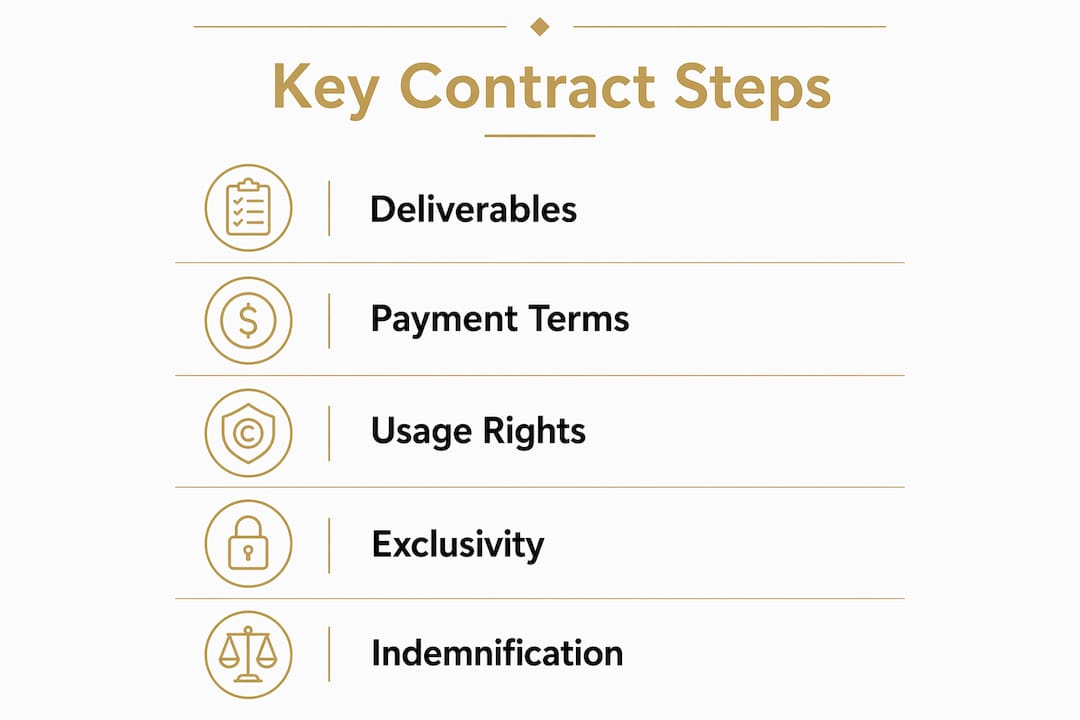
The four highest-risk clauses in any creator contract are perpetuity, broad exclusivity, revenue splits, and indemnification. Perpetuity means the brand can use your content forever without additional compensation. Broad exclusivity can prevent you from working with entire product categories for months. Aggressive indemnification clauses can make you financially responsible for the brand's legal costs in disputes you did not cause. These four terms are where most creators unknowingly surrender long-term value.
How licensing fees change your earning potential
The most financially significant insight in creator contract negotiation is the separation of production fees from commercial usage rights. Separating production fees from commercial usage rights allows creators to license content repeatedly and scale revenue without adding labor hours. A video that costs $850 to produce can generate an additional $1,275 in licensing fees for a six-month ad license. That is a 150% increase in revenue from the same deliverable.
"Professional creators separate their basic production fees from licensing rights to commercial usage, significantly increasing potential earnings." — The Creator Economy Is a Real Business
This structure also protects you when a brand wants to extend usage beyond the original agreement. Without a defined licensing term in your contract, brands often assume they own the content outright. With a defined term, you have a clear trigger for renegotiation or additional fees.
Attorney Frank Poe advocates for mutual termination and force majeure clauses in every creator contract, arguing these provisions balance risk fairly between creators and brands. A mutual termination clause means either party can exit the agreement under defined conditions, not just the brand. Force majeure protects you from penalties when circumstances outside your control, such as platform outages or health emergencies, prevent delivery.
When reviewing influencer contract templates or drafting brand collaboration terms from scratch, always check whether the exclusivity clause is category-specific or blanket. A blanket exclusivity clause that prevents you from working with any competing brand in a broad industry category can cost you tens of thousands in lost deals over a 90-day period.
How to prepare and manage brand contracts efficiently
Contract preparation is where most creators lose time and money through disorganization. The process becomes predictable and fast when you treat it as a system rather than a one-off task.
| Step | What to prepare | Common mistake |
|---|---|---|
| Entity documentation | LLC formation certificate, EIN letter from IRS | Using personal SSN instead of EIN on W-9 |
| Contract review | Check deliverables, payment terms, usage rights, exclusivity | Signing without defining revision limits |
| Invoice setup | Business name matching LLC, payment terms, late fee clause | Mismatched names between contract and invoice |
| Payment processing | Business bank account, ACH or wire details | Providing personal account details |
| Filing | Signed contract, invoice copy, correspondence | No paper trail for verbal amendments |
Inconsistencies in your documentation packet cause contract delays and payment issues more often than any other factor. If your LLC is registered as "Smith Creative LLC" but your W-9 lists "John Smith," a brand's accounts payable team will flag the discrepancy and hold payment until it is resolved. That delay can stretch from days to weeks.
When reviewing a contract, work through it in three passes. The first pass identifies what you are being asked to deliver and when. The second pass isolates every clause that restricts your future work or assigns you financial liability. The third pass checks that payment terms, including the amount, currency, due date, and late payment penalties, are explicit and enforceable.
Pro Tip: Build a one-page "creator contract packet" that includes your LLC formation certificate, EIN confirmation letter, a completed W-9, and your standard invoice template. Send this proactively when a brand initiates a deal. It signals professionalism and eliminates the back-and-forth that delays payment.
Multi-stream revenue contracts, which combine a flat production fee, a usage license, and an affiliate commission, require separate line items for each revenue type. Bundling them into a single number makes it nearly impossible to renegotiate individual components later. Platforms like Blackx provide structured contract frameworks that keep these components distinct and trackable from the start.
How do you protect your brand IP beyond contracts?
Contracts protect specific deals. Trademarks protect your brand identity across every deal, platform, and market. Creators who build recognizable brands without registering trademarks are one copycat away from losing the name, handle, or slogan they spent years building.
Creators should trademark brand names, handles, and slogans to protect IP and avoid disputes as their business scales. The U.S. Patent and Trademark Office (USPTO) registration process takes six to twelve months and costs between $250 and $350 per class of goods or services. That investment becomes critical the moment a brand or competitor attempts to use your identity without permission.
Key IP assets creators should register:
- Your primary brand name as used in commerce
- Your main social media handle if it functions as a brand identifier
- Any recurring slogan or tagline tied to your content
- Your logo or distinctive visual mark
- Domain names for your primary web presence
The interaction between your LLC and your trademarks matters more than most creators realize. When your LLC owns the trademark, licensing that mark to brands becomes a formal, revenue-generating transaction. You can charge a brand for the right to use your name or likeness in their advertising, separate from the content creation fee. This is how top-tier creators structure six-figure deals that go far beyond a single sponsored post.
Understanding media IP fundamentals is the foundation for knowing what you own, what you can license, and what you should never sign away. Copyright protects your content automatically upon creation, but it does not protect your brand name or identity. That is what trademark registration covers. Together, copyright and trademark form the IP backbone of a creator business.
Key takeaways
Establishing a legal entity and negotiating well-structured brand contracts are the two decisions that determine whether your creator business scales or stagnates.
| Point | Details |
|---|---|
| Form an LLC first | An LLC separates personal and business liability and costs a couple hundred dollars to set up online. |
| Separate production from licensing | Charging distinct fees for content creation and usage rights can increase revenue by 150% or more per deal. |
| Avoid four high-risk clauses | Perpetuity, broad exclusivity, revenue splits, and indemnification require negotiation before signing. |
| Align all documentation | Mismatched LLC names, EINs, and bank details are the leading cause of payment delays in brand deals. |
| Register your trademarks | Trademarking your brand name, handle, and slogan protects your identity and creates licensable IP assets. |
Why most creators get the legal foundation backwards
Here is what I have observed working at the intersection of creator businesses and contract infrastructure: most creators treat legal setup as a milestone they will reach once they are "big enough." That logic is exactly backwards. The legal entity and contract framework you establish early determines the ceiling of what you can negotiate later.
I have seen creators with hundreds of thousands of followers still signing contracts under their personal names, with no EIN, no LLC, and no defined usage rights. When a brand offers them a six-figure licensing deal, they cannot accept it cleanly because the paperwork infrastructure does not exist. The deal either falls through or gets restructured in the brand's favor.
The other pattern I see constantly is creators treating contracts as formalities rather than financial instruments. A contract that grants a brand perpetual, royalty-free usage of your content is not a standard agreement. It is a transfer of long-term asset value in exchange for a one-time fee. Contract updates reflect real-world challenges discovered only after repeated use, which is why treating your contracts as living documents matters. Review and revise them after every deal cycle.
The creators who build durable businesses are not necessarily the ones with the largest audiences. They are the ones who understood early that their content, brand identity, and licensing rights are assets. They structured their businesses to own and monetize those assets rather than give them away in poorly negotiated deals.
— Brian
How Blackx helps creators manage contracts and brand deals
Blackx is the contract intelligence layer built specifically for the creator economy, and it removes the friction between a creator's legal setup and their brand partnership workflow.

With Blackx, creators get structured deal infrastructure tools that keep production fees, licensing terms, and payment schedules in separate, trackable components. The platform supports contract review, usage rights clarity, and payment processing in one place, so you stop losing time to disorganized paperwork and mismatched documentation. Whether you are closing your first brand deal or managing a portfolio of partnerships, Blackx gives you the infrastructure to operate like the business you actually are. Explore Blackx for creators and see how the platform supports your legal and brand partnership operations from day one.
FAQ
What legal entity is best for content creators?
An LLC is the most recommended legal structure for content creators because it separates personal and business liability and costs only a couple hundred dollars to form online. It also signals professionalism to brands during contract negotiations.
What should every brand partnership agreement include?
Every brand partnership agreement should define deliverables, payment terms with due dates, usage rights with a specific duration, revision limits, and a termination clause. Missing any of these creates ambiguity that typically favors the brand.
How do licensing fees work in creator contracts?
Licensing fees are charged separately from production fees and compensate you for the brand's right to use your content commercially. A six-month ad license can add over $1,000 to a base production fee, significantly increasing total deal value.
Why do creators need to trademark their brand?
Trademark registration protects your brand name, social handle, and slogan from being used by competitors or brands without your permission. It also creates a licensable asset your LLC can monetize independently of content creation work.
What are the riskiest clauses in influencer contract templates?
The four highest-risk clauses are perpetuity, broad exclusivity, revenue splits, and indemnification. Each can limit your future earning potential or expose you to financial liability, so negotiate or remove them before signing.