
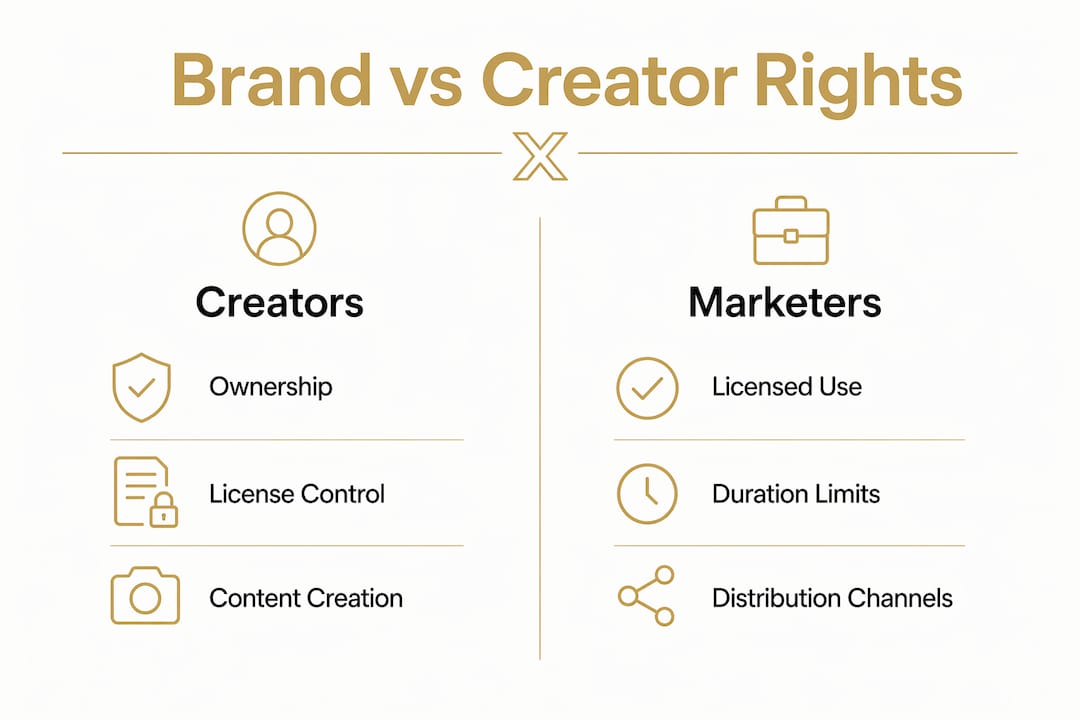
Brand usage rights define the specific permissions a brand holds to use creator content, and those permissions vary widely depending on contract terms, content type, and distribution channel. Paying for content does not transfer ownership. It grants a license. That distinction separates a clean deal from a costly legal dispute. Platforms like Billo, Insense, and JoinBrands each structure these licenses differently, which means a creator signing with one platform faces entirely different terms than one signing with another. For content creators, marketers, and legal professionals working with user-generated content, understanding brand usage rights is not optional. It is the foundation of every fair deal.
How brand usage rights differ: the core parameters
Brand usage rights, known formally as content licensing terms, are defined by four contract parameters: where content can be used, how it can be used, how long it can be used, and who can use it. Get any one of these wrong and you have either an underpaid creator or an overexposed brand.
The "where" covers distribution channels. A brand might license content for Instagram organic posts but not for paid Facebook ads. Those are legally distinct uses, and paid usage rights for ads and whitelisting are priced higher than organic repost rights because the exposure and commercial risk are greater. A creator who agrees to organic reposting at one rate and later discovers the brand ran paid ads with their content has a legitimate legal claim.
The "how" covers usage method. Organic reposting, paid advertising, whitelisting (running ads from the creator's account), and embedding in third-party websites are all distinct methods. Each carries different reach, different commercial value, and different risk profiles for both parties.

The "how long" is duration. Common usage terms range from 30 days to 12 months, with perpetual rights sitting at the expensive and risky end of the spectrum. Perpetual rights are costly for brands to manage and damaging for creators who may want to renegotiate or retire content.
The "who" covers exclusivity and sublicensing. An exclusive license prevents the creator from licensing the same content to a competitor. A sublicensing clause lets the brand pass rights to a third-party agency or media buyer. Both terms shift significant value away from the creator and must be priced accordingly.
Comparing usage rights types at a glance
| Rights Type | Scope | Duration | Price Tier |
|---|---|---|---|
| Organic repost | Brand's own social channels | 30 to 90 days | Low |
| Paid advertising | Paid media placements | 3 to 6 months | Medium to high |
| Whitelisting | Ads run from creator's account | 30 to 90 days | High |
| Perpetual buyout | All channels, unlimited time | Indefinite | Premium |
| Exclusive license | One brand only, all channels | Negotiated | Premium |
How do usage rights differ across UGC platforms?
The platform a creator or brand chooses determines the default licensing structure before any negotiation begins. UGC platforms like Billo, Insense, and JoinBrands each use a different economic model, and those models carry real consequences for both sides of the deal.
Billo includes perpetual usage rights in its base pricing. That sounds generous for brands, but it means creators are granting unlimited, time-unrestricted licenses at a flat rate. For a creator producing one or two pieces, this may feel acceptable. For a creator building a catalog of content, it quietly erodes long-term leverage.
Insense operates on a monthly subscription model with tiered rights extensions. Brands pay a recurring fee for access to creators, and additional rights cost more. For brands producing more than 20 pieces of content monthly, the per-unit economics of a subscription model like Insense can outperform one-off licensing deals. That math matters when you are scaling a UGC program.
JoinBrands gives creators more control by allowing them to set their own rates and negotiate terms directly. This model respects creator agency but requires creators to understand their own value and the legal weight of what they are signing.
- Billo: Perpetual rights included in base price. Simple for brands, limiting for creators.
- Insense: Subscription access with tiered paid extensions. Better economics at volume.
- JoinBrands: Creator-set rates with negotiable terms. Most flexible, most responsibility on the creator.
Pro Tip: Split your content creation fee from your licensing fee in every contract. This makes the value of each component visible and gives you a clear basis for renewal pricing when the license term expires.
One critical nuance: platforms like Meta and TikTok grant broad rights to themselves through their Terms of Service, but platform ToS rights do not substitute for explicit written brand permissions. A brand cannot point to a platform's terms to justify running paid ads with a creator's content. Written agreements are required, separately and explicitly.
What is the difference between copyright and usage rights?
Copyright is ownership. Usage rights are a license to use what someone else owns. These two concepts are frequently confused, and that confusion costs creators money and brands legal exposure.
When a creator produces a video or photo, copyright attaches automatically at the moment of creation. Creators retain copyright while granting brands licenses that vary in exclusivity and term. The brand never owns the content unless the contract explicitly transfers copyright through a "work made for hire" clause or a full IP assignment.
"Work made for hire" is the most dangerous phrase in a creator contract. Under U.S. copyright law, content created under this designation belongs to the commissioning party from the moment it is made. Creators who sign work-made-for-hire agreements without understanding the implications lose all future rights to that content, including the right to display it in their own portfolio.
Broad buyout clauses carry similar risks. Perpetual or overly broad rights transfer significant control and value from creators to brands, affecting career options and future negotiations in ways that compound over time. A creator who signs a perpetual exclusive buyout at age 25 may find that same content used in campaigns a decade later without any additional compensation.
Watch for these contract traps:
- "Work made for hire" clauses that transfer copyright entirely
- Perpetual license language without a defined end date
- Sublicensing rights that let brands pass content to third parties
- Broad IP assignment clauses that cover derivative works
- No edit controls that allow brands to alter content without creator approval
Pro Tip: Before signing any contract, identify whether the agreement transfers copyright or grants a license. If the word "assign" appears next to "intellectual property," you are likely giving up ownership, not just usage rights. Consult a contract template like the one at Blackx's influencer contract guide to understand what standard clauses should look like.
Strategic licensing is not just a financial transaction. It is central to how a creator builds their brand identity and how a company manages its market positioning. Treating it as a formality is the fastest way to regret a deal.
How can brands and creators manage rights and reduce risk?
Managing brand usage rights well requires governance, not just good intentions. The most common failure mode is "permission drift," where a brand uses content beyond the scope of the original contract, often not through bad faith but through poor internal tracking. Failing to govern usage systematically leads to unauthorized use beyond contract scope, risking legal disputes and revenue loss. Successful brands use asset management tools to align contractual permissions with actual content use.
Here is a practical framework for both sides:
- Define the start date explicitly. Usage rights start date ambiguity causes chronic friction. Creators typically expect rights to begin on the posting date. Brands often assume rights begin at contract signing. Aligning both parties to the posting date is best practice and prevents unintentional infringement from the first day of the campaign.
- Set renewal terms upfront. A license that expires without a renewal clause either lapses or defaults to perpetual in some interpretations. Build in a defined renewal fee so both parties know what continued use costs.
- Use tiered pricing for different channels. Organic social, paid media, and out-of-home advertising each carry different commercial value. Price them separately rather than bundling everything into one flat fee.
- Retain edit controls. Creators should specify whether brands can modify, crop, or add overlays to content. Unrestricted editing can result in content being used in contexts the creator never intended.
- Audit usage regularly. Brand asset governance enables audit readiness and prevents unauthorized uses, saving money and protecting brand reputation. Set a calendar reminder to review active licenses quarterly.
Clear usage rights empower creators to monetize fairly and give brands the confidence to leverage content fully with less conflict. The goal is not to make contracts adversarial. It is to make them precise. Precision protects everyone.
Key takeaways
Brand usage rights are licenses, not ownership transfers, and the specific terms of scope, duration, exclusivity, and channel define their value and legal weight.
| Point | Details |
|---|---|
| Rights are licenses, not ownership | Paying for content grants a license; copyright stays with the creator unless explicitly assigned. |
| Four parameters define every deal | Scope, duration, exclusivity, and channel determine the value and risk of any usage rights agreement. |
| Platform models vary significantly | Billo, Insense, and JoinBrands each use different licensing structures with different economic tradeoffs. |
| Permission drift is a real risk | Without systematic governance and asset tracking, brands routinely exceed contract scope. |
| Start dates must be explicit | Aligning usage rights to the posting date, not the signing date, prevents unintentional infringement. |
Why most brand-creator contracts fail before they start
I have reviewed hundreds of creator contracts over the years, and the same problem appears in nearly every dispute: neither party read the rights clause carefully before signing. Not because they were careless. Because the clause was buried in paragraph nine of a twelve-paragraph agreement, written in language that assumed both parties had a law degree.
The creator economy has matured faster than its legal infrastructure. Platforms have made it easy to connect brands with creators, but the contracts governing those connections still lag behind. Most creators I speak with cannot tell you whether their last deal included sublicensing rights. Most brand managers cannot tell you when their current licenses expire.
What I find most concerning is the normalization of perpetual rights in base-tier platform pricing. When a platform bundles perpetual usage into a flat fee, it trains both brands and creators to treat unlimited access as the default. That is not a neutral default. It is a transfer of long-term value from creators to brands, dressed up as convenience.
The fix is not complicated. It requires treating the rights clause as the most important part of the contract, not an afterthought. Separate creation fees from licensing fees. Define every channel, every duration, every edit right. Use technology to track what you have agreed to. The brands and creators who do this consistently build partnerships that last. The ones who skip it end up in disputes that cost more than the original deal was worth.
— Brian
How Blackx helps you manage usage rights with confidence
Blackx is built specifically for the creator economy as a contract intelligence layer that makes usage rights visible, trackable, and enforceable. If you are a creator tired of signing contracts you do not fully understand, or a brand struggling to track which licenses are active and which have expired, Blackx gives you the infrastructure to manage both sides of the deal clearly.

The platform covers contract clarity, verified partnerships, and licensing management so that every deal you sign reflects what you actually agreed to. For creators, that means knowing exactly what rights you are granting and for how long. For brands, it means never accidentally running an expired license in a paid campaign. Explore creator deal infrastructure on Blackx and see how structured contracts protect your content and your revenue from day one.
FAQ
What are brand usage rights?
Brand usage rights are licenses that define how, where, and for how long a brand can use creator-produced content. They are distinct from copyright ownership, which remains with the creator unless explicitly transferred.
How do organic and paid usage rights differ?
Organic usage rights cover a brand reposting content on its own social channels, while paid usage rights cover running that content as a paid advertisement. Paid rights carry higher commercial exposure and are priced higher as a result.
Does paying a creator mean you own the content?
No. Payment does not transfer copyright. It grants a license with the specific terms outlined in the contract. Ownership only transfers if the agreement includes a "work made for hire" clause or an explicit IP assignment.
When do usage rights begin?
Usage rights start dates are a common source of disputes. Creators typically expect rights to begin on the posting date, while brands often assume they begin at contract signing. The contract must specify the start date explicitly to avoid unintentional infringement.
What is whitelisting and how does it affect usage rights?
Whitelisting allows a brand to run paid ads directly from the creator's social media account, using the creator's handle and audience. It requires a separate, explicit license and is typically priced higher than standard paid advertising rights because it uses the creator's personal brand equity.