
Invoicing brands as a UGC creator is the process of formally requesting payment by submitting a detailed document that links your deliverables, usage rights, and agreed commercial terms to a specific campaign. Without a professional invoice, even a completed and approved content deal can stall at the finance department for weeks. Creators who treat invoicing as part of their content workflow, not an afterthought, get paid faster and build stronger brand relationships. Tools like Useme, QuickBooks, and Canva invoice templates have made this process accessible to creators at every level.
What does invoicing brands as a UGC creator actually require?
A complete UGC creator invoice must include a unique invoice number, your legal name or business name, the brand's legal entity details, invoice date, supply date, campaign description, itemized deliverables, amounts due, applicable VAT, payment terms, due date, and your bank or payment details. That list is longer than most creators expect, and each field exists for a reason. Finance teams at brands use invoice numbers to track payments in their systems. Missing a campaign description means the accounts payable team cannot match your invoice to a purchase order, which triggers a rejection.
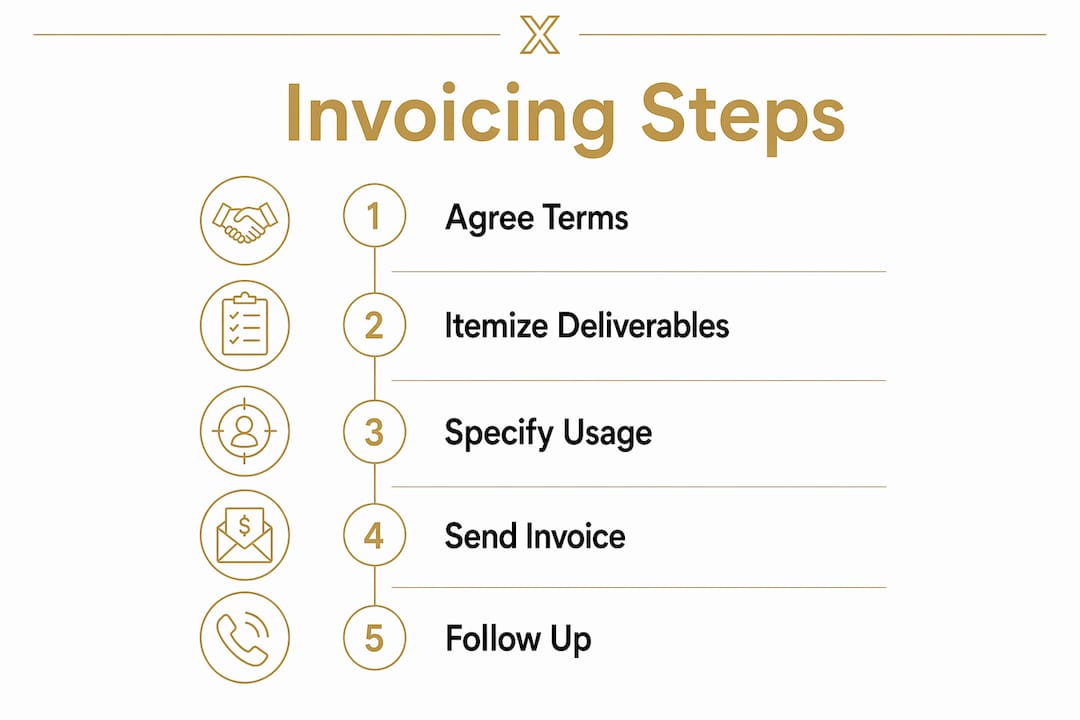
The deliverables section deserves particular attention. Instead of writing "content creation," write "3 x 30-second UGC videos for the Spring 2026 campaign per agreement dated March 1, 2026." Specificity protects you if a dispute arises and speeds up internal approval. Standardized invoice formats help finance and marketing teams approve payments faster because they recognize the structure immediately.

Pro Tip: Number your invoices sequentially from day one. INV-001, INV-002, and so on. This makes tracking overdue payments trivial and signals to brands that you run a professional operation.
| Invoice field | Why it matters |
|---|---|
| Unique invoice number | Allows brands to track and match payments in their accounting systems |
| Campaign description | Links the invoice to a specific brief and prevents AP rejection |
| Itemized deliverables | Confirms scope and protects against scope creep disputes |
| Usage rights summary | Triggers correct payment tier and avoids licensing confusion |
| Payment terms and due date | Sets clear expectations and gives you grounds to chase overdue amounts |
How to agree contract terms before you send the first invoice
The invoice is the final step in a conversation that should start before you create a single frame of content. Before invoicing, you and the brand need to agree on fee, deliverables, invoice recipient, purchase order requirements, payment method, currency, VAT treatment, usage rights, exclusivity terms, and the specific trigger that releases payment.
Payment triggers are where most creators get caught out. "Payment on delivery" sounds simple, but delivery of what, exactly? Delivery of the raw file, delivery of the approved edit, or the content going live? Nail this down in writing before you start work. Typical structures include an upfront deposit with the balance on approval, or a 50/50 payment split where half is paid upfront and half on the live date. Monthly retainers are invoiced at the start of each month to secure payment before work begins.
For international deals, currency and transfer fees add another layer of complexity. If a U.S. brand is paying a creator in the UK, agree upfront whether the invoice amount is in USD or GBP, who absorbs the Wise or PayPal conversion fee, and whether the timeline extends to account for international transfer delays. These details belong in the contract, not in a follow-up email after the invoice bounces.
Pro Tip: Always ask for a purchase order number before submitting your invoice. Many large brands will not process payment without one, and chasing a PO after the fact can add two to four weeks to your payment timeline.
For larger campaigns and retainers, request a formal brief document that you can reference directly on each invoice. This creates an audit trail that protects both parties and makes the creator economy partnership feel like a real business relationship rather than a handshake deal.
What tools and templates work best for UGC creator invoicing?
The right invoicing tool depends on your volume and complexity. Creators can choose from QuickBooks, FreeAgent, Xero, Canva invoice templates, the Useme platform, and payment processors with built-in invoicing like Stripe and PayPal. Each serves a different need.
| Tool | Best for | Key limitation |
|---|---|---|
| Canva templates | Beginners, one-off deals | No payment tracking or automation |
| QuickBooks | Creators with multiple income streams | Monthly cost, accounting-focused |
| FreeAgent | UK-based creators with VAT obligations | Less suited for U.S. creators |
| Useme | Agencies and creators scaling UGC deals | Platform-dependent workflow |
| Stripe Invoicing | Creators who want integrated payment links | Requires setup and verification |
Useme stands out for creators working with agencies at scale. Tears of Joy agency processes over 1,200 UGC creator deals through Useme, where creators complete a simple form post-approval and receive payment typically within 48 hours. The agency consolidates all creator payments into one invoice on its end, which eliminates the back-and-forth that normally slows down multi-creator campaigns. That 48-hour payment cycle is a meaningful benchmark. Most creators on standard net-30 terms wait four to six times longer.
Whatever tool you choose, prioritize these features: custom fields for campaign names and rights details, VAT handling, multi-currency support, and invoice status tracking. A tool that cannot tell you whether an invoice has been viewed is not a tool. It is a document sender.
How to structure invoices to reflect usage rights and licensing
Usage rights licenses typically specify platforms, duration, ad spend caps, content approval rights, targeting restrictions, and revocation terms. Whitelisting, which allows a brand to run paid ads directly from your creator account, commands a premium because it uses your identity and audience trust. Your invoice must reflect these distinctions explicitly.
Here is how to structure usage rights on an invoice:
- Content creation fee: The base rate for producing the deliverables, regardless of how the brand uses them.
- Organic usage rights (6 months): A separate line item for the right to repost your content on the brand's owned channels.
- Paid media rights (3 months): An additional fee for the brand to run your content as a paid ad on Meta or TikTok.
- Whitelisting fee: A premium line item for the brand to run ads directly from your creator account, typically the highest-value rights tier.
- Exclusivity fee (if applicable): Compensation for agreeing not to work with competing brands during a defined period.
Payment approval depends heavily on invoice fields reflecting usage rights, territory, duration, and exclusivity, not just total amounts. Finance teams and marketing teams often have separate approval workflows. Marketing approves the creative. Finance approves the payment. When your invoice clearly separates rights tiers, both teams can sign off without needing to go back to the contract.
Pro Tip: When a brand wants to extend usage rights beyond the original term, treat it as a new invoice line item, not a verbal agreement. Reference the original invoice number and agreement date so the extension is traceable.
Common invoicing mistakes that delay UGC creator payments
Most payment delays trace back to avoidable errors made before the invoice is even sent. Missing campaign linkage, unclear payment terms, delayed submission, and poor follow-up are the four most common causes of late or missed payments for UGC creators.
The specific mistakes to watch for include:
- Generic campaign descriptions: Writing "social media content" instead of referencing the specific campaign, brief date, and deliverable count gives accounts payable no way to match your invoice to an approved purchase order.
- No payment terms stated: An invoice without a due date is a request, not a demand. Always state net 14 or net 30 clearly.
- Late invoice submission: Submitting an invoice weeks after content goes live, without prior agreement, can push your payment into the next billing cycle. Some brands only process invoices on specific dates.
- No follow-up system: Tracking invoice status and sending polite, prompt payment chase emails significantly reduces nonpayment risk. A single follow-up email sent one day after the due date recovers most overdue amounts.
- Ignoring VAT and currency fees: If you are VAT-registered, failing to include VAT on an invoice can create legal and tax complications. If you are invoicing internationally, ignoring conversion fees means you receive less than agreed.
- Informal formats: A PDF created in Google Docs with no invoice number, no legal entity name, and no payment details will be rejected by most brand finance teams regardless of the content quality.
A repeatable invoicing system that includes rights workflow, moderation, distribution, and measurement is what separates creators who scale from those who stay stuck in admin chaos. The invoice is not the end of the deal. It is the mechanism that closes it cleanly.
Key takeaways
Invoicing brands as a UGC creator requires itemized deliverables, explicit usage rights tiers, agreed payment triggers, and a professional format that finance teams can process without follow-up questions.
| Point | Details |
|---|---|
| Agree terms before invoicing | Confirm fee, deliverables, PO number, payment trigger, and currency before creating content. |
| Itemize usage rights separately | List organic, paid media, and whitelisting fees as distinct line items on every invoice. |
| Use the right tool for your volume | Canva templates work for beginners; Useme or QuickBooks suit creators managing multiple brand deals. |
| Submit invoices promptly | Send your invoice on the agreed trigger date, not weeks later, to avoid missing payment cycles. |
| Follow up on overdue invoices | Track invoice status and send a polite chase email the day after the due date passes. |
Why invoicing is actually your most underrated brand asset
Most creators treat invoicing as the boring part of the job. I think that framing is exactly backwards. After years of watching creators build and lose brand relationships, the ones who stay booked are almost always the ones whose back-end process is as clean as their content.
A well-structured invoice tells a brand three things simultaneously: you understand the commercial terms, you have a professional operation, and you are easy to work with. That last point matters more than most creators realize. Brand managers and marketing coordinators work with dozens of creators. The ones who submit clean invoices on time, reference the correct campaign, and follow up professionally get re-booked. The ones who send a PayPal request with a note that says "for the videos" do not.
I also think creators underestimate how much invoices function as a record of their own growth. When you can look back at INV-047 and see that a brand paid a whitelisting premium on top of your base rate, you have concrete evidence of your market value. That evidence is what you use to negotiate your next deal at a higher rate.
The influencer contract and the invoice are two sides of the same document. One sets the terms. The other enforces them. Creators who treat both seriously build the kind of brand trust that turns one-off campaigns into long-term partnerships. That is not an administrative outcome. It is a business development outcome.
— Brian
How Blackx makes invoicing and deal management simpler for creators
Blackx is built specifically as the contract intelligence layer for the creator economy, which means it handles the infrastructure that sits between a brand brief and a paid invoice.

With Blackx, creators can link deliverables, usage rights, and payment terms directly to their deal records so every invoice reflects exactly what was agreed. The platform removes the gap between contract and invoice that causes most payment delays. For brands, it means faster approvals. For creators, it means fewer follow-up emails and a clear paper trail for every campaign. If you are ready to treat your creator business like a business, Blackx for creators gives you the deal infrastructure to do it.
FAQ
What should a UGC creator invoice include?
A UGC creator invoice must include a unique invoice number, creator and brand legal details, invoice and supply dates, campaign description, itemized deliverables, amounts due, VAT if applicable, payment terms, due date, and payment details. Missing any of these fields can trigger a rejection from the brand's accounts payable team.
How do I handle usage rights on a UGC invoice?
List usage rights as separate line items covering organic use, paid media, whitelisting, and exclusivity with defined durations and platforms. Finance teams approve payments faster when rights tiers are explicit rather than bundled into a single content fee.
What payment terms should UGC creators use?
Net 14 or net 30 are standard for UGC deals, with larger campaigns often using a 50% upfront deposit and 50% on approval or live date. Monthly retainers are invoiced at the start of each month to secure payment before work begins.
Which invoicing tools work best for UGC creators?
QuickBooks, FreeAgent, Useme, Canva invoice templates, and Stripe Invoicing are all viable options depending on your volume and location. Useme is particularly effective for creators working with agencies, with payment cycles as fast as 48 hours after approval.
How do I follow up on an overdue UGC invoice?
Send a polite, professional email the day after the due date passes, referencing the invoice number, amount, and original due date. Tracking invoice status through your invoicing tool tells you whether the invoice has been viewed, which informs how urgently you need to escalate.