
You're juggling five brand deals, three deadlines this week, and a payment that's already two weeks late. Sound familiar? Managing multiple brand contracts is one of the biggest operational challenges for UGC creators today, and most people handle it with a messy mix of email threads, sticky notes, and half-filled spreadsheets. The result is missed payments, compliance slip-ups, and creative burnout. This guide walks you through exactly how to organize, execute, and stay compliant across every deal you sign, so you can focus on creating instead of chasing paperwork.
Table of Contents
- What you need before managing contracts
- Step-by-step: Organizing and tracking brand contracts
- Compliance and key contract clauses to watch
- Troubleshooting, negotiation, and edge cases
- Why contract chaos hurts creators and what really works
- Streamline your brand contracts with BlackX
- Frequently asked questions
Key Takeaways
| Point | Details |
|---|---|
| Centralize contract management | Dedicated platforms save time and prevent errors in tracking multiple brand deals. |
| Know critical contract clauses | Terms like exclusivity, usage rights, and payment deadlines affect your income and legal standing. |
| Automate for scale | Automation and reminders help creators handle more contracts without burning out. |
| Standardize for reliability | Consistent processes and templates reduce risk and missed opportunities. |
| Negotiate edge cases | Securing higher rates for special clauses and international deals boosts your bottom line. |
What you need before managing contracts
With the problem defined, let's figure out exactly what you need to set yourself up for success.
Before you build any system, you need to understand where you are right now. How many active deals do you have? How many are you expecting in the next 90 days? Your answer determines which tools and processes actually make sense for your situation. Throwing a complex platform at a two-deal workload wastes time. Relying on a spreadsheet when you're managing 15 active brands is a recipe for disaster.
The right approach scales with your volume. Methodologies scale with volume: creators handling 1 to 3 deals can manage with email and spreadsheets, those working with 4 to 10 brands need standardized contracts and monthly check-ins, and anyone managing 10 or more partnerships requires dedicated platforms for brand deals with automated workflows, tiered segmentation, and centralized performance metrics.
| Deal volume | Recommended approach | Key tools |
|---|---|---|
| 1 to 3 brands | Email plus basic spreadsheet | Gmail, Google Sheets |
| 4 to 10 brands | Standardized templates plus check-ins | Notion, Airtable |
| 10+ brands | Dedicated platform | Creator deal platforms |
Beyond tools, you need a baseline of legal awareness. You don't need a law degree, but you do need to understand the fundamentals before you sign anything. Here's what every creator must know:
- Exclusivity clauses restrict which competitors you can work with and for how long
- Usage rights determine whether a brand can repurpose your content for paid ads
- Payment terms define when you get paid and what happens if a brand pays late
- Deliverables and timelines spell out exactly what you owe and by when
- Termination provisions explain how either party can exit the deal and what penalties apply
- Content ownership clarifies whether you retain rights or sign them over entirely
Pro Tip: Start organized from day one, even when you only have one or two deals. Creators who build clean systems early never have to untangle a mess of contracts later. Retroactively organizing three years of deals is far more painful than setting up a simple intake process on your first brand partnership.
Step-by-step: Organizing and tracking brand contracts
Once you've gathered the right tools and background, it's time to set up your contract tracking system.
The single biggest mistake creators make is treating each brand deal as a one-off event. Every deal needs to flow through the same process, from the first email to the final payment confirmation. That consistency is what prevents things from falling through the cracks.
Specialized creator tools like Manage Deals, Rella, Collabed, and Alfie are built for this workflow, centralizing inbound emails, tracking deal pipelines from negotiation to payment, flagging key clauses like exclusivity and usage rights, and automating organization without requiring a single spreadsheet.
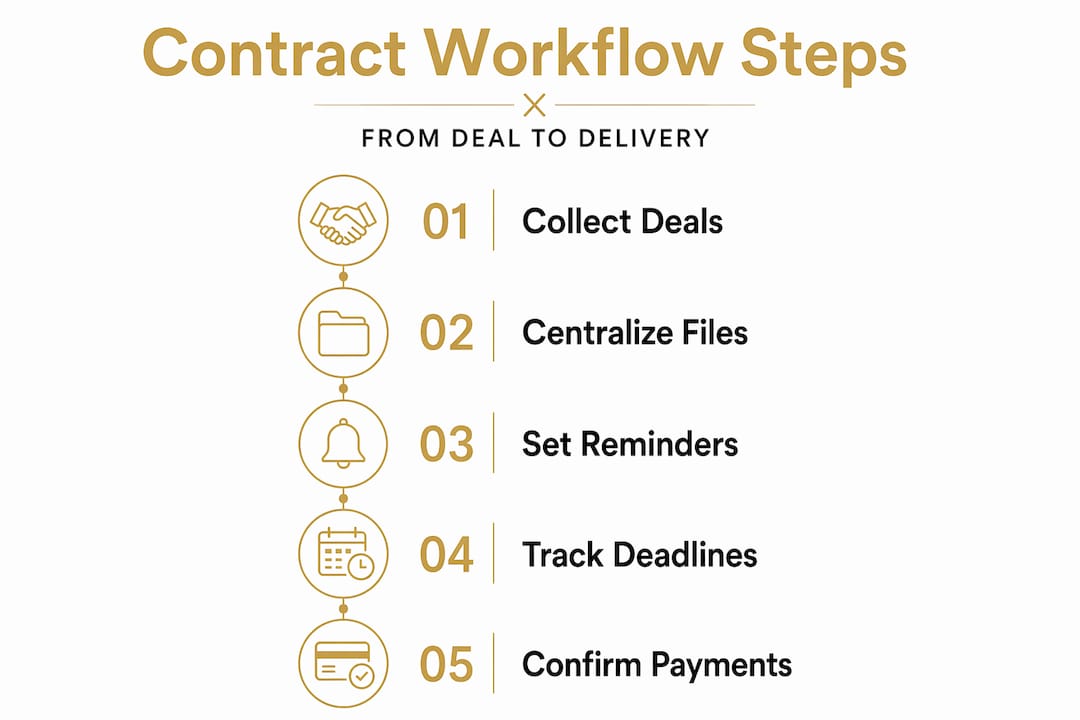
Here's how to structure your end-to-end contract workflow:
- Intake: When a brand reaches out, log the deal immediately. Record the brand name, contact person, proposed rate, deliverables, and proposed timeline in your tracking system before you reply.
- Negotiation: Review the offer against your rate card. Flag exclusivity, usage rights, and payment terms before agreeing to anything. Counter in writing, always.
- Clause review: Before signing, highlight every clause that affects your pay or creative freedom. Use a checklist so nothing gets skipped.
- Deadline mapping: Once signed, add every deliverable deadline and payment due date to your calendar with reminders set 72 hours in advance.
- Content delivery: Submit deliverables on time and confirm receipt in writing. This creates a paper trail if payment disputes arise later.
- Payment tracking: Log the expected payment date. If payment doesn't arrive within the agreed window, follow up immediately with a documented message.
- Closeout: Once payment clears, archive the contract with notes on performance, relationship quality, and whether you'd work with the brand again.
| Approach | Best for | Pros | Cons |
|---|---|---|---|
| Spreadsheet | 1 to 5 deals | Free, flexible | Manual, error-prone |
| Project management tool | 5 to 10 deals | Visual, shareable | Not contract-specific |
| Creator deal platform | 10+ deals | Automated, clause-aware | Monthly cost |
For segmenting creator deals by priority, group your active contracts into tiers: high-value retainers, one-off campaigns, and exploratory deals. This helps you allocate your time and energy where it matters most, rather than treating a $200 single-post deal with the same urgency as a $5,000 three-month retainer.
Pro Tip: Set automated reminders for every payment due date and every deliverable deadline. Most creator platforms let you build these in. If yours doesn't, use a calendar tool with email alerts. Chasing payments manually is exhausting and often too late.

Compliance and key contract clauses to watch
With tracking in place, staying compliant and protecting your interests is the next critical step.
Compliance is not optional. The FTC requires that any material connection between a creator and a brand be clearly disclosed, and "material connection" includes free products, discounts, and affiliate commissions, not just direct payment. The rule is simple: if a brand gave you something of value, your audience needs to know.
Key compliance requirements include FTC-required disclosures such as placing #ad in the first line of a caption or within the first three seconds of a video, specific deliverables with clear timelines, payment terms like net 30 with late fees, exclusivity clauses, content ownership terms, usage rights, and termination provisions. Creators should always push to retain portfolio rights after a campaign ends.
Beyond FTC compliance, these are the clauses that most directly affect your income and creative control:
- Exclusivity: A brand asking for 90-day exclusivity across an entire product category is very different from 30-day exclusivity for a single competitor. Read this carefully and price accordingly.
- Content ownership vs. licensing: Work-for-hire language means the brand owns your content outright. Licensing language means you retain ownership and grant them specific usage rights. Licensing is almost always better for creators.
- Usage rights: Organic posting rights, paid amplification rights, and third-party licensing rights are three different things. Each should be priced separately.
- Kill fees: If a brand cancels a project after you've started work, a kill fee protects your time. This should be in every contract.
- Late payment penalties: A contract that includes a late fee clause gives you leverage and motivates brands to pay on time.
"52% of UGC creators experience late payments, with the average delay reaching 45 days. Creators with written contracts that include payment terms and late fee clauses are significantly better protected against these delays."
Creators with written contracts earn 40% more than those operating on verbal agreements or informal arrangements. That number alone should motivate you to never accept a deal without a signed document. Review legal regulations for creators to stay current on what's required in your region and content category.
Troubleshooting, negotiation, and edge cases
Understanding what can go wrong lets you set up for success and handle tricky deals confidently.
Even with a solid system, you'll run into situations that don't fit the standard playbook. A brand wants to use your content for AI training. A deal falls apart mid-production. A brand asks for exclusivity across your entire niche for six months. These edge cases require specific negotiation strategies and contract language.
For negotiation strategies for creators, the key is knowing your leverage points before you enter any conversation. Rate benchmarks matter here. UGC rates benchmark at $100 to $300 per video for creators with 1,000 to 10,000 followers, $300 to $800 for 10,000 to 100,000 followers, and $800 or more for audiences above 100,000. Knowing these numbers prevents you from undervaluing your work.
When it comes to edge cases, the rules are clear. Negotiate higher pay for exclusivity at 2 to 3 times your standard rate, perpetual usage rights at 2 times or more, and AI remixing rights at a 50% premium. International deals need explicit tax and currency clauses. If a platform changes its algorithm or terms mid-campaign, that's a legitimate reason to renegotiate. Kill fees should cover at least 25% to 50% of the total contract value for canceled projects.
Here are the most common pitfalls creators face and how to prevent them:
- Vague deliverables: Always define the exact number of posts, formats, word counts, and revision rounds in writing before signing
- Missing payment milestones: For larger deals, request a 50% deposit upfront and the remainder on delivery
- Overlooked exclusivity scope: Check whether exclusivity applies to a specific product, a brand, or an entire category before agreeing
- No revision limit: Unlimited revisions are a trap. Cap them at two rounds in the contract
- Verbal scope creep: If a brand asks for additional deliverables after signing, treat it as a new contract amendment and price it accordingly
Check the platform cost comparison to find a tool that fits your current deal volume and budget. Overpaying for enterprise features when you're managing five deals is just as counterproductive as underinvesting when you're managing twenty.
Pro Tip: Always confirm payment timing and deliverable deadlines in writing, even if you've already discussed them verbally on a call. A quick email summary after every negotiation call protects you if a dispute arises weeks later.
Why contract chaos hurts creators and what really works
Here's the perspective most contract guides skip: the problem isn't just disorganization. It's that disorganization compounds over time in ways that quietly drain your income, your energy, and your creative output.
Spreadsheets don't fail because they're the wrong tool for one deal. They fail because they require manual discipline at every step, and discipline erodes when you're exhausted from managing six campaigns simultaneously. Outgrowing spreadsheets isn't a scale problem. It's a burnout prevention issue. The moment your contract management system requires more mental energy than your actual content creation, you've already lost.
What separates creators who thrive from those who burn out isn't just using better tools. It's the combination of automation for the repetitive and a personal touch for the relational. Automated reminders, centralized clause tracking, and standardized intake forms handle the mechanical work. But the brands that become long-term partners, the ones who refer you to other brands and increase rates without being asked, those relationships are built on clear communication and genuine follow-through.
There's also an underrated practice that most creators ignore: retaining portfolio rights in every contract. Your past work is a sales asset. Every piece of content you've created for a brand is proof of your capability. When you sign away ownership without retaining portfolio rights, you lose the ability to show that work to future clients. Over a career, that's a significant competitive disadvantage.
The creators who consistently earn more and work less aren't necessarily the most talented. They're the ones who treat their business infrastructure with the same seriousness they give their content. Use segmentation and resource allocation for creators to prioritize high-value relationships, automate the administrative load, and protect your creative leverage at every stage of every deal.
Streamline your brand contracts with BlackX
Managing brand contracts at scale requires more than good intentions and a color-coded spreadsheet. BlackX Technologies is built specifically for creators who need contract intelligence at every stage of a deal, from initial offer to final payment.

With BlackX, you get tailored contract management for creators that flags key clauses automatically, tracks payment timelines, and keeps your entire deal pipeline organized in one place. The all-in-one deal platform eliminates the manual work that leads to missed deadlines and lost revenue. And with built-in compliance and verification for creators, you stay protected on FTC requirements and legal obligations without needing a lawyer on speed dial. If you're ready to stop managing contracts reactively and start running your creator business like the operation it is, BlackX is where you start.
Frequently asked questions
Which tools are best for managing more than 10 brand contracts at once?
Specialized platforms like Manage Deals, Rella, Collabed, and Alfie work best for creators managing more than 10 contracts, offering automated tracking and clause flagging that spreadsheets simply can't replicate at that volume.
What clauses in brand contracts most affect creator pay?
Exclusivity, perpetual usage, AI remixing, and content ownership clauses can significantly raise or lower your rate. Negotiate higher pay for exclusivity at 2 to 3 times your standard rate and AI remixing rights at a 50% premium.
How do I avoid burnout when managing a high volume of brand deals?
Use centralized tracking tools, tier your deals for focus, automate reminders, and keep clear communication to manage workload and reduce stress. Balancing standardization with relational communication is the key to staying sustainable at scale.
Does having a written contract really improve my income as a creator?
Yes. Creators with written contracts earn about 40% more on average than those relying on verbal agreements or informal arrangements.
What's the most common reason creators lose money in brand deals?
Missed deadlines, overlooked exclusivity or licensing clauses, and lack of follow-up on payments cause most lost revenue. 52% of creators experience late payments averaging 45 days, making proactive payment tracking essential.