
Multiple brand UGC management is the strategic process of collecting, rights-clearing, moderating, scoring, and routing user-generated content across several brands through integrated automated systems. Done right, it converts scattered social posts into a measurable content asset engine that drives engagement and brand loyalty at scale. Most marketing teams treat UGC as a campaign tactic. The ones outperforming their peers treat it as infrastructure. This guide gives you the framework to build that infrastructure across every brand in your portfolio, using tools like TINT, Stackla, Cloudinary, and Flockler as reference points throughout.
What are the key components of a multi-brand UGC management pipeline?
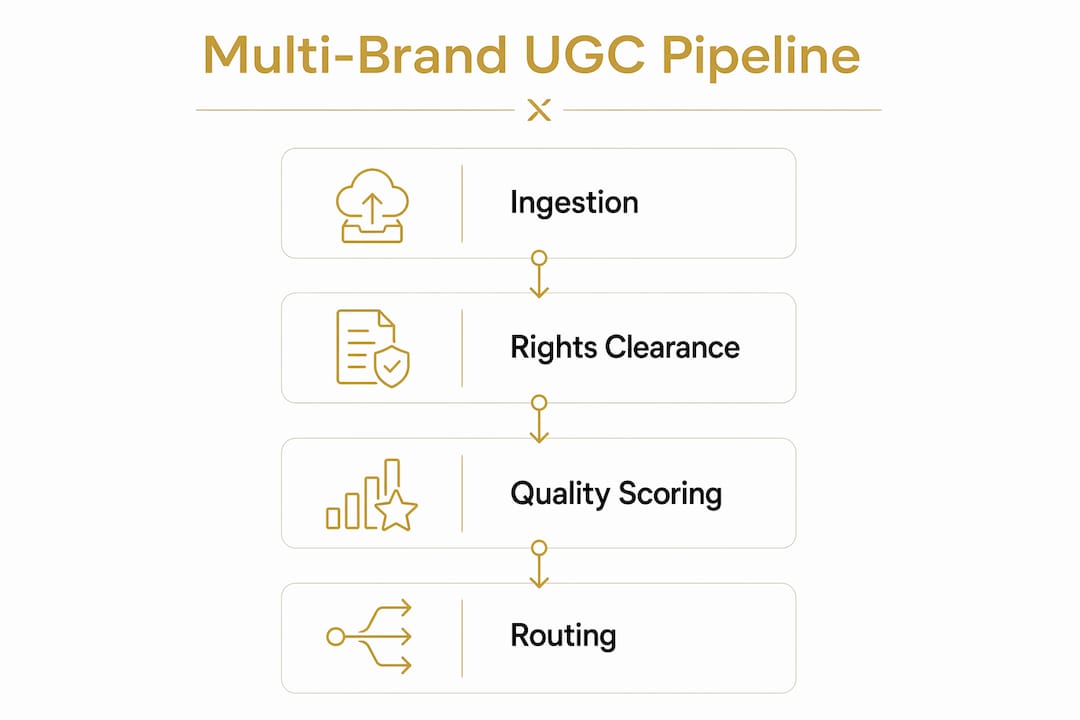
Teams scaling UGC across multiple brands use a four-layer pipeline to convert content from discovery to channel-ready assets. Any break in that pipeline degrades the entire workflow, not just one stage. Understanding each layer is the starting point for building a system that holds up under volume.
The four layers are:
- Ingestion: Pulling content from Instagram, TikTok, YouTube, LinkedIn, and brand hashtags into a central repository. This requires normalized data formats so assets from different platforms carry consistent metadata from the moment they enter the system.
- Rights clearance: Obtaining documented consent from creators before any asset is used commercially. Automated rights clearance with programmatic consent capture shortens this bottleneck from days to minutes, enabling sub-two-hour content deployment cycles. That speed advantage compounds across a multi-brand portfolio.
- Quality scoring: AI-based scoring models evaluate resolution, composition, brand alignment, and engagement signals. This filters out low-quality assets before they reach human reviewers, reducing manual workload significantly.
- Repurposing routing: Approved, scored assets get automatically assigned to the right channel, brand, and funnel stage. Consistent creative IDs across tools enable feedback-loop optimization between rights records and analytics.
Granular rights metadata should specify permitted uses such as organic versus paid, timeframes, territories, attribution requirements, and version control. Without that specificity, cross-channel reuse creates compliance exposure that compounds across brands.
Pro Tip: Build your rights metadata schema before you build your ingestion connectors. Retrofitting metadata fields onto an existing pipeline is far more expensive than designing them in from the start.

How do you integrate multiple social platforms and brands technically?
Platform integration is where most multi-brand programs stall. Each social network has distinct authorization requirements, permission scopes, and token behaviors that do not transfer between brands or accounts.
| Platform | Auth Method | Key Complexity |
|---|---|---|
| Facebook App Review | Business account linking, scope approval | |
| TikTok | TikTok for Developers API | Separate app registration per brand |
| OAuth 2.0 | Organization page permissions, token refresh | |
| YouTube | Google OAuth | Channel-level scopes, quota limits |
Multi-platform API integrations require normalization of authentication, permission handling, and token lifecycle management to reduce operational overhead. Without a central abstraction layer, your team ends up managing token refresh logic for dozens of brand-platform combinations manually. That is not a workflow. That is a liability.
The practical solution is an aggregation API or internal connector abstraction that consolidates social feeds into one normalized data stream. Flockler's Content API, for example, supports programmatic feed management that separates platform-specific logic from your core ingestion workflow. This means adding a new brand to your pipeline does not require rebuilding authentication from scratch.
Scaling from two brands to ten exposes a second problem: permission drift. Tokens expire, platform policies change, and brand accounts get restructured. Success in multi-brand ingestion depends on central aggregation or internal connector abstractions that consolidate social feeds effectively. Schedule quarterly permission audits across all brand-platform connections, not just when something breaks.
Pro Tip: Assign a unique brand namespace to every asset at ingestion. This single convention prevents misrouting, simplifies audit trails, and makes brand-level performance reporting trivial later.
What moderation and brand governance measures are critical for multi-brand UGC?
Generic content safety filters are not enough for multi-brand programs. Each brand has distinct visual guidelines, messaging standards, and audience expectations that a one-size-fits-all moderation model cannot enforce.
Brand-specific moderation models trained on visual guidelines enforce logos, colors, and messaging at scale. This approach reduces reliance on generic unsafe content filters and enables faster, more confident approvals. Cloudinary's moderation tools, for instance, apply AI-based checks that detect off-brand colors, incorrect logo usage, poor image quality, and synthetic or manipulated content. That last category matters more than most teams realize.
Multi-brand UGC governance extends beyond unsafe content to authenticity and originality checks, including AI detection of synthetic images and reverse image search for originality verification. Using AI-generated or plagiarized content as if it were genuine UGC creates reputational and legal risk that no brand can afford.
Audit trails are the compliance backbone of any multi-brand program. Capturing immutable evidence including source URLs, timestamps, consent references, and content hashes is necessary for resolving disputes and satisfying regulatory requirements. This is not optional infrastructure. It is the difference between a defensible program and a legal exposure.
"AI moderation handles volume. Human governance handles judgment. The brands that get this right use AI to surface decisions and humans to own them."
The practical governance structure combines three elements: brand-specific AI models for visual compliance, a human review queue for edge cases and high-stakes placements, and an immutable audit log that records every decision with its rationale. You can also reference podcast content moderation practices for additional frameworks on how moderation drives brand safety across content types.
How to create a repeatable UGC strategy that scales across multiple brands?
Only 16% of brands have a dedicated UGC strategy, yet those brands consistently outperform the 87% that use UGC reactively. That gap is not about budget or team size. It is about whether UGC is treated as a system or a tactic.
Building a repeatable multi-brand content strategy requires four ongoing systems, not one-time setups:
- Collection pipelines: Define which platforms, hashtags, and creator tiers feed each brand. Set ingestion schedules and volume thresholds so the pipeline runs without manual triggering.
- Moderation criteria: Document brand-specific approval standards for each brand in your portfolio. These criteria should be version-controlled so changes are tracked and auditable.
- Rights workflows: Automate consent requests at the point of discovery. Programmatic consent capture tied to creator profiles reduces follow-up friction and increases response rates.
- Distribution plans: Map approved assets to funnel stages and specific KPIs before they enter the routing layer. An asset without a destination is just storage cost.
Winning UGC programs are continuous engines that map content to KPIs and funnel stages, enabling sustained performance beyond individual campaigns. This is the structural difference between a brand that gets a spike from a UGC campaign and a brand that compounds engagement quarter over quarter.
Prioritize platforms by brand audience before scaling to all channels. A B2B brand in your portfolio should have LinkedIn and YouTube ingestion fully operational before you add TikTok. A consumer lifestyle brand should have Instagram and TikTok locked down before expanding to Pinterest. Spreading integration effort evenly across all platforms dilutes quality everywhere.
Pro Tip: Map each UGC asset to a specific funnel stage at the routing layer. Awareness assets go to paid social. Consideration assets go to email and landing pages. Decision assets go to product pages and retargeting. This mapping alone improves conversion rates without changing the content itself.
For teams managing repurposed social video assets, routing decisions become even more consequential. A single high-performing UGC video can serve three funnel stages if it is edited and distributed correctly.
What common pitfalls should be avoided in managing multi-brand UGC?
The most expensive mistakes in multi-brand UGC programs are operational, not strategic. They compound quietly until a compliance issue or a brand safety incident forces a full audit.
The most common failure points are:
- Fragmented rights records: Rights stored in spreadsheets, email threads, or platform-specific tools create gaps that surface during audits or disputes. Centralize rights records in a searchable database with automatic expiry alerts.
- Inconsistent moderation standards: When each brand applies different approval criteria without documentation, quality drift is inevitable. Standardize the criteria format even when the content standards differ.
- API token expirations: Expired tokens silently stop ingestion without triggering alerts in most setups. Build token health monitoring into your pipeline with automated refresh and failure notifications.
- Manual overload at scale: Human reviewers cannot maintain consistent judgment across hundreds of assets per day. AI scoring should handle the first pass; humans should only review flagged or borderline content.
Clear routing rules and human oversight of AI automation balance speed and compliance when pushing UGC into paid media. Removing human oversight entirely to gain speed is the single most common cause of brand safety incidents in automated UGC programs.
Regular integration testing and quarterly workflow audits catch drift before it becomes a crisis. Review routing decisions monthly to identify misassignments. Check moderation approval rates by brand to spot model degradation. Verify that rights expiry alerts are firing correctly. These are not complex processes. They are the maintenance schedule for a system that runs your content supply chain.
Key takeaways
Effective multiple brand UGC management requires a four-layer pipeline, brand-specific governance models, and continuous rights infrastructure to convert user content into a measurable, scalable asset engine.
| Point | Details |
|---|---|
| Build the four-layer pipeline | Ingestion, rights clearance, quality scoring, and routing must all function together or the workflow breaks. |
| Centralize rights metadata | Specify permitted uses, territories, and expiry dates to enable cross-channel reuse without compliance risk. |
| Use brand-specific moderation models | Generic content filters cannot enforce logo, color, or messaging standards unique to each brand. |
| Treat UGC as a continuous system | Only 16% of brands have a dedicated UGC strategy, yet they consistently outperform reactive programs. |
| Audit integrations regularly | Token expirations and permission drift silently degrade ingestion; quarterly audits prevent compounding failures. |
Why rights infrastructure is the real competitive advantage
Most brand managers I talk to focus their UGC conversations on content volume and creative quality. Those matter. But after working through multi-brand content programs, the variable that separates high-performing teams from struggling ones is almost always rights infrastructure.
Here is what I have found in practice: teams that invest early in searchable, auditable rights records move faster than teams that do not. Not because they have better content. Because they can say yes to a deployment decision in two hours instead of two days. That speed advantage compounds. A brand that can deploy approved UGC to paid media the same day it clears rights runs more tests, learns faster, and builds a larger approved asset library over time.
The counterintuitive lesson is that compliance infrastructure is a speed enabler, not a speed constraint. The brands treating rights clearance as a bottleneck to minimize are the ones that eventually face a dispute they cannot defend. The brands treating it as a strategic asset are the ones with a searchable library of cleared content ready to deploy on any channel, at any time.
I also want to push back on the instinct to automate everything immediately. Start with one brand, one platform, and one moderation model. Get the feedback loops working. Measure approval rates, deployment times, and downstream performance. Then layer in the next brand. Complexity added before the foundation is solid creates technical debt that is genuinely painful to unwind.
Educating creators upfront about consent and usage rights is the other underrated lever. When creators understand what they are agreeing to and why, consent rates improve and disputes drop. That is not a legal nicety. It is a workflow efficiency gain.
— Brian
How Blackx accelerates multi-brand UGC rights and partnership management
Managing rights clearance and creator partnerships across a multi-brand portfolio is exactly the operational problem Blackx was built to solve. Blackx is the contract intelligence layer for the creator economy, giving brand managers a secure, searchable rights database with programmatic consent capture built in.

For brand managers running UGC campaigns across multiple brands, Blackx for brands provides audit-ready infrastructure that reduces manual bottlenecks at the rights clearance stage. Automatic expiry tracking, immutable evidence retention, and creator-facing deal clarity tools mean your team spends less time chasing permissions and more time deploying content. If you are building or rebuilding your multi-brand UGC pipeline, explore Blackx to see how contract intelligence fits into your workflow.
FAQ
What is multiple brand UGC management?
Multiple brand UGC management is the process of collecting, rights-clearing, moderating, scoring, and routing user-generated content across several brands through integrated automated systems. It treats UGC as a continuous content asset engine rather than a campaign-by-campaign tactic.
How do you handle rights clearance across multiple brands at scale?
Programmatic consent capture tied to creator profiles at the point of discovery shortens rights clearance from days to minutes. Rights metadata should specify permitted uses, territories, and expiry dates for each brand to enable cross-channel reuse without compliance exposure.
What moderation tools work best for multi-brand UGC programs?
Brand-specific moderation models trained on each brand's visual guidelines outperform generic content safety filters. Cloudinary's moderation tools apply AI-based checks for off-brand visuals, synthetic content, and originality, while maintaining audit trails for compliance.
Why do most UGC programs fail to scale across multiple brands?
Fragmented rights records, inconsistent moderation standards, and API token expirations are the most common failure points. Only 16% of brands have a dedicated UGC strategy, which means most programs lack the documented systems needed to maintain quality and compliance at volume.
How often should multi-brand UGC integrations be audited?
Quarterly audits of token health, moderation approval rates, and routing accuracy are the minimum maintenance schedule for a multi-brand UGC pipeline. Monthly reviews of routing decisions catch misassignments before they create brand safety issues.