
If you negotiate brand deals for a living, skip the enterprise contract lifecycle management platforms entirely and look at creator-specific contract intelligence tools instead. BlackX is built for exactly this problem: it reads a brand deal, scores its clarity on a 100-point scale, flags red flags like open-ended whitelisting or vague exclusivity windows, and can generate a counter-proposal automatically. Beyond BlackX, the practical alternative categories are clause-matching tools (fast, narrow, good at spotting missing terms), generative redlining assistants (better at rewriting problem clauses), and creator-ops platforms with bolted-on contract modules.
The reason this matters more than most creators realize: 67% of influencer-brand disputes trace back to unclear contract terms, not missed deadlines or underperformance. That's not a legal-team problem. That's a "nobody flagged the whitelisting clause before you signed" problem.
- Clause-matchers — fastest, cheapest, best for catching missing terms in standard templates
- Generative redliners — rewrite problem language and suggest alternative phrasing
- Creator-ops platforms with contract add-ons — useful if you already live in a CRM, weaker on deep clause analysis
- Creator-focused contract intelligence (BlackX) — combines clarity scoring, red-flag detection, and automated counter-proposals in one workflow
What "SpotDraft Alternatives" Actually Means for Creators
Searching for SpotDraft alternatives usually turns up enterprise CLM software built for procurement teams and in-house legal departments. That's a different category solving a different problem. This article is about something narrower and more useful to you: AI tools that read a single influencer or sponsorship agreement, tell you what's wrong with it, and help you push back before you sign.
The job to be done here has four parts: redlining a contract against known risk patterns, scoring how clear (or exploitative) the terms are, drafting a counter-proposal you can actually send, and tracking what you agreed to after signature so nobody "forgets" a kill fee deadline. Enterprise CLM tools manage hundreds of vendor contracts across a legal department's workflow. You're managing one deal at a time, usually under a deadline, usually without a lawyer on retainer.
The clauses that decide whether a deal is fair almost never show up in the first two sections a creator reads:
- Usage rights and duration — how long can the brand use your content, and where
- Whitelisting — paid promotion of your content through the brand's ad account, which is a separate right that should carry separate pricing
- Exclusivity scope — does it lock you out of an entire category or just direct competitors
- Deliverables and revision limits — vague deliverables invite scope creep
- Kill fees and termination terms — what happens if the brand cancels after you've started production
The Feature Checklist for Evaluating Any Contract AI Tool
Before you pay for anything, run it through this list. Most tools fail at least two of these.
- Clause detection depth: Does it catch usage duration limits, whitelisting language, and exclusivity scope, not just generic "IP clause present" flags?
- FTC disclosure checks: Does it flag missing or ambiguous disclosure language, since that's a compliance risk that sits outside normal contract review?
- Explainability: When it suggests a redline, does it show you why, with reference to comparable deal terms, or just spit out a suggestion with no rationale?
- Model-training governance: Can you opt out of having your contracts used to train shared models, and is that opt-out contractual, not just a settings toggle?
- Data handling: Does the vendor publish SOC 2 Type II status and support data export if you leave?
- Workflow fit: Does it plug into whatever you already use for deal tracking and e-signature, or does it force you into a new standalone system?
- Clarity scoring: Does it give you a single number you can cite in a negotiation, like "this contract scores 61 out of 100 on clarity," or does it just list problems with no way to benchmark them?
- Line-item pricing visibility: Does the report separate exclusivity and whitelisting into distinct pricing recommendations, or bundle everything into one vague "this seems low" comment?
Pro Tip: Feed the tool a contract with a deliberately vague whitelisting clause, something like "brand may use content for promotional purposes." A tool worth paying for will flag the missing duration and ad-spend cap immediately. One that says nothing isn't ready for real deal work.
Clause-Matchers, Generative Redliners, and Negotiation Agents: Which Tier Fits You
AI contract tools for creator deals split into three real tiers, and picking the wrong one wastes both money and trust.
Clause-matching tools compare your contract against a library of known clause patterns and flag anything unusual. They're fast and cheap, and they're genuinely good at catching a missing whitelisting duration or an exclusivity clause with no geographic limit. What they don't do well is help you respond. You get a flag, not a fix.
Generative redlining assistants go a step further: they don't just flag the problem clause, they draft replacement language. This tier tends to be stronger on pricing-related pushback, like suggesting a separate line item for exclusivity instead of just noting the clause is broad.
Negotiation agents are the newest tier, aiming to run more of the back-and-forth automatically. They're promising but still need tight human oversight, since no serious workflow should let AI-only approval sign off on indemnity or IP ownership language.
- Clause-matchers: best for volume, weak on nuance
- Generative redliners: best for pricing and language fixes
- Negotiation agents: best for speed, needs the tightest guardrails
Security and Model-Training Questions Before You Sign
Your contracts contain your rates, your exclusivity terms, and your negotiating leverage. Ask these before you commit to any vendor, creator-focused or otherwise.
- Do you train shared AI models on customer contract data, and can I opt out contractually, not just through a settings page?
- Do you carry SOC 2 Type II certification, and will you provide the report on request?
- Is there a full audit trail, timestamped approvals, and version history I can pull for a dispute?
- Can I export everything, contracts, redline history, and clarity scores, if I switch tools?
- What's the human-in-the-loop threshold for high-risk terms like indemnity, IP ownership, and perpetual usage grants?
That last question matters more than it sounds. Human oversight on indemnities, IP ownership, and morality clauses isn't optional for any tool worth trusting with real deal terms.
Pricing Models and How to Run a Real Pilot
Most creator contract tools price one of three ways: per seat (flat monthly fee regardless of volume), per contract (you pay when you actually use it), or usage-based tiers that scale with deal volume. Solo creators usually do better on per-contract or entry-tier per-seat pricing. Brands managing dozens of creator deals a month tend to save more on usage-based tiers once volume climbs.
Before committing to a paid tier, run a 30-contract pilot using past deals you already have outcomes for.
- Feed the tool 30 anonymized historical contracts
- Compare its flagged issues against what your past legal review actually caught
- Track time saved on first-pass review, not just accuracy
- Check whether it integrates natively or forces a separate, disconnected workflow
Vendors commonly report 50 to 70% reductions in initial review time on standard clauses. Complex deals still need a human pass.
That's the tool telling you it needs more training data or isn't ready for your contract types.*
Your First 30 Days: Onboarding and Verification Steps
Buying the tool is the easy part. Verifying it actually works on your contracts is where most teams skip steps.
- Run 30 anonymized past contracts through the system and compare flags against known legal outcomes; expect roughly 85% or better overlap with manual review before trusting it on live deals
- Set escalation rules now, before you need them, for indemnity, IP ownership, and any perpetual usage grant
- Train whoever negotiates deals to read the clarity score and cite the vendor's rationale directly in pushback emails
- Document a rollback and export procedure so switching tools later doesn't mean losing your contract history
Skip step one and you're trusting a tool on faith. Skip step two and you'll find out the hard way what "AI-only approval" costs you.
How BlackX Compares to SpotDraft on Actual Creator Features
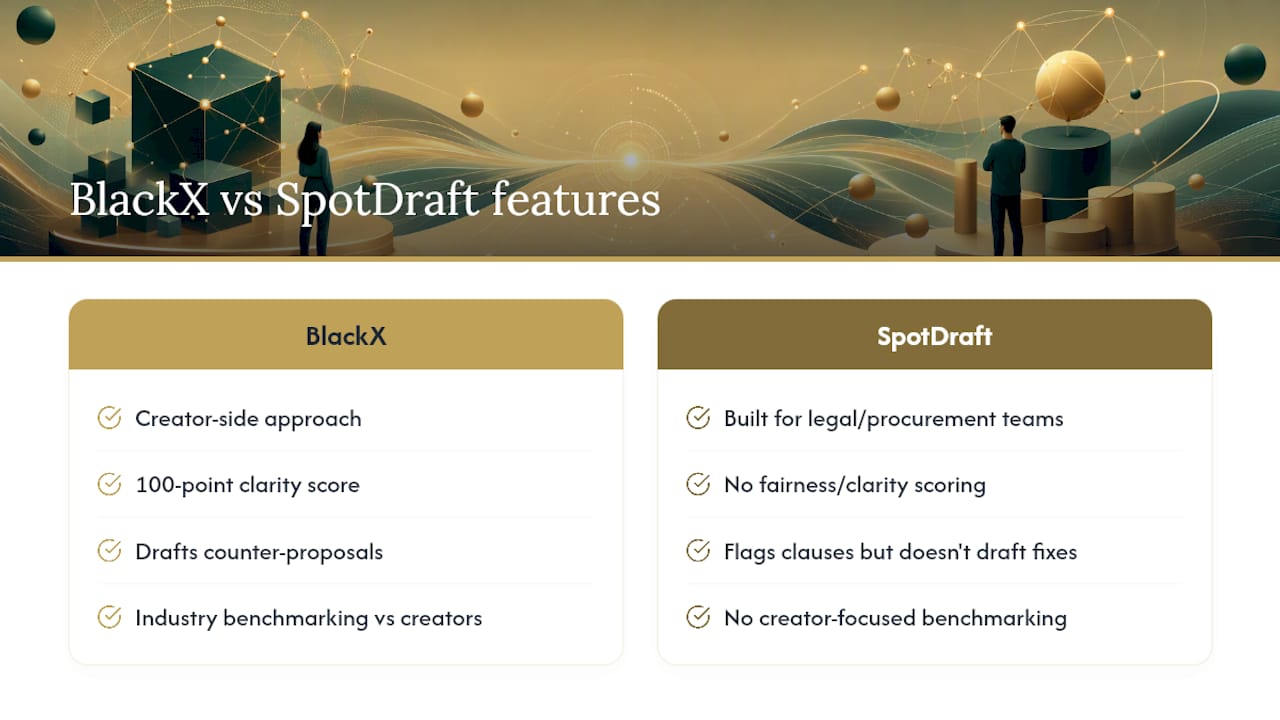
SpotDraft was built for legal teams managing vendor and procurement contracts at scale. It's not designed to score a brand deal's fairness or flag a missing whitelisting duration, because that's simply not the job it was built for. BlackX approaches the same category of problem, a contract that needs review before signature, from the creator's side of the table.
The clearest functional gap shows up in three places. First, clarity scoring: BlackX assigns a 100-point score to a contract based on how clearly usage rights, exclusivity, and compensation are defined, something generic CLM tools don't attempt because they're not built to benchmark deal fairness. Second, automated counter-proposals: instead of just flagging a problem clause, BlackX drafts language you can send back to the brand, cutting the gap between "here's an issue" and "here's what to say next." Third, industry benchmarking: a score means little in isolation, so BlackX compares your contract's terms against patterns seen across other creator deals, which is a fundamentally different reference point than a procurement-focused tool would use.
The Black X Verified badge adds a layer neither generic CLM tools nor most creator-ops platforms offer: a visible signal to brands that a creator or brand meets defined transparency standards, useful in a market where unclear terms drive most disputes in the first place.
Interface and Workflow Differences That Actually Affect Your Day
The interface differences between creator contract tools and generic CLM software aren't cosmetic. They change how fast you can actually use the thing during a live negotiation.

Enterprise CLM interfaces are built around document repositories, approval chains, and multi-stakeholder sign-off, because that's what a legal department needs when twelve people touch one vendor contract. A solo creator or a five-person brand team doesn't need that. You need to open a contract, get a score, see what's wrong, and act within minutes, often between other work.
Creator-focused tools tend to lead with a single readable output: a score, a short list of red flags, and a suggested next step. That's a deliberate design choice, not a limitation. When you're negotiating a deal on a tight deadline, a dashboard full of approval workflows is friction you don't need.
Where these tools tend to differ from each other is in report readability. Some present flagged clauses as raw legal language with a comment attached, which is technically accurate but unreadable if you're not a lawyer. Others translate the flag into plain language, "this clause lets the brand use your content indefinitely with no expiration," paired with a suggested fix. For a creator without in-house counsel, that plain-language translation is often the entire value of the tool. If you're evaluating options, open a sample report before you buy and check whether you understand it without a legal dictionary.
Onboarding and Support Quality Vary More Than You'd Expect
Support quality is where budget creator contract tools tend to cut corners, and it's worth checking before you commit to an annual plan.
The baseline you should expect from any paid tier: a walkthrough of how the clarity score is calculated, documentation on what clause types the tool detects, and a real answer (not a canned one) when you ask about model-training data policies. Free tiers reasonably offer less here. Self-serve help centers and community forums are standard for no-cost access.
Where it gets uneven is at the paid tier. Some vendors treat onboarding as a five-minute product tour. Others walk you through your first few real contracts, explain why a specific clause triggered a red flag, and adjust their flagging logic based on the deal types you actually negotiate. If you manage a high volume of similar deals, brand partnerships, sponsorship packages, licensing agreements, that second kind of onboarding compounds. A vendor that tunes its detection to your specific deal patterns in month one saves you review time in month six.
Ask directly, before signing anything, whether onboarding includes a walkthrough of your own historical contracts or just a generic demo. The answer tells you more about the vendor's actual support model than anything in their marketing copy.
Scalability: What Happens When Your Deal Volume Grows
A tool that works fine for one contract a month can fall apart at twenty. Scalability in this category comes down to three things: pricing that scales sensibly, workflow that doesn't create manual bottlenecks, and customization that adapts to your specific deal types.
Per-contract pricing works well at low volume but gets expensive fast once you're running multiple deals a week. Usage-based or tiered per-seat pricing tends to make more sense once volume climbs, which is why brands managing rosters of creators usually land on a different pricing tier than a solo creator doing occasional sponsorships.
Customization matters more than most buyers check for upfront. Can you adjust risk thresholds for your specific deal types? Can a small brand add custom clause categories relevant to its industry (say, health and wellness disclosure requirements that don't apply to a gaming sponsorship)? A platform that only recognizes generic influencer clause patterns will miss category-specific risk as your program grows into new verticals. Look for tools that let you tune flagging sensitivity rather than accepting a fixed rule set built for the median deal.
What Real Users Say About These Tools in Practice
The honest pattern across creator and brand feedback on AI contract tools: the technology reduces review time meaningfully but doesn't replace judgment on high-stakes clauses. Treat these tools as augmentation, not a replacement, and you'll get realistic value from them. Treat them as a substitute for legal review on a six-figure exclusivity deal, and you're taking a risk the tool was never built to cover.
The most consistent praise pattern in creator feedback centers on speed for routine deals, catching missing whitelisting durations or vague usage windows on standard sponsorship agreements. The most consistent complaint centers on complex or unusual contract structures, where flagging logic trained on typical creator deals sometimes misses industry-specific risk or unusual deal architecture. That's not a flaw unique to any one vendor. It's a limitation of pattern-matching in general, and it's exactly why the 30-contract pilot approach matters before you scale usage across your full deal volume.
Creators managing high deal volume tend to report the biggest time savings, since the tool's value compounds with repetition. Occasional negotiators, someone doing two or three brand deals a year, get less proportional benefit from a paid tier and often do fine on a free plan with basic red-flag detection.
Why BlackX Built a Contract Intelligence Layer for Creators, Not Lawyers
Most contract software assumes a legal team is reading the output. Creators don't have that luxury, and the deals that go wrong usually aren't the obvious scams. They're the ones where a whitelisting clause quietly grants indefinite ad use, or an exclusivity window is broader than anyone intended to negotiate.
That's the gap BlackX was built to close: a clarity score you can cite in a negotiation, red-flag detection tuned to creator deal patterns, and counter-proposals generated automatically instead of left to guesswork. The Verified badge exists because transparency should be visible, not just claimed.
— Brian
Try BlackX on Your Next Brand Deal Before You Sign
Every tool in this article helps with some piece of the puzzle: clause-matchers catch missing terms, generative redliners fix language, negotiation agents speed up back-and-forth. BlackX does all three in one workflow, built specifically around creator deal patterns instead of generic contract templates.

The clarity score gives you a number to cite when you push back on a vague clause. Red-flag detection catches the whitelisting and exclusivity issues that generic tools miss entirely. Automated counter-proposals turn a flagged problem into language you can send back the same day, and the Verified badge signals to brands that your deals meet a real transparency standard. Onboarding walks you through your own past contracts, not a generic demo, so the tool starts flagging accurately from your first upload.
Start with the free tier on the creator landing page to score your next contract before you sign it, or check the full platform overview for pricing on upgraded tiers with unlimited scoring and the negotiation agent.
Sources
- Brand Deal Contracts: What Streamers Need to Know
- AI Co-Pilot Tools for Influencer Contract Redlining
- 12 Influencer Sponsorship Legal Mistakes in 2026
FAQ
What Are the Best SpotDraft Alternatives for Creators?
For creator and small-brand deal review, creator-focused contract intelligence platforms like BlackX outperform enterprise CLM tools because they score clarity, flag creator-specific risks like whitelisting, and generate counter-proposals automatically.
Is SpotDraft Good for Influencer Contracts?
SpotDraft is built for enterprise procurement and vendor contract management, not for scoring the fairness of a single brand deal or flagging creator-specific clauses like exclusivity scope or FTC disclosure gaps.
How Much Do AI Contract Review Tools Cost for Creators?
Pricing typically falls into per-seat, per-contract, or usage-based tiers, with solo creators generally best served by per-contract or entry-level per-seat pricing and BlackX offering a free tier alongside paid upgrades.
Can AI Contract Tools Replace a Lawyer for Brand Deals?
No. AI contract tools work best as an augmentation layer, catching common issues fast, but high-risk terms like indemnity and IP ownership still need human legal review.
What Is Whitelisting in an Influencer Contract?
Whitelisting grants a brand permission to run paid ads through your account or content, which is a distinct, higher-value right that should be priced and defined separately from organic usage rights.