Most creators assume that uploading content means keeping full control over it. You made it, you own it, right? That logic feels solid until you actually read the fine print. Creator rights differ across platforms primarily due to variations in Terms of Service, which grant each platform a different scope of license to your content. The moment you click "agree," you hand over more than most creators realize, and the specific terms vary wildly depending on where you post. Understanding these differences is not optional if you care about your income or your creative legacy.
Table of Contents
- Why platforms set different rules for creator rights
- What creator rights do platforms actually grant (and take)??)
- Comparing creator rights: YouTube, TikTok, Twitch, and Kick
- How these differences impact creator income and control
- How to protect your rights across platforms
- Why the 'upload and own' myth fails creators
- Secure your creator rights with Black X
- Frequently asked questions
Key Takeaways
| Point | Details |
|---|---|
| Terms of Service impact control | Every platform's ToS defines what rights you keep and what you lose when publishing content. |
| Licensing differs across platforms | Some platforms offer perpetual broad licenses while others allow creators to revoke rights more easily. |
| Monetization models affect earnings | Revenue splits and content claims tools create big differences in how much creators really earn. |
| Protect yourself proactively | Reading the fine print and posting across multiple platforms is your best defense for retaining rights and revenue. |
| Regulations drive ToS evolution | Global compliance and liability concerns continue to shape platform approaches to creator rights. |
Why platforms set different rules for creator rights
Every platform operates a distinct business model, and that model shapes how it writes its Terms of Service. A short-form video app built on advertising revenue needs broad rights to repurpose and distribute your content across its ad network. A live streaming platform built on subscriptions has different priorities. Neither is writing its ToS to protect you. They are writing it to protect themselves.
Business models, liability protection, payment processor compliance, regional regulations, and competitive strategies all drive the differences between platform policies. A platform operating in the European Union must account for GDPR. A platform processing payments through major card networks must comply with those networks' content standards. These external pressures push platforms toward stricter or more nuanced ToS language, and creators end up absorbing the consequences.
"Platforms can unilaterally change ToS, and continued use implies acceptance, affecting creator rights unpredictably."
That quote should make every creator uncomfortable. You could build an entire content library on a platform today and wake up tomorrow to new terms that fundamentally change what the platform can do with your work. You never get a direct vote. Clicking "continue" is your signature.
Competition does create some pressure in the other direction. When one platform offers more platform differentiation that favors creators, others sometimes respond with friendlier policies to attract top talent. Kick's aggressive revenue split is a direct response to creator frustration with other platforms. But competition alone will not protect you. It just shifts the battlefield.
Key business reasons platforms write creator-restrictive ToS:
- Advertising revenue requires the ability to place ads on and around your content without paying you extra
- Liability shielding means platforms need broad licenses so they cannot be sued for hosting or distributing your work
- Payment compliance forces content restrictions that protect the platform's relationship with card networks
- Global distribution requires rights that cover every country where the platform operates
- Product development lets platforms use your content to train algorithms, build features, and improve recommendations
What creator rights do platforms actually grant (and take)?
Before comparing platforms, it helps to get clear on terminology. Copyright is the legal ownership of your creative work. It exists the moment you create something original. A license is permission you grant someone else to use that work in specific ways. When you upload to any major platform, you keep your copyright but grant the platform a license. The question is how broad that license is.
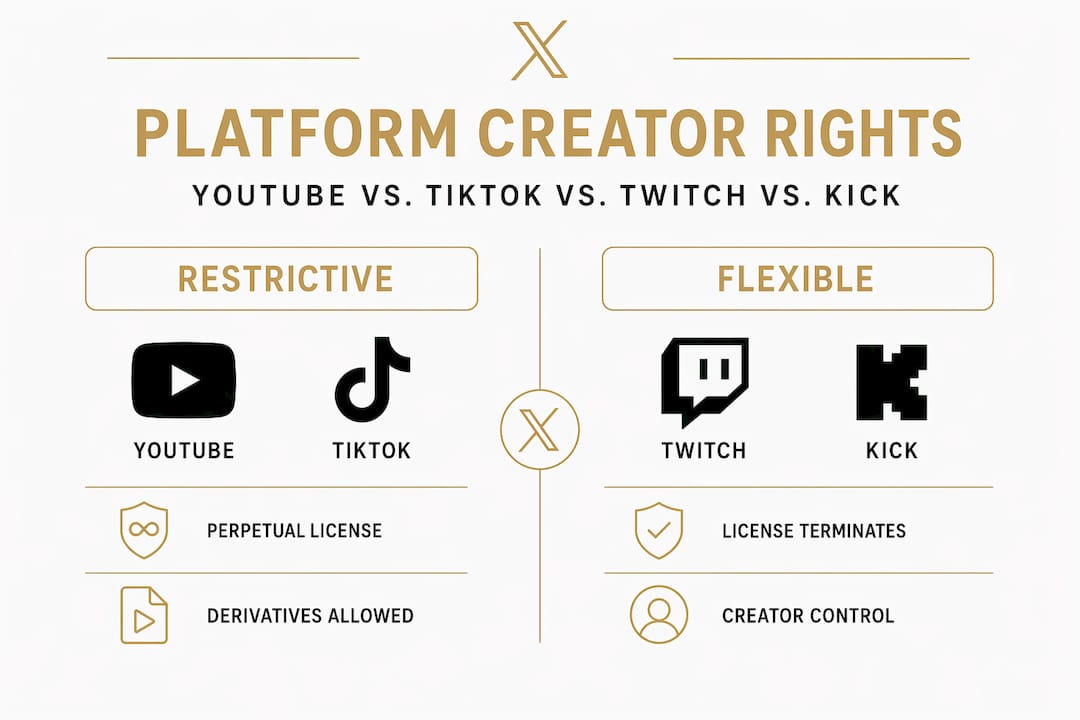
Platforms require broad licenses to host, distribute, promote, and monetize content, but the extent varies significantly. YouTube holds a worldwide perpetual license that persists even after you delete your content. TikTok's license allows the creation of derivative works and also survives account deletion. Twitch's license, by contrast, terminates when you delete the VOD.
That distinction matters enormously. A "perpetual" license means the platform retains rights to your content forever, even if you leave. An "irrevocable" license means you cannot take back the permission you granted, even if you change your mind. Most major platforms combine both terms, which is why deleting your account does not always erase the platform's rights to what you already uploaded.

Creators retain copyright ownership but grant irrevocable, royalty-free licenses via ToS, trading control for distribution and monetization access. Multi-platform strategies help mitigate these risks by reducing dependency on any single platform's terms.
| Feature | What it means for you |
|---|---|
| Royalty-free license | Platform uses your content without paying you additional fees |
| Worldwide license | Rights apply in every country, not just where you live |
| Perpetual license | Rights do not expire, even after you delete content |
| Irrevocable license | You cannot withdraw the license once granted |
| Derivative works right | Platform can edit, remix, or build on your content |
Pro Tip: Distribute your best content across multiple platforms simultaneously. If one platform's ToS shifts against you, your content and audience are not locked in a single ecosystem. Creator verification benefits also help establish your identity and rights across channels.
Comparing creator rights: YouTube, TikTok, Twitch, and Kick
Now let's get specific. The differences between these four platforms are not minor technicalities. They represent fundamentally different philosophies about who content belongs to and how much leverage creators actually hold.
YouTube holds a worldwide perpetual license. TikTok allows derivatives and its license persists post-account deletion. Twitch's license ends with VOD deletion. Kick offers a 95/5 subscription split, the most favorable revenue arrangement of the four. These are not small print details. They are the core terms that determine your relationship with each platform.
| Platform | License duration | Derivatives allowed | License survives deletion | Sub revenue split |
|---|---|---|---|---|
| YouTube | Perpetual, worldwide | Yes | Yes | ~55% to creator |
| TikTok | Perpetual | Yes | Yes | Not applicable (ad fund) |
| Twitch | Ends with VOD deletion | Limited | No | 50/50 standard |
| Kick | Ends with deletion | Limited | No | 95/5 |
More creator-friendly platforms like Kick and Twitch prioritize termination of licenses upon deletion to attract ownership-conscious creators. This directly contrasts with the broad perpetual licenses on YouTube and TikTok. For creators who care deeply about long-term content ownership, that termination clause is a significant advantage.
A few edge cases deserve attention. YouTube's Content ID system lets rights holders (often music labels or studios) automatically claim and monetize videos that contain their material. Even if you use a song legally, a Content ID match can redirect your ad revenue to the claimant. TikTok's Duet and Stitch features let other users build directly on your content, creating derivatives that you did not authorize individually. These systems exist to serve the platform's ecosystem, not your interests.
Key differences to watch across platforms:
- YouTube gives the broadest license but the largest ad revenue potential
- TikTok has the most aggressive derivative rights and the weakest direct monetization per view
- Twitch offers cleaner license termination but restricts streaming exclusivity for top-tier partners
- Kick is the most creator-friendly on both revenue split and license termination, but has a smaller audience
Pro Tip: Before signing any brand deal that involves platform-hosted content, check whether the platform's license to your content could interfere with the exclusivity or usage rights you are promising to that brand. Use creator-friendly rights frameworks to structure deals that account for what you have already granted platforms. Cross-reference your platform comparison insights before committing to long-term brand partnerships tied to a single channel.
How these differences impact creator income and control
Rights are abstract until they hit your bank account. Here is where platform licensing differences become very concrete.
Monetization rights differ significantly across platforms. YouTube RPM (revenue per thousand views) ranges from roughly $1 to $25 or more depending on niche and audience geography. TikTok's creator fund pays approximately $0.40 to $1.00 per 1,000 views, which is dramatically lower. Twitch revenue depends heavily on subscriber count and tier. Kick's 95/5 split means a creator keeping $9.50 of every $10 subscription, compared to Twitch's standard 50/50 arrangement.
The Content ID system on YouTube allows rights holders to claim and monetize parts of videos, complicating creator control even over fully original content. A single background song, a clip of a TV show, or even ambient music in a vlog can trigger a claim that strips your revenue entirely. You can dispute it, but the process is slow and the burden of proof falls on you.
Steps to retain more income streams across platforms:
- Register your original music and audio with a performing rights organization before uploading anywhere
- Use only royalty-free or original music to avoid Content ID claims
- Document your creative process with timestamps and drafts to establish proof of authorship
- Diversify monetization beyond platform ad revenue into memberships, merchandise, and direct deals
- Review your ToS on each platform at least once per year, since terms change without direct notice
- Archive original files locally and on cloud storage so you always have the master copy regardless of what a platform does
One stat worth sitting with: TikTok's creator fund pays creators a fraction of what YouTube pays per view, yet TikTok's license is arguably more aggressive about derivative rights. You give more and earn less. That imbalance is not accidental. It reflects the platform's business priorities, not yours.
Content ownership safeguards become especially important when you start earning meaningful income. A demonetization event or ToS change that cuts your revenue by 30% is a business crisis, not just an inconvenience.
How to protect your rights across platforms
Understanding the problem is step one. Acting on it is step two. Here is a practical framework for protecting your rights as a working creator.
Numbered steps for protecting your content rights:
- Read the ToS for every platform you use, specifically the sections labeled "license," "intellectual property," and "content rights"
- Screenshot or save the current ToS so you have a record if it changes later
- Post your most valuable content on platforms with cleaner license termination clauses first
- Never post content exclusively on a single platform unless you have a specific contractual reason to do so
- Use watermarks or metadata tagging on video and image content to establish provenance
- Build an email list or owned channel (like a newsletter or website) so your audience relationship is not entirely controlled by a platform
Creators retain copyright ownership but grant irrevocable, royalty-free licenses via ToS. The only way to limit platform rights is to choose platforms with narrower licenses, delete content before rights become entrenched, and diversify where your audience lives.
Pro Tip: When you delete content from a platform with a perpetual license, the platform may still retain the right to content already distributed or cached. Deletion does not always undo what has already been licensed. Check the specific language around "removal" in each platform's ToS before assuming your content disappears.
Third-party deal infrastructure plays a growing role here. Platforms designed to support creator contracts and rights management give you a layer of protection that ToS alone never will. Security for creators means having documented, enforceable agreements that sit outside the platform's own terms.
Key protective habits every creator should build:
- Audit your content library annually to identify what lives only on high-risk platforms
- Register copyrights for your most commercially valuable work with the U.S. Copyright Office
- Use contracts for every brand deal that specifies exactly which platform, which content, and which rights are involved
- Monitor ToS changes using services that track policy updates across major platforms
Why the 'upload and own' myth fails creators
Here is the uncomfortable truth that most platform-centric creator advice skips over. Terms of Service were never designed to protect creators. They were designed by legal teams working for the platform, reviewed by executives focused on growth and liability, and approved without any creator input. The idea that a platform's ToS represents a fair exchange is a myth that serves the platform, not you.
Regulatory pressures like GDPR and payment compliance force platforms to tailor their ToS for liability minimization, leading to stricter controls on some platforms versus others. When regulations tighten, platforms do not absorb the risk. They push it down to creators through updated terms.
The deeper problem is that most creators operate as if platform access equals business stability. It does not. A platform can ban your account, demonetize your content, or change its revenue model overnight. Your entire income can evaporate without legal recourse because you agreed to ToS that gave the platform that power.
The creators who build lasting careers are the ones who treat platforms as distribution channels, not as employers or business partners. They use platforms to reach audiences, then move those audiences to owned channels where the relationship is not governed by a third party's ToS.
Creator independence strategies are not just about protecting content. They are about building a business that does not collapse when a single platform changes its rules. Every creator should be asking: if my largest platform disappeared tomorrow, what would I still own? If the answer is "not much," that is the real risk to address.
Secure your creator rights with Black X
Rights protection is not a one-time task. It is an ongoing part of running a creator business, and it gets more complex as you grow.
BlackX Technologies is built specifically for this challenge. As the contract intelligence layer for the creator economy, Black X gives you the infrastructure to document, manage, and enforce your content rights across every platform and brand deal. You do not have to navigate ToS complexity alone or hope that a platform's policies stay favorable.
Black X for creators provides transparent deal structures, rights tracking, and monetization tools designed around your ownership, not a platform's growth targets. If you want to understand exactly how Black X works and what it means for your content rights and income, the tools are ready when you are.
Frequently asked questions
Do I lose copyright if I share my videos on YouTube or TikTok?
No, you keep your copyright, but you grant the platform an extensive license to use, distribute, and sometimes modify your content. Creators retain copyright ownership while giving up significant control through irrevocable, royalty-free licenses embedded in ToS.
Can platforms change their content rules after I've uploaded?
Yes, platforms can update their Terms of Service at any time, and your continued use counts as acceptance. Platforms can unilaterally change ToS, which means rights you thought you had can shift without warning or negotiation.
Which platform offers the best monetization split for creators?
Kick currently offers a 95/5 revenue split for creators, which is the most favorable of all major platforms and significantly better than Twitch's standard 50/50 arrangement.
What's the risk of content ID or derivative features for my work?
Automated systems like YouTube's Content ID or TikTok's Duet and Stitch features let others monetize or alter your content, sometimes stripping your revenue or creating derivative works you never individually approved.
How can I limit a platform's rights to my content?
You cannot negotiate most ToS terms, but you can reduce exposure by multi-platform posting, reading fine print carefully, and choosing platforms where licenses terminate upon deletion rather than persisting indefinitely.