
Brand exclusivity cost is defined as a premium percentage added to a creator's base content rate, compensating them for restricting partnerships with competing brands during a defined period. In influencer marketing, this premium typically ranges from 30% for a short 30-day category window up to 300% or more for flagship full media exclusivity. The industry term for this structure is the exclusivity premium, and understanding how it scales is the single most important factor in evaluating your campaign budget. Platforms like The Viral App and MomentIQ have published 2026 benchmarks that give brand managers concrete numbers to negotiate against. Blackx works directly in this space, helping brands structure and verify these terms before a dollar is committed.
What does brand exclusivity cost by type and duration?
The exclusivity premium is not a flat fee. It scales by scope and length, and the difference between a 30-day category restriction and a full media ambassador deal can mean a 10x difference in total cost.
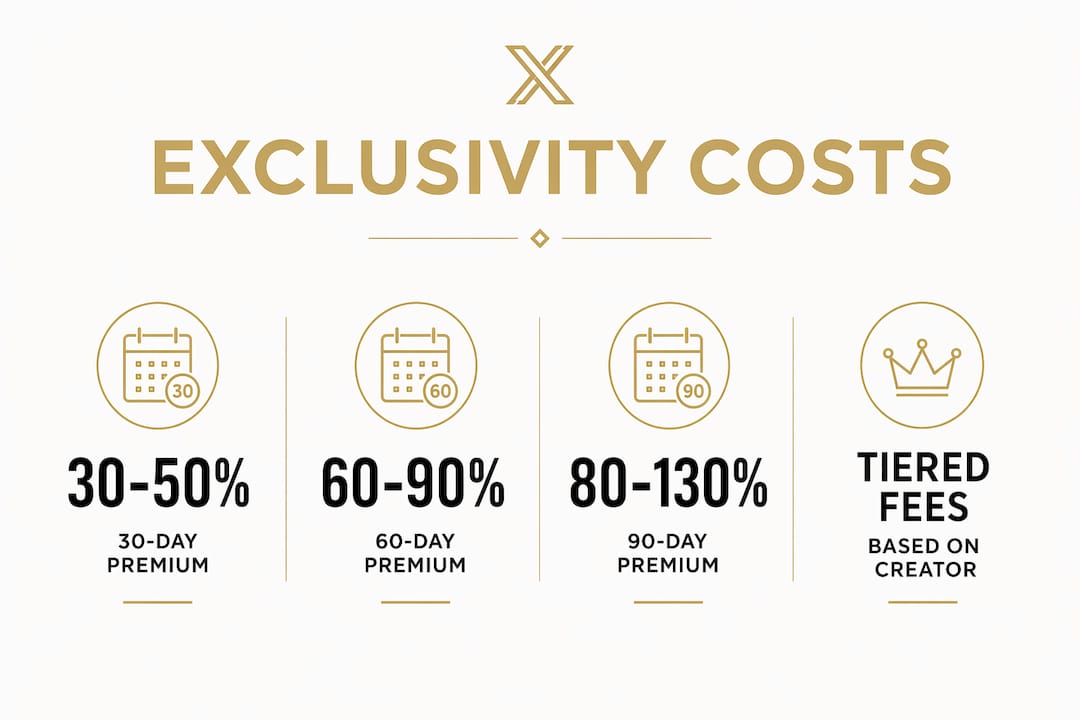
Category exclusivity premiums follow a clear progression: 30-50% above base rate for a 30-day window, 60-90% for 60 days, and 80-130% for a 90-day window. Full media exclusivity for flagship ambassador deals exceeds 150-300% of the creator's standard rate. That means a creator charging $10,000 per post could cost $25,000 to $40,000 per month under a full exclusivity arrangement.

Three exclusivity types drive most brand deals in 2026:
| Exclusivity type | Typical premium | Best use case |
|---|---|---|
| Category exclusivity | 30-130% (30-90 days) | Competitive product launches |
| Platform-only exclusivity | 20-60% | Channel-specific campaigns |
| Full media exclusivity | 150-300%+ | Flagship ambassador programs |
Category exclusivity restricts the creator from working with direct competitors in your product category. Platform-only exclusivity limits the restriction to a single channel, such as TikTok or Instagram, which costs less but leaves competitive exposure on other platforms. Full media exclusivity blocks all competing brand deals across every channel, which is the most expensive and the most protective.
Pro Tip: Reserve full media exclusivity for creators who have already delivered measurable ROI in a prior campaign. Paying 300% of base rate for an untested creator is a high-risk bet with no performance baseline.
The exclusivity fee structure also varies by creator tier. Nano and micro influencers often accept lower absolute premiums, but the percentage markup can be proportionally higher because their opportunity cost is lower. Macro and mega influencers command higher absolute premiums and are more likely to push back on long windows.
What factors drive the cost of brand exclusivity?
Several variables determine where a specific deal lands within the premium ranges above. Brand managers who understand these levers can negotiate more precisely.
- Creator tier and reach. A macro influencer with 2 million followers loses more potential income by going exclusive than a nano creator with 15,000 followers. Opportunity friction can cost top creators 30-60% of potential income over 3-5 years, which is why their exclusivity premiums are non-negotiable at the high end.
- Market competition intensity. In saturated categories like beauty, fitness supplements, and fintech, competing brands are actively recruiting the same creators. Exclusivity in these categories commands a higher premium because the creator is giving up more realistic competing offers.
- Contract enforcement complexity. Vague exclusivity windows and undefined monitoring requirements create legal ambiguity. Unenforceable or vague clauses cost brands 25-50% of campaign budget through wasted spend on restrictions that never hold. Clear definitions of what constitutes a competing brand, which platforms are covered, and how violations are handled all affect the final negotiated price.
- Exit clause terms. Contracts without defined exit ramps lock brands into declining performance. Contracts without 90-day exit ramps become sunk-cost traps when engagement plateaus, which means the absence of an exit clause increases the effective cost of the deal over time.
- Exclusivity duration. Every additional month of restriction compounds the creator's opportunity cost. A 90-day window is not simply three times a 30-day window in cost. It often carries a disproportionate premium because it covers an entire campaign cycle and blocks multiple potential deals.
Understanding these factors before entering negotiations gives brand managers a concrete basis for pushing back on inflated premiums or justifying higher spend when the strategic case is clear.
How does exclusivity cost compare to alternative strategies?
The real question is not what exclusivity costs in isolation. It is whether exclusivity delivers more value than the same budget spent on open affiliate or multi-creator campaigns.
An open affiliate model distributes budget across a larger pool of creators with no exclusivity restrictions. This approach generates broader reach, more content variations, and lower per-creator cost. The trade-off is competitive exposure: a creator you pay $5,000 for a single post can accept a deal from your direct competitor the following week.
Exclusivity is frequently misused when brands apply it to one-off sponsored posts, where the 20-50% premium adds cost without strategic benefit. A single post does not justify a 30-day category restriction. The creator's audience sees the content once, the campaign ends, and the brand has paid a premium for protection it never needed.
Exclusivity justifies its cost in three specific scenarios:
- The creator has a proven track record of driving direct conversions for your category, and a competitor acquiring that creator would cause measurable revenue loss.
- You are running a sustained ambassador program where the creator's identity is being built around your brand over multiple months.
- You are in a high-stakes launch window, such as a product release or seasonal campaign, where competitive interference would directly undermine your messaging.
Outside these scenarios, open influencer models or verified creator partnerships with performance-based terms typically deliver better cost efficiency. The budget saved on exclusivity premiums can fund three to five additional creator relationships, expanding reach without the restriction overhead.
Pro Tip: Before adding an exclusivity clause, ask one question: if this creator posts for a competitor next month, does it materially hurt our campaign? If the honest answer is no, drop the clause and reinvest that premium into content volume.
How exclusivity shapes brand perception and long-term pricing power
Brand exclusivity cost is not only a line item in a campaign budget. It is also a strategic signal that affects how consumers perceive your brand's value and price point.
Luxury brands treat exclusivity as a core pricing mechanism. Hermès uses deliberate scarcity to push prices up 5-15% annually, sustaining desirability in markets where demand is inelastic. The price increase is not driven by production cost. It is a signal that the brand remains inaccessible, which is the product itself for luxury buyers. Chanel operates on the same principle, with controlled distribution and selective retail partnerships that reinforce perceived value.
The same logic applies to creator exclusivity at the brand level. When a brand secures an exclusive relationship with a high-profile creator, it signals market dominance and category authority. Competitors see the restriction and know they cannot access that audience through that voice. This competitive moat has real value, but it is difficult to quantify in a standard ROI model.
The risk runs in the opposite direction too. Brand gating agreements that restrict distribution can inflate consumer prices without delivering quality improvements. Buy Box prices for tablets rose nearly 30% relative to control markets after brand gating agreements, with no measurable quality benefit. That price inflation can erode consumer trust if buyers perceive the exclusivity as price manipulation rather than quality signaling.
The long-term risk is what strategists call the one-way door. Moving a brand upmarket via exclusivity is often irreversible. Brands that lose exclusivity through over-distribution or discount channel entry face years of recovery. The cost of rebuilding perceived exclusivity after it has been diluted almost always exceeds the short-term revenue gained from broader distribution.
Good friction in exclusivity, such as curated waitlists and application-only access, enhances brand value. Bad friction, like confusing purchase flows or arbitrary restrictions, harms customer perception. The distinction matters when designing exclusivity programs: friction that signals selectivity builds equity, while friction that signals disorganization destroys it.
Key takeaways
Brand exclusivity cost is a premium on a creator's base rate, and paying it without a clear strategic rationale is one of the most common and expensive mistakes in influencer marketing.
| Point | Details |
|---|---|
| Premium ranges by duration | 30-day category exclusivity costs 30-50% above base rate; full media exclusivity exceeds 150-300%. |
| Opportunity cost drives pricing | Top creators lose 30-60% of income potential under exclusivity, which is reflected in their premium demands. |
| One-off posts rarely justify exclusivity | Applying exclusivity to single sponsored posts wastes 20-50% of campaign budget with no strategic return. |
| Exit clauses reduce total cost | Contracts with 90-day exit ramps prevent sunk-cost traps when creator performance declines. |
| Exclusivity signals brand value | Luxury brands like Hermès use deliberate scarcity to sustain price increases of 5-15% annually. |
Why I stopped treating exclusivity as a default contract clause
Most brand managers I talk to treat exclusivity as a standard line item. They add it to every influencer contract because it feels like protection. After years of watching campaigns play out, I think that instinct is almost always wrong.
Exclusivity is expensive, and most of the time, the protection it buys is theoretical. The creator you are restricting is rarely the creator your competitor would have hired anyway. You are paying a 50-130% premium to block a competitive scenario that may never materialize.
The deals where exclusivity genuinely pays off share one characteristic: the creator has already proven they can move your specific audience. Not just engagement numbers. Actual conversions, tracked and attributed. When that is true, the exclusivity premium is cheap compared to the cost of your competitor acquiring that relationship.
The mistake I see most often is brands negotiating exclusivity terms before they have any performance data. They lock in a 90-day window at a 100% premium on a creator they have never worked with, then spend three months hoping the numbers justify the spend. That is not strategy. That is expensive optimism.
Negotiate exclusivity after the first campaign, not before. Use the influencer contract framework to build in performance triggers that activate or extend exclusivity only when defined KPIs are met. This approach cuts your upfront exclusivity cost and ties the premium to results you can actually measure.
— Brian
How Blackx helps brands control exclusivity costs

Blackx is the contract intelligence layer for the creator economy, built specifically for the deal structures that brand managers negotiate every day. The Blackx platform for brands tracks exclusivity terms, verifies creator and brand profiles, and surfaces the premium benchmarks you need to negotiate from a position of knowledge rather than guesswork. When you can see exactly what a 90-day category exclusivity window should cost for a creator at a given tier, you stop overpaying for protection you do not need and start structuring deals that deliver measurable returns. Blackx also flags vague exclusivity clauses before they become unenforceable, which is where most brands quietly lose 25-50% of their exclusivity budget.
FAQ
What is a typical brand exclusivity cost for influencer deals?
Category exclusivity premiums range from 30-50% above base rate for 30-day windows, scaling to 80-130% for 90-day windows. Full media exclusivity for flagship ambassador deals exceeds 150-300% of the creator's standard content rate.
Are exclusive brand deals worth the extra cost?
Exclusivity justifies its premium when the creator has a proven conversion record in your category and competitive interference would cause measurable revenue loss. For one-off posts or untested creators, open affiliate models typically deliver better cost efficiency.
How does exclusivity duration affect the price?
Each additional month of restriction compounds the creator's opportunity cost, so premiums do not scale linearly. A 90-day window carries a disproportionately higher premium than three separate 30-day windows because it blocks an entire campaign cycle of potential competing deals.
What happens if an exclusivity clause is vague or unenforceable?
Vague exclusivity windows without defined monitoring cost brands 25-50% of campaign budget through wasted spend on restrictions that never hold. Clear definitions of competing brands, covered platforms, and violation terms are required for the clause to deliver any value.
How do luxury brands use exclusivity to protect pricing?
Luxury brands like Hermès use deliberate scarcity and controlled distribution to push prices up 5-15% annually, sustaining demand in markets where consumers treat price as a proxy for status. This model treats exclusivity as a pricing mechanism, not just a competitive restriction.