
A brand deal contract is a legally binding agreement between a creator and a brand that defines deliverables, payment, usage rights, and compliance obligations for sponsored content. Without one, every verbal promise made in a Zoom call or Slack thread is unenforceable. The contract is the official record of your deal, and it formalizes everything from what you post to how long the brand can run your content in paid ads. Whether you're a YouTube creator landing your first sponsorship or an Instagram influencer managing multiple brand partnerships, understanding what goes into this document protects your income, your content, and your reputation.
What is a brand deal contract and why does it matter?
A brand deal contract, also called a creator agreement or sponsorship agreement, is the written document that converts a negotiated deal into enforceable terms. The industry standard term is a "creator agreement" or "influencer agreement," but "brand deal contract" is how most creators search for and discuss it. Both terms refer to the same thing: a formal record of what each party owes the other.
Contracts can range from a simple email confirmation for a low-value one-off post to a detailed multi-page document for a six-figure ambassador partnership. The format scales with the stakes. A $300 Instagram story deal might live in an email thread. A $50,000 campaign with exclusivity and paid media rights requires a formal contract reviewed by a lawyer.
The core purpose is alignment. When a brand's marketing team changes, when a campaign gets canceled, or when a brand tries to repurpose your content in ways you never agreed to, the contract is the only thing that protects you. Creators who skip formal agreements often discover the hard way that a brand's memory of "what we agreed on" differs significantly from their own.
What key elements does a brand deal contract typically include?
Standard brand deal contracts cover six core areas that every creator should review before signing. Missing even one of these can create serious problems during or after the campaign.
- Deliverables and content requirements: Specifies exactly what you create, including format, platform, length, posting date, and any mandatory messaging or hashtags.
- Fee structure and payment schedule: States your total compensation, payment method, and timing. Look for whether payment is tied to deliverable approval or a fixed calendar date.
- Usage rights: Defines where, how long, and in what contexts the brand can use your content after posting. This includes organic reposts, paid advertising, third-party platforms, and edited versions.
- Approval process: Outlines how many revision rounds are allowed, who approves content, and what the turnaround time is. Undefined review timelines can delay your posting schedule and hold up payment.
- Exclusivity terms: Restricts you from working with competing brands for a defined period. Always check the category definition and duration before agreeing.
- Cancellation and disclosure clauses: Covers what happens if the brand pulls the campaign and what FTC disclosure language you are required to include.
Pro Tip: Before signing, compare the contract against every email and brief exchanged during negotiation. The contract is the final record, and any discrepancy between the brief and the signed document will be resolved in the brand's favor unless you catch it first.
How do usage rights and content ownership work in brand deals?

Usage rights are the most financially significant and most misunderstood element of any creator agreement. Ownership and licensing are not the same thing. As the creator, you typically retain copyright over the content you produce. What the contract grants the brand is a license, meaning permission to use that content under specific conditions.
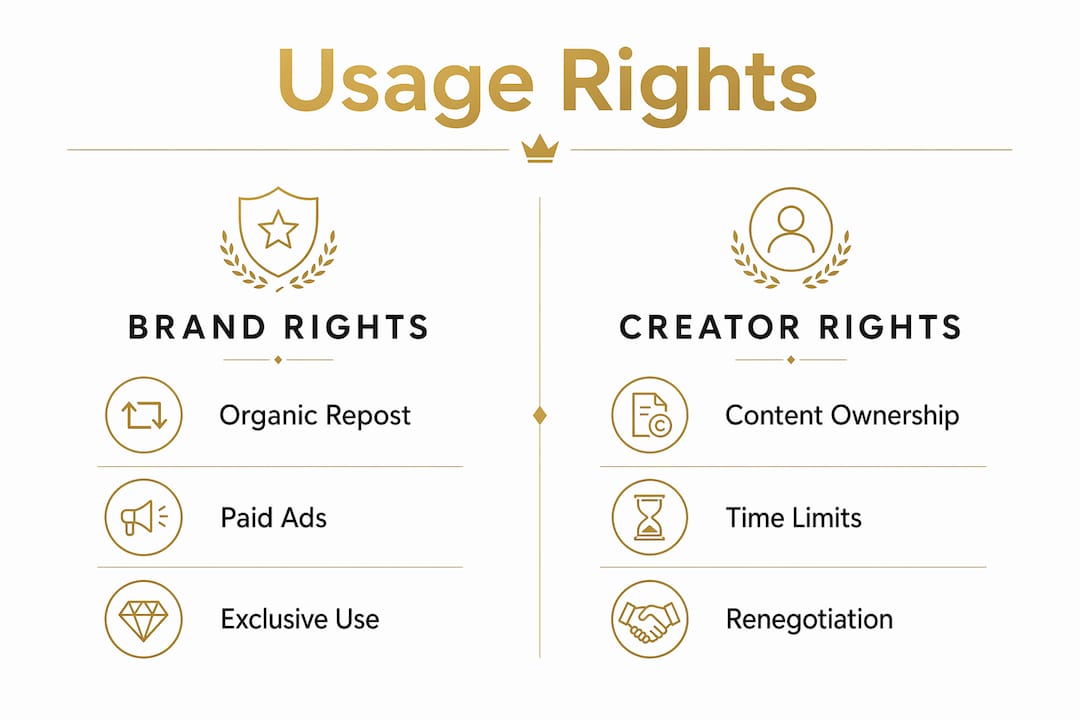
Usage rights function as an economic lever in every negotiation. Your base fee covers the act of creating and posting the content. The license fee covers what the brand does with that content afterward. These are two separate values, and many creators undercharge because they treat them as one.
| Usage type | What it means for you |
|---|---|
| Organic reposts | Brand shares your post on their own channels. Low commercial value, often included in base fee. |
| Paid advertising (whitelisting) | Brand runs paid ads using your content or account. High commercial value; negotiate a separate fee. |
| Derivative use | Brand edits or remixes your content for new assets. Requires explicit permission and additional compensation. |
| Extended duration | Brand uses content beyond the initial agreed period. Each renewal should trigger a new licensing fee. |
| Territory | Brand uses content in markets beyond the original agreement. International use typically commands a premium. |
Pro Tip: When a brand asks for "all rights in perpetuity," that phrase eliminates your ability to ever renegotiate or reclaim the content. Counter with a defined term, such as 12 or 24 months, with an option to renew at a new rate.
Whitelisting deserves special attention. When a brand runs paid ads through your social account, they are borrowing your audience relationship and your credibility. That is worth significantly more than a standard organic post, and brands negotiate usage rights heavily precisely because of that ongoing marketing value.
What are the FTC's disclosure requirements for brand deals?
The Federal Trade Commission requires that any material connection between a creator and a brand be disclosed clearly and conspicuously to the audience. A material connection includes payment, free products, affiliate commissions, and family or business relationships. The 2023 revisions to the FTC Endorsement Guides strengthened these requirements and clarified that platform-native tags like Instagram's "Paid Partnership" label alone are not always sufficient.
What "clear and conspicuous" means in practice:
- Disclosures must appear at the start of a video or audio segment, not buried at the end after the endorsement has already landed.
- In written posts, the disclosure must appear before the "more" or "see more" cutoff, not hidden in a list of hashtags.
- Verbal disclosures in video must be spoken clearly, not mumbled over background music.
- Visual disclosures must be on screen long enough to read, in a font size and color that contrasts with the background.
FTC compliance is often assigned contractually to creators, but that does not eliminate the brand's liability. Both parties can face enforcement action if disclosures are inadequate. The contract should specify the exact disclosure language required, where it must appear, and who is responsible for verifying it.
Operationalizing FTC compliance requires more than a clause in a contract. A creator who includes the required language in their brief but forgets it in the final post is still in violation. The contract clause is the starting point, not the finish line. Podcast creators navigating sponsored content compliance face the same standards, with verbal disclosures required at the point of endorsement, not just in show notes.
How can creators negotiate and protect themselves in a brand deal?
Negotiation is not just about the fee. The terms that protect you most are often the ones brands hope you overlook. Here is a structured approach to reviewing and negotiating any brand deal contract:
- Clarify the deliverables in writing. Every post format, platform, caption requirement, and posting date should be explicit. Vague deliverables give brands room to request additional work without additional pay.
- Define the approval process. Specify the number of revision rounds, who has approval authority, and the maximum turnaround time for feedback. Unclear approval clauses reduce your leverage and can delay payment indefinitely.
- Negotiate a kill fee. A kill fee is compensation paid to you if the brand cancels the campaign after you have started work. A standard kill fee is 25 to 50 percent of the total contract value for work completed.
- Limit exclusivity scope. Brands often request broad exclusivity across an entire product category. Push back with a narrower definition and a shorter duration. "No competing skincare brands for 30 days post-publication" is more reasonable than "no beauty brands for 6 months."
- Tie payment to milestones, not approval. If payment is contingent on brand approval with no deadline, a brand can delay approval indefinitely and withhold payment. Negotiate payment tied to submission plus a defined approval window.
Termination clauses deserve particular scrutiny. "Termination for convenience" means the brand can cancel at any time for any reason. "Termination for cause" means they can only cancel if you breach the contract. The difference is significant. Always negotiate for a cure period, which gives you time to fix an issue before the contract is terminated.
Pro Tip: Request that the contract explicitly states the brand's obligations, not just yours. Brands routinely draft agreements that list every creator obligation in detail while leaving their own responsibilities vague. If the contract doesn't specify when they pay, they decide when they pay.
What are the common types of brand deal contracts?
Legal risk and contract complexity scale with deal size, and the type of contract you sign should match the scope of the partnership.
| Contract type | Typical use case | Key features |
|---|---|---|
| One-off sponsored post | Single post or story for a product launch | Simple deliverables, one payment, short usage window |
| Multi-post campaign | Series of posts over 4 to 12 weeks | Staggered deliverables, milestone payments, defined exclusivity period |
| Brand ambassador agreement | Long-term partnership, 6 to 12 months | Broad exclusivity, recurring fees, content calendar, performance clauses |
| Content licensing agreement | Brand purchases rights to existing or new content | No posting requirement; fee based on usage scope and duration |
| Whitelisting agreement | Brand runs paid ads through creator's account | Access to creator's ad account, separate licensing fee, defined ad spend limits |
For deals under $1,000, a detailed email confirmation covering deliverables, payment, and basic usage rights often suffices. For deals above $5,000, a formal contract reviewed by a lawyer familiar with creator agreements is the standard. Understanding brand partnerships at different scales helps creators recognize which agreement type applies to their situation and what protections to prioritize.
Key takeaways
A brand deal contract is the single document that determines whether a sponsorship protects or exposes you, making every clause worth reading before you sign.
| Point | Details |
|---|---|
| Contract as official record | The signed contract overrides all prior emails and verbal agreements; review it against your brief before signing. |
| Usage rights carry separate value | Licensing fees for paid ads and extended use are distinct from your base creation fee; negotiate them separately. |
| FTC disclosures are your legal responsibility | Platform tags alone are often insufficient; contracts must specify exact disclosure language and placement. |
| Kill fees protect completed work | Always negotiate a kill fee of 25 to 50 percent to cover work done if a brand cancels the campaign. |
| Contract type should match deal size | Email agreements work for small deals; formal multi-page contracts are required for high-value or long-term partnerships. |
Why most creators sign contracts that don't actually protect them
After working with creators across dozens of brand partnerships, the pattern I see most often is not that creators get bad deals. It's that they sign contracts they haven't fully read, then discover the problem six weeks later when a brand runs their content in paid ads they never agreed to, or withholds payment because "approval is still pending."
The contracts themselves are rarely malicious. They're drafted by brand legal teams to protect the brand, which is exactly what legal teams are supposed to do. The problem is that creators treat contract review as a formality rather than a negotiation. They're excited about the deal, they don't want to seem difficult, and they sign.
What I've found actually works is treating the contract review as part of the creative brief process. Read the usage rights clause the same way you read the content brief. If the brand wants whitelisting rights, that's a separate line item on your rate card, not a bonus they get for free. If the exclusivity clause covers "all wellness brands" for six months, that's potentially thousands of dollars in lost revenue. Price it accordingly or narrow the definition.
The influencer contract templates that Blackx provides are a useful baseline for understanding what a fair agreement looks like before you receive a brand's version. Knowing the standard makes it much easier to spot what's missing or one-sided in the document sitting in your inbox.
FTC enforcement is also not going away. The 2023 updates to the Endorsement Guides made clear that the FTC is watching, and the responsibility lands on creators first. A contract clause that assigns disclosure duties to you is not protection. It's confirmation that you accepted the obligation. Build disclosure into your content workflow, not just your contract.
— Brian
How Blackx helps creators manage brand deal contracts

Blackx is built specifically for the creator economy as the contract intelligence layer between creators and brands. The platform gives you the tools to manage deliverables, track usage rights, and secure payment without needing a lawyer on retainer for every deal.
With Blackx, creators get deal infrastructure built for them, including contract templates, approval workflows, and payment milestone tracking that keeps both parties accountable. Usage rights are documented clearly so there's no ambiguity about what the brand can do with your content and for how long. If you're ready to stop signing contracts you don't fully understand and start negotiating from a position of clarity, Blackx is where that starts.
FAQ
What is a brand deal contract in simple terms?
A brand deal contract is a written agreement between a creator and a brand that defines what content you create, how much you get paid, and what rights the brand has to use your content. It is the legally enforceable record of your sponsorship deal.
Do I need a formal contract for every brand deal?
Not always. Small, low-value deals can be handled with a detailed email confirmation covering deliverables, payment, and usage rights. For deals above $5,000 or any partnership involving exclusivity or paid media rights, a formal contract is the standard.
What happens if a brand cancels a brand deal contract?
The outcome depends on the termination clause. If you negotiated a kill fee, you receive a percentage of the contract value for work already completed. Without a kill fee clause, you may receive nothing for work done before cancellation.
Are platform "Paid Partnership" tags enough for FTC compliance?
No. The FTC's 2023 Endorsement Guides clarify that platform tags alone are often insufficient. Disclosures must be clear, conspicuous, and placed before the audience encounters the endorsement, whether in captions, video intros, or spoken audio.
What are usage rights in a brand deal contract?
Usage rights define the scope of the brand's license to use your content after posting, including which platforms, for how long, in which territories, and whether they can run it as paid advertising. These rights carry separate economic value from your base creation fee and should be negotiated and priced independently.