
A creator exclusivity window is a contractual restriction that prevents a creator from promoting competing brands or products for a defined period after publishing sponsored content. These clauses appear in nearly every brand deal today, and exclusivity scope and duration vary widely depending on the brand, category, and negotiation. Understanding what is a creator exclusivity window matters because the terms you accept directly determine how much revenue you can earn during that period. A poorly negotiated clause can quietly cost you tens of thousands of dollars across a year. Blackx, the contract intelligence layer for the creator economy, breaks down exactly how these windows work and how to negotiate them in your favor.
What is a creator exclusivity window and how does it work?
A creator exclusivity window is defined as a time-bound contractual clause that restricts a creator from working with competing brands within a specified category. The restriction typically activates after a piece of sponsored content goes live, though the exact start date is one of the most negotiated points in any deal. Exclusivity clauses should always be narrowly tailored to avoid suppressing creator income beyond what the brand legitimately needs.
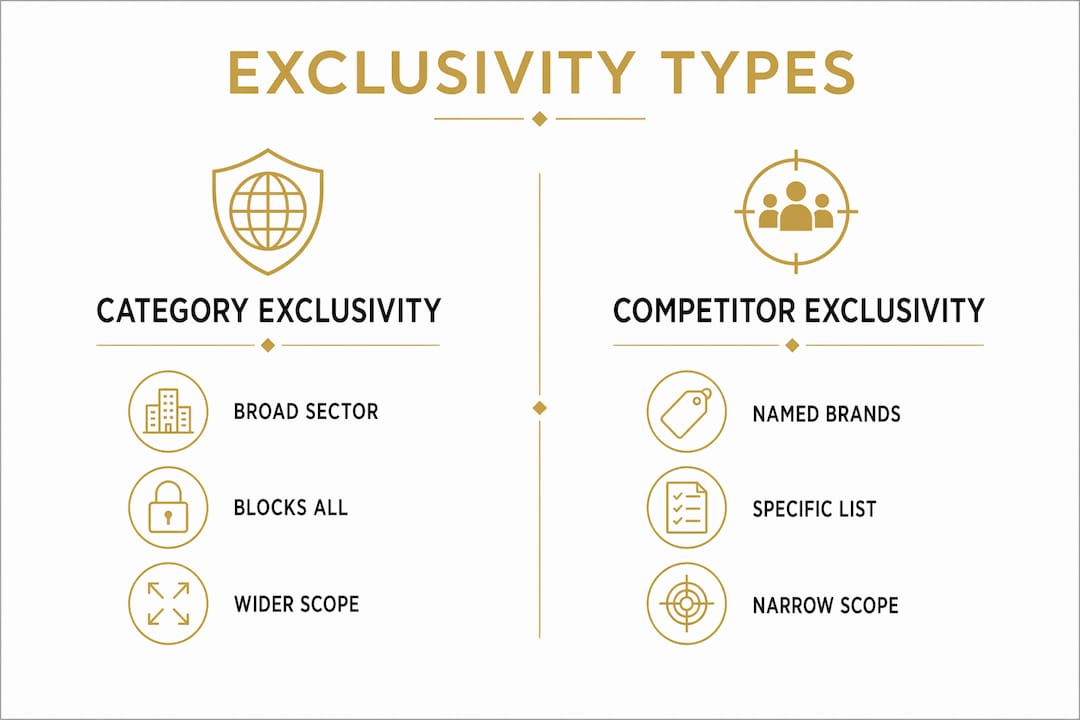
Two types of exclusivity exist in most deals. Category exclusivity bars you from working with any brand in a broad sector, such as "personal finance" or "fitness supplements." Competitor exclusivity is narrower, restricting only named direct competitors. The difference matters enormously. A finance creator locked into category exclusivity cannot work with any fintech, brokerage, or budgeting app during the window. A creator under competitor exclusivity might only be blocked from one or two specific brands.

The three variables that define any exclusivity window are scope, duration, and start date. Each one affects your earnings differently, and each one is negotiable. Most creators focus only on the fee and overlook all three. That is where the real money is lost.
How scope and duration shape your restrictions and revenue
Duration norms in the creator economy have settled into a recognizable range. Most exclusivity clauses run 14 to 30 days for standard deals, with 60-day windows reserved for high-budget campaigns that carry proportionally higher fees. A 60-day window is considered restrictive by most industry standards and should trigger a significant compensation premium.
The scope of the exclusivity clause does more damage to your earnings than duration alone. A broad category definition can block you from three, four, or five potential deals simultaneously, even if the window is only 14 days. A narrow competitor list limits the blast radius. When you negotiate, narrowing the competitor definition is the single highest-leverage move you can make before touching duration or start date.
Here is how common durations compare in terms of creator impact:
| Duration | Industry norm | Compensation expectation | Typical earnings risk |
|---|---|---|---|
| 14 days | Standard, widely accepted | Base rate | Low if category is narrow |
| 30 days | Common, negotiable | Base rate + 10–20% | Moderate to high |
| 60 days | Restrictive | Base rate + 30–40% | High, especially in active niches |
| 90+ days | Rare, high-value campaigns | Significant premium required | Very high |
Pro Tip: Ask the brand to replace "personal finance category" with a named list of three to five specific competitors. This single change can preserve multiple deal slots on your calendar without reducing the brand's actual protection.
How the start date affects your earnings and contract fairness
The start date of an exclusivity window is the most overlooked variable in creator contracts. Exclusivity starting at signing rather than at publication means you burn through your restricted period while the content is still in production, review, or revision cycles. A 30-day window that starts at signing and takes 10 days to publish leaves you with only 20 days of actual post-live protection for the brand, but you have already lost 10 days of earning potential.
The financial consequence is direct. If a brand deal takes two weeks from signing to publication, and your exclusivity window is 30 days starting at signing, you effectively have a 16-day post-live window. You lose two weeks of deal availability for free. Negotiators consistently recommend pushing the start date to publication for exactly this reason. It aligns the brand's actual protection period with the creator's actual restriction period.
Here is what to push for in any exclusivity clause:
- Start at publication, not signing. This is the most creator-favorable position and is increasingly accepted by brands.
- Define publication clearly. Specify the exact platform and URL to avoid ambiguity about when the clock starts.
- Cap revision cycles separately. If the brand has unlimited revision requests, your pre-publication period can stretch indefinitely, which compounds the start-date problem.
- Request written confirmation of the go-live date. This protects you if a brand delays publication after you have already turned down other deals.
Pro Tip: When a brand resists moving the start date to publication, offer a compromise: start the clock at "content approval" rather than "signing." This cuts the pre-publication dead zone significantly without requiring the brand to accept full publication-date risk.
Exclusive vs. non-exclusive partnerships: benefits and trade-offs
Exclusive partnerships give a brand the right to be the only sponsor in their category on your channel during the window. Non-exclusive partnerships carry no such restriction. The distinction sounds simple, but the financial and strategic implications run deep.
Exclusive deals require 20 to 40% higher fees than non-exclusive ones because they limit your future earning potential. That premium is not a bonus. It is compensation for real opportunity cost. If you accept an exclusive deal at a non-exclusive rate, you are subsidizing the brand's competitive protection out of your own pocket.
| Factor | Exclusive partnership | Non-exclusive partnership |
|---|---|---|
| Fee premium | 20–40% above base rate | Base rate |
| Competing deals | Blocked during window | Permitted |
| Brand value | Higher perceived value | Standard |
| Creator risk | High if category is broad | Low |
| Best for | High-budget, flagship campaigns | Ongoing, multi-brand strategies |
Exclusivity makes sense when the deal fee is large enough to offset the deals you will decline, the window is short and narrowly scoped, and the brand relationship has long-term value. Non-exclusive deals make more sense for creators with active sponsorship pipelines, especially those in high-demand niches like personal finance, software, or health where multiple brands compete for the same audience.
The hidden cost of exclusivity is not just the deals you turn down. It is the deals you never get offered because brands see your calendar as blocked and move on. Exclusivity functions as an opportunity shutoff that can block multiple deals simultaneously when category definitions are broad.
Practical negotiation strategies to maximize value and minimize lost opportunities
Treating exclusivity as a standard clause rather than a negotiation item is the most expensive mistake creators make. Exclusivity is commercially valuable precisely because it limits your future options. That value belongs to you as much as it belongs to the brand.
Follow this sequence when reviewing any exclusivity clause:
- Identify the scope first. Is this category exclusivity or competitor exclusivity? If it is category-based, request a named competitor list instead.
- Check the duration. Anything over 30 days requires a fee premium. Anything over 60 days requires a significant one.
- Confirm the start date. Push for publication date. If the brand resists, negotiate for content approval date.
- Map it to your content calendar. Block out the window and count how many deals it displaces. That number is your minimum negotiation floor.
- Price the exclusivity separately. Quote your base rate for the content, then add an explicit exclusivity fee as a line item. This makes the cost visible to both sides.
- Request a named-competitor list in writing. Vague category language creates disputes later. Named competitors eliminate ambiguity.
For deals above a certain value threshold, a legal review of the exclusivity clause is worth the cost. Exclusivity clauses combine multiple hidden costs beyond the flat fee, including category breadth, start date timing, and potential renewal clauses that extend restrictions without additional compensation.
Pro Tip: Build a simple spreadsheet that maps every active exclusivity window against your publishing schedule. When a new deal arrives, you can immediately see conflicts and price them into your counter-offer rather than discovering them after you have already committed.
Real-world impact of exclusivity windows on creator monetization
The financial consequences of a poorly negotiated exclusivity window are not theoretical. A finance creator with an active sponsorship pipeline can lose $9,000 or more from a single 30-day exclusivity window if the category definition is broad enough to block three or four concurrent deals worth $3,000 to $8,000 each.
The impact compounds across a year. Consider these scenarios:
- A creator who accepts four 30-day exclusive deals per year with broad category definitions effectively blocks their calendar for four months out of twelve.
- A creator in the software niche who accepts "SaaS tools" as their exclusivity category cannot work with productivity apps, project management tools, or CRM platforms during the window, even if none of those brands compete directly with the sponsor.
- A creator who maps exclusivity windows against their content schedule discovers that two overlapping windows from different brands can create a combined blackout period of 45 to 60 days.
Creators must map exclusivity windows against their content schedules before signing, not after. The content calendar is the financial model. Exclusivity windows are the constraints that shape it. Treating them as an afterthought is the equivalent of signing a lease without reading the termination clause.
Key takeaways
A creator exclusivity window costs you real money when scope, duration, and start date are left unaddressed. Negotiate all three as separate line items, not as a package concession.
| Point | Details |
|---|---|
| Scope is the biggest lever | Narrow category definitions to named competitors to protect your deal pipeline. |
| Duration drives compensation | Windows beyond 30 days require a 20 to 40% fee premium to be financially fair. |
| Start date matters as much as length | Push for publication-date start to avoid burning exclusivity time pre-launch. |
| Price exclusivity separately | Quote a base content fee plus an explicit exclusivity fee to make the cost visible. |
| Map windows to your calendar | Identify deal conflicts before signing, not after, to negotiate from a position of clarity. |
Why most creators negotiate exclusivity backwards
Most creators I have worked with approach exclusivity negotiation in the wrong order. They push back on duration first because it is the most visible number in the clause. Thirty days feels long, so they ask for fourteen. The brand agrees, and both sides feel like a deal was made. But the category definition never changed. The start date never changed. The creator accepted a shorter window with the same broad scope and the same pre-publication dead zone. They saved nothing meaningful.
The order matters. Narrowing the competitor scope first is the move that protects the most revenue. Duration reduction is second. Start date adjustment is third. Most creators reverse this entirely, which is why they keep leaving money on the table even when they think they are negotiating well.
The other pattern I see constantly is creators treating exclusivity as a binary. Either they accept it or they refuse it. The reality is that exclusivity is a spectrum. You can accept exclusivity for named competitors only, for 14 days, starting at publication, with a 25% premium. That is a completely different deal from "30-day category exclusivity starting at signing." Both are called exclusivity. Only one is fair.
Proactively managing your sponsorship calendar is not optional at the level where exclusivity clauses start appearing. It is the job. Blackx was built specifically to give creators the infrastructure to track these windows, flag conflicts, and enter negotiations with full visibility into what they are actually agreeing to.
— Brian
How Blackx helps you manage exclusivity with clarity
Exclusivity windows are only a problem when you cannot see them clearly. Blackx gives creators the deal infrastructure to track every active exclusivity clause, map windows against their content calendar, and enter brand negotiations with full visibility into what each clause actually costs. The platform surfaces scope, duration, and start date as separate data points so nothing gets buried in contract language.
For digital marketers managing creator rosters, Blackx provides the same clarity at scale. Every brand partnership on the platform includes structured exclusivity fields so both sides know exactly what is restricted, for how long, and when the window opens again. No surprises. No disputes. No lost deals from calendar conflicts that could have been caught before signing. If you are serious about protecting your revenue from exclusivity clauses, see how it works and start treating your deal terms as the financial infrastructure they actually are.
FAQ
What is a creator exclusivity window?
A creator exclusivity window is a contractual clause that prevents a creator from promoting competing brands within a defined category for a set period after publishing sponsored content. The three key variables are scope, duration, and start date.
How long is an exclusivity window typically?
Most exclusivity windows run 14 to 30 days for standard brand deals. Windows of 60 days or more are considered restrictive and require proportionally higher compensation to be financially fair to the creator.
What is the difference between category and competitor exclusivity?
Category exclusivity blocks all brands in a broad sector, such as "fintech" or "fitness." Competitor exclusivity restricts only named direct competitors. Competitor exclusivity is significantly less damaging to creator earnings because it preserves more deal opportunities.
Should exclusivity start at signing or publication?
Exclusivity should start at publication, not at contract signing. Starting at signing wastes the creator's restricted period during production and revision cycles, effectively giving the brand free protection time at the creator's expense.
How much extra should you charge for an exclusive deal?
Exclusive partnerships typically require a 20 to 40% fee premium above the base content rate to compensate for the future earning potential the creator gives up during the window.