
A creator legal entity is a formal business structure that legally separates your personal assets from the liabilities of your creative work. Without one, every brand deal gone wrong, every copyright dispute, and every contract breach lands directly on your personal bank account, your car, your home. The creator economy is maturing fast. In 2026, brands increasingly require registered entities for deals above $5,000 to $10,000, and new legislation in markets like India is formalizing creators' professional status globally. If you earn money from content, freelance work, or digital products, understanding your legal structure is not optional. It is the foundation of every smart business decision you will make.
What is a creator legal entity and which type fits your business?
A creator legal entity is the legal wrapper around your creative business. It defines how you pay taxes, how you get sued, and how you own your intellectual property. The four structures most relevant to creators are sole proprietorships, single-member LLCs, multi-member LLCs, and S-corporations.
Sole proprietorship is the default. You start creating, you start earning, and legally you are the business. There is no separation between you and your revenue. Creators operating as sole proprietors pay full self-employment tax on all income with zero liability protection. Every dollar you earn is exposed.
Single-member LLC is the most common upgrade. The IRS treats it as a "disregarded entity," meaning it files taxes on your personal return by default, but your personal assets are legally separated from business debts and lawsuits. Formation costs vary by state, and California charges an $800 annual LLC fee regardless of revenue. That cost is real, but the protection is worth it for most working creators.

Multi-member LLC works when two or more creators collaborate. It defaults to partnership taxation, meaning profits and losses pass through to each member's personal return. Operating agreements become critical here to define ownership splits, decision rights, and exit terms.
S-corporation election is a tax strategy layered on top of an LLC or corporation. It splits your income into a salary and a distribution, reducing the portion subject to self-employment tax. The math works best when your net income crosses roughly $100,000, and the added complexity of payroll and separate filings must be weighed against the savings.
| Entity type | Tax treatment | Liability protection | Administrative complexity |
|---|---|---|---|
| Sole proprietorship | Personal income tax, full SE tax | None | Minimal |
| Single-member LLC | Disregarded entity (personal return) | Yes | Low |
| Multi-member LLC | Partnership pass-through | Yes | Moderate |
| S-corporation | Salary + distribution split | Yes | High |
| C-corporation | Corporate tax rate | Yes | Very high |
C-corporations are rarely the right starting point for individual creators. The double taxation on dividends and the compliance overhead make them a tool for later-stage businesses raising institutional capital.
How does a legal entity protect your personal assets as a creator?
Operating without a formal entity exposes creators to personal liability from defamation claims, copyright infringement suits, and breach of contract disputes. Your savings account, your car, and any property you own are all fair game in a judgment.
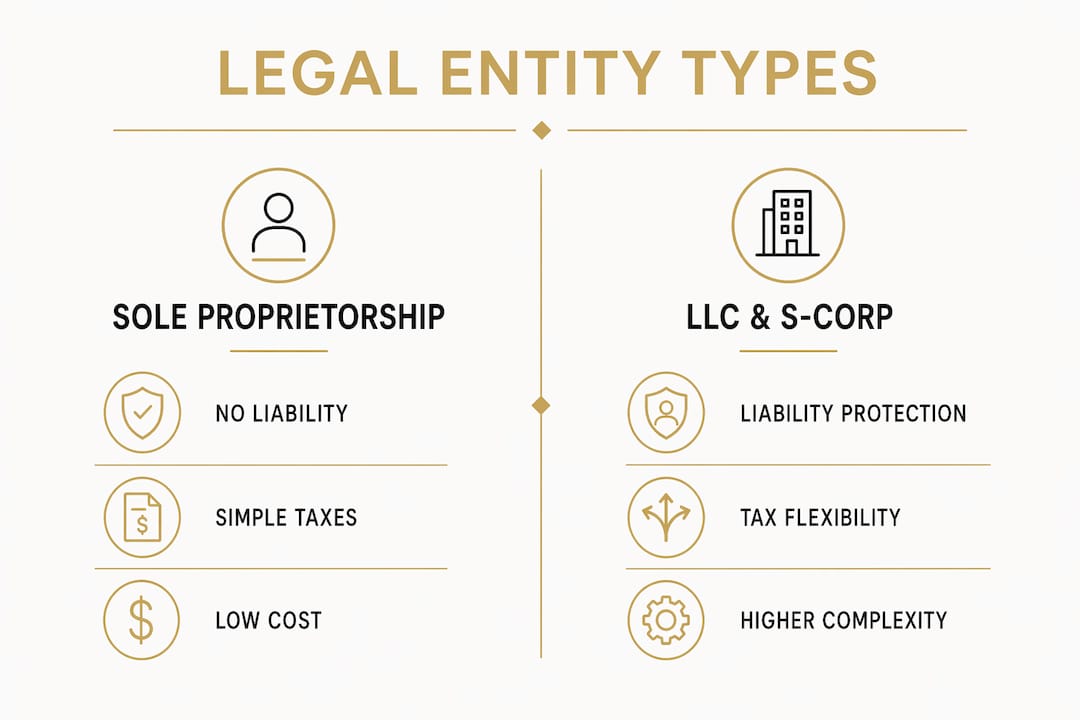
A legal entity draws a hard line. When your LLC signs a brand deal, the LLC is the contracting party. If the deal collapses and the brand sues, the lawsuit targets the LLC's assets, not yours personally. This protection only holds if you maintain what lawyers call the "corporate veil." That means keeping separate bank accounts, not mixing personal and business expenses, and signing contracts in the entity's name.
Beyond protection, a registered entity signals professionalism. Brands and agencies treat LLCs differently than they treat individuals. You get taken more seriously in negotiations, your contracts are cleaner, and your platform accounts and intellectual property can be held in the entity's name from day one.
- Hold all platform accounts (YouTube, TikTok, Patreon) under the entity's name where possible
- Register trademarks and copyrights in the entity's name, not your personal name
- Sign every brand deal, affiliate agreement, and licensing contract through the entity
- Open a dedicated business bank account immediately after formation
Pro Tip: Form your legal entity before you register platform accounts or sign your first major brand deal. Transferring accounts and contracts after the fact is messy and sometimes impossible.
What are the tax implications for creators in 2026?
Tax strategy is where entity choice pays off most directly, and where most creators leave money on the table. The default single-member LLC files on Schedule C of your personal return. You pay income tax plus a 15.3% self-employment tax on net profit. That SE tax covers Social Security and Medicare, and it applies to every dollar of profit.
The S-corp election changes that math. You pay yourself a reasonable salary, which is subject to payroll taxes. Profit above that salary flows to you as a distribution, which is not subject to SE tax. S-corp election becomes cost-effective around $100,000 net income in high-tax states. Below that threshold, the cost of payroll processing and additional filings often exceeds the tax savings.
State-level costs matter too. California's $800 annual LLC minimum franchise tax applies even if your LLC earns nothing. New York has its own publication requirements and fees. These are not reasons to avoid forming an entity. They are reasons to factor real compliance costs into your financial planning.
| Tax factor | Sole proprietorship | Single-member LLC | S-corporation |
|---|---|---|---|
| Self-employment tax | Full 15.3% on profit | Full 15.3% on profit | Only on salary portion |
| Filing complexity | Schedule C | Schedule C | Separate 1120-S return |
| Payroll required | No | No | Yes |
| State fees | None | Varies ($0 to $800+) | Varies |
| Best income range | Under $40K | $40K to $100K | $100K+ |
Quarterly estimated tax payments are non-negotiable for creators. The IRS expects payments in April, June, September, and January. Creators frequently underestimate their tax obligations and get hit with underpayment penalties. Set aside 25% to 30% of every payment you receive.
Pro Tip: Work with a CPA who has experience in the creator economy specifically. Generic small-business tax advice often misses deductions unique to content creation, like home studio costs, equipment, and software subscriptions.
How can creators use multiple entities to protect their IP?
Most creators start with one LLC and treat it like a legal junk drawer. Everything goes in: the YouTube channel, the merchandise brand, the online course, the podcast. That structure works until it does not. One lawsuit against any part of the business can threaten all of it.
A single operating company holding all assets risks losing everything in litigation. The solution is entity architecture: separating what you own from what you operate.
The holding company model works like this. A parent LLC owns the intellectual property, trademarks, and copyrights. It licenses those assets to one or more operating LLCs that run the day-to-day business. If an operating LLC gets sued, the IP sitting in the holding company is insulated.
- A gaming commentary channel with controversial content operates in its own LLC, separate from a family-friendly cooking brand
- An online course platform and its associated software are held in an IP LLC, licensed to the operating business
- Merchandise and physical product sales sit in a separate entity from the content creation business
Entities that combine IP holding and operating companies create tax advantages too. Royalty payments from the operating LLC to the IP holding company can be structured to minimize overall tax exposure. This is advanced territory that requires a business attorney and a CPA working together, but for creators generating $250,000 or more annually, the savings justify the setup cost.
What emerging legal clauses should creators watch in 2026?
The license grant in any brand deal is the most consequential section most creators never read carefully. It defines exactly what rights you are handing over. Exclusive, worldwide, sublicensable, and irrevocable terms determine how much control you surrender over your own content. An irrevocable license means the brand can use your content forever, even after the deal ends, and you cannot take it back.
AI clauses have become critical in 2026 contracts. Brands are now inserting language that grants them rights to use your likeness, voice, and content to train AI models or generate synthetic versions of you. These clauses can be perpetual and sublicensable, meaning the brand can sell that right to third parties. Creators need explicit limits and separate compensation terms for any AI-related use.
- Identify every clause that grants rights to your likeness, voice, or content for AI training
- Negotiate time limits on AI use rights, even if the brand pushes back
- Require separate compensation for AI-generated content that uses your identity
- Hold all contracts in your entity's name so the entity, not you personally, is the licensor
Treating your legal structure as decision infrastructure rather than a compliance checkbox changes how you negotiate. When your IP sits in a holding company and your operating LLC signs the deal, you have natural leverage. The brand cannot reach your core assets. That clarity also makes it easier to say no to bad terms.
Pro Tip: Review your entity structure and contract templates at least once a year. As your revenue grows and your content expands into new categories, your legal architecture needs to grow with it.
Key takeaways
A creator legal entity is the single most important infrastructure decision a content creator makes, because it determines personal risk exposure, tax efficiency, and negotiating power across every deal.
| Point | Details |
|---|---|
| Entity type determines risk | Sole proprietors have zero liability protection; a single-member LLC is the minimum viable structure for working creators. |
| S-corp election saves taxes | The S-corp election reduces self-employment tax but only makes financial sense above roughly $100,000 in net income. |
| IP separation protects assets | Holding IP in a separate LLC from your operating business insulates trademarks and copyrights from operational lawsuits. |
| AI clauses require negotiation | Brand contracts in 2026 increasingly include AI training rights; creators must negotiate explicit limits and separate compensation. |
| Entity is decision infrastructure | Strategic entity management improves capital access, deal terms, and long-term scalability. |
Why most creators get this backwards
I have reviewed hundreds of creator contracts and spoken with creators at every income level, from $30,000 a year to well past $1 million. The pattern is consistent. Creators treat entity formation as something they will get to eventually, after the brand deals start coming in, after the audience grows, after things feel more "official." That is exactly backwards.
The creators who get hurt are not the ones who made bad content. They are the ones who signed a brand deal as an individual, got into a dispute, and discovered their personal savings were on the table. Or they signed a contract with an irrevocable worldwide license because they did not have a legal structure that made them feel like a real business, so they did not negotiate.
Forming an LLC does not make you a bureaucrat. It makes you a business owner. That shift in identity changes how you show up in negotiations, how brands perceive you, and how you make decisions about what deals to take. The reality of being a creator in 2026 is that the business side is no longer optional. Platforms change, algorithms shift, but a well-structured business survives all of it.
Entity choice is a strategic decision based on capital needs, tax priorities, and ownership complexity. Treat it that way. Revisit it every year. The creators who build lasting businesses are the ones who take their legal architecture as seriously as their content.
— Brian
How Blackx helps creators manage deal infrastructure

Blackx is the contract intelligence layer built specifically for the creator economy. When you are managing brand deals, licensing agreements, and AI clauses across multiple entities, the complexity compounds fast. Blackx gives creators a single place to track deal terms, flag risky contract language, and maintain clarity across every partnership. The platform is built for creators who treat their business like a business, not a hobby. If you are ready to protect your work and negotiate from a position of strength, explore what Blackx offers creators and see how deal infrastructure changes the way you operate.
FAQ
What is a creator legal entity?
A creator legal entity is a formal business structure, such as an LLC or S-corporation, that legally separates a creator's personal assets from their business liabilities. It provides liability protection, tax planning options, and a professional foundation for contracts and brand deals.
Do content creators really need an LLC?
Many brands now require a registered entity for deals above $5,000 to $10,000, and operating without one exposes your personal assets to lawsuits from defamation, copyright, or contract disputes. An LLC is the minimum recommended structure for any creator earning consistent income.
When should a creator elect S-corp status?
S-corp election becomes cost-effective at roughly $100,000 in net annual income, where the self-employment tax savings on distributions exceed the added cost of payroll processing and separate tax filings.
What is a creator legal clause in a brand deal?
A creator legal clause defines the rights a brand receives over your content, including license scope, duration, and exclusivity. In 2026, AI-related clauses that grant rights to your likeness or voice for synthetic content have become a critical area to review and negotiate before signing.
Can a creator have more than one LLC?
Yes, and for creators with significant intellectual property or multiple content brands, a holding company structure with separate operating LLCs is a proven method to isolate risk and protect core assets from operational lawsuits.