
Content contracts are legally binding agreements that define deliverables, ownership, usage rights, and obligations between brands and creators, making them the primary mechanism for protecting brand assets in any creator partnership. Without a signed contract, a brand's control over its image, messaging, and content ends the moment a creator hits publish. Brand managers who treat contracts as optional paperwork are leaving their most valuable assets unprotected. The FTC, the IAB, and courts across the country have all reinforced one consistent truth: written agreements govern outcomes, and informal conversations do not.
Why content contracts protect brands from asset misuse
The most direct answer to why content contracts protect brands is this: they define exactly who owns what, for how long, and under what conditions. Creator contracts cover deliverables, usage rights, exclusivity, approvals, cancellation, and liability. That scope matters because a single campaign post can become a billboard, a paid social ad, or a competitor's testimonial if usage rights are left undefined.

Downstream usage rights are the most critical brand protections in any content agreement. IP grants and exclusivity windows determine whether a brand can repurpose assets across time zones, territories, and platforms. A contract that says "brand may use content for six months in North America" is categorically different from one that says "brand may use content in perpetuity worldwide." Most disputes between brands and creators trace back to this exact ambiguity.
Contracts also prevent scope creep, which is the quiet erosion of campaign boundaries that happens when terms are vague. Specific clauses that brands must include are:
- Usage rights: Platform, format, and duration of permitted content use
- Exclusivity windows: Category and post-campaign holdout periods that prevent creators from working with direct competitors
- Territory limits: Geographic boundaries on where content can be distributed
- Paid amplification: Whether the brand can boost or whitelist creator content in paid media
- License type: Exclusive vs. non-exclusive, and whether sublicensing is permitted
Exclusivity clauses require precise language. A clause that blocks a creator from working with "similar brands" for 90 days after a campaign protects brand messaging during a product launch. A clause that is too broad can expose the brand to legal challenges from the creator. Precision protects both parties, but it protects the brand first.
Pro Tip: Read every IP grant clause before signing. The grant defines what the brand actually owns. If it only covers the initial post and not derivatives, the brand cannot legally run that content as a paid ad without renegotiating.
How FTC disclosure requirements in contracts safeguard brand reputation
The FTC requires that any material connection between a brand and a creator be disclosed in a way that is clear and conspicuous, meaning the disclosure must appear within the post itself, not buried in a caption, hidden behind a "more" button, or placed on a separate page. This is not optional guidance. It is an enforceable standard, and brands bear liability when creators fail to comply.
A material connection includes any of the following:
- Paid partnerships: Direct monetary compensation for content creation or promotion
- Gifted products: Free products, services, or experiences provided in exchange for coverage
- Affiliate relationships: Commission-based arrangements tied to sales or clicks
- Employment or ownership: Creator has a financial stake in the brand being promoted
- Family or personal relationships: Creator promotes a brand owned by a close associate
Embedding disclosure obligations directly into a content contract converts an FTC requirement into an enforceable contractual term. If a creator publishes content without the required "#ad" or "Paid partnership" label, the brand has both a regulatory defense and a contractual remedy. Without a contract, the brand has neither.
The reputational stakes are significant. Consumers who discover undisclosed paid promotions report sharply lower trust in both the creator and the brand. A contract that mandates disclosure placement, language, and timing removes ambiguity and protects the brand from being associated with deceptive practices, even when the creator makes the error.
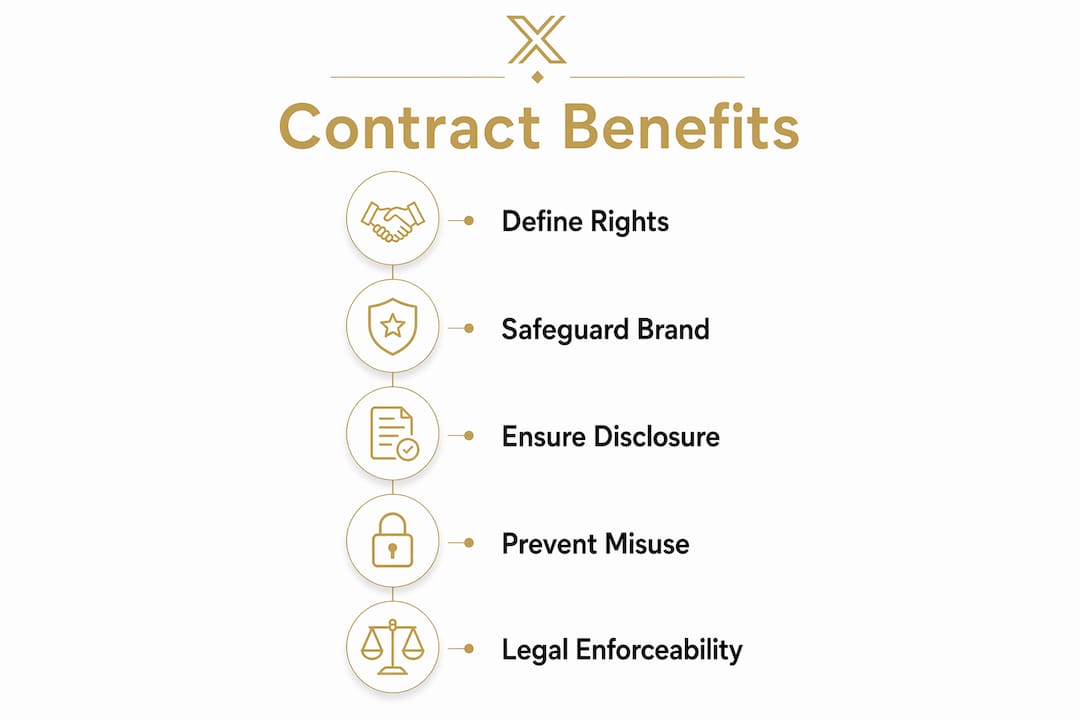
Pro Tip: Embed disclosure clauses that mirror FTC language exactly. Specify where the disclosure must appear, what it must say, and what happens contractually if the creator fails to include it. Vague disclosure clauses are nearly as risky as no clause at all.
What AI transparency frameworks mean for content contracts in 2026
The IAB's 2026 AI Transparency and Disclosure Framework establishes that AI disclosure is required only when AI materially risks misleading consumers. This materiality and risk-based approach is a significant shift from blanket disclosure mandates. It means brands need contracts that define when AI use crosses the threshold into required disclosure territory, and who bears responsibility for making that call.
The IAB advises that AI disclosure triggers should activate only when AI materially affects the authenticity of content, not simply because AI tools were used in production. A creator using AI to generate a background image faces different obligations than one using AI to synthesize a voice or fabricate a product demonstration. Contracts must now define these distinctions explicitly.
Practically, this means adding clauses that address:
- AI use definitions: What counts as AI-generated versus AI-assisted content in the context of the campaign
- Disclosure triggers: Specific conditions under which the creator must disclose AI involvement
- Approval rights: Whether the brand must approve AI-generated elements before publication
- Proof of origin: Documentation requirements that establish content creation records for downstream use
Contracts that embed AI governance rules assign asset owners and written disclosure obligations, which mitigates risk in AI and content reuse workflows. This is not just a legal precaution. It is a consumer trust strategy. Brands that can demonstrate documented AI governance are better positioned when regulators or journalists start asking questions.
The comparison below shows how traditional disclosure clauses differ from AI-specific transparency terms:
| Clause type | Traditional disclosure | AI-specific transparency |
|---|---|---|
| Trigger condition | Material connection (paid, gifted) | AI materially affects authenticity |
| Disclosure placement | Within the post, clear and conspicuous | Platform-appropriate, context-specific |
| Responsibility | Creator discloses; brand verifies | Contract assigns responsibility explicitly |
| Documentation | Campaign brief and signed contract | Asset chain records with AI use logs |
| Regulatory standard | FTC endorsement guidelines | IAB 2026 AI Transparency Framework |
Pro Tip: Align contract language with the IAB's materiality standard now, before regulators formalize requirements. Brands that build AI disclosure into contracts today will face far less friction when compliance becomes mandatory.
How contracts protect brands from disputes through legal enforceability
Signed contracts carry a legal weight that no email thread, Slack message, or verbal agreement can match. Under the parol evidence rule, courts treat the signed written agreement as the final and authoritative record of the parties' intentions. Prior emails, earlier drafts, and verbal assurances are inadmissible to contradict the contract's terms. For brand managers, this means the contract is not just a formality. It is the only document that will matter in a dispute.
Brand approvals given informally lack legal enforceability compared to signed contract terms. A creator who claims the brand verbally approved a content change has no legal standing if the contract requires written approval for all revisions. This protection is only available when the contract is specific enough to cover approval workflows, not just deliverables.
Key contract terms that reduce dispute risk include:
- Kill fees: Guaranteed payment to the creator if the brand cancels without cause, which protects both parties and prevents bad-faith cancellations
- Indemnification clauses: Specify which party bears liability for third-party claims arising from the content
- Approval workflows: Define who approves content, in what format, and within what timeframe
- Revision limits: Cap the number of revision rounds to prevent indefinite scope expansion
- Termination conditions: Spell out what constitutes a breach and what remedies are available
The enforceability of content contracts also extends to usage rights disputes. If a creator later claims the brand used content outside the agreed license, the contract is the definitive record. Without it, the brand is arguing its case with screenshots and memory. With it, the brand has a signed document that courts will uphold.
Key takeaways
Content contracts protect brands by converting informal expectations into legally enforceable terms that govern rights, disclosures, and dispute resolution across the full lifecycle of a creator partnership.
| Point | Details |
|---|---|
| Define usage rights precisely | Specify platform, territory, duration, and amplification permissions to prevent unauthorized content use. |
| Embed FTC disclosure obligations | Contractual disclosure terms give brands both a regulatory defense and a legal remedy if creators fail to comply. |
| Incorporate AI transparency clauses | Align with the IAB 2026 framework by defining AI use triggers and assigning disclosure responsibility in writing. |
| Rely on signed contracts in disputes | The parol evidence rule makes the signed contract the only enforceable record; verbal approvals have no legal standing. |
| Include kill fees and indemnification | Financial and liability protections in contracts prevent brands from absorbing costs from bad-faith cancellations or third-party claims. |
The contract is the strategy, not the paperwork
Most brand managers I have worked with treat the contract as the last step before a campaign goes live. That instinct is exactly backward. The contract is where brand strategy gets encoded into law. Every vague term in a brief becomes a liability the moment a creator interprets it differently than you intended.
The brands that get burned are not the ones that skip contracts entirely. They are the ones that use template agreements that were not written for the creator economy. A standard vendor contract does not account for exclusivity holdout periods, whitelisting rights, or AI-generated content. Those gaps are where disputes live.
What I have seen work consistently is treating the contract negotiation as a creative brief review. Every deliverable, every approval step, every disclosure requirement gets pressure-tested against the question: what happens if this goes wrong? Kill fees, indemnification language, and revision caps are not pessimistic additions. They are the difference between a campaign that ends cleanly and one that ends in a legal dispute.
The brands that build contract review into their creator workflows before the first brief goes out are the ones that scale creator programs without accumulating legal and reputational debt. That is not caution. That is how professional brand management works.
— Brian
How Blackx makes content contracts work for your brand
Blackx is the contract intelligence layer for the creator economy, built specifically to give brand managers enforceable agreements without the legal overhead.

Blackx converts brand deal terms into structured, signed contracts that cover deliverables, usage rights, FTC disclosure obligations, and AI transparency requirements aligned with the IAB 2026 framework. Every agreement is tracked, version-controlled, and auditable, so your team always knows what was agreed and when. If a creator publishes outside the agreed terms, you have documented proof. If a campaign gets canceled, kill fee terms are already in place. Explore creator partnership tools built for brands that take content protection seriously, or visit blackx.app to see how the platform works.
FAQ
What is a content contract?
A content contract is a written agreement between a brand and a creator that specifies deliverables, usage rights, exclusivity, disclosure obligations, and liability terms. Contracts cover the full scope of a brand deal, not just the initial post.
What happens if a creator skips FTC disclosure?
Without a contract, the brand shares regulatory exposure and has no legal remedy against the creator. A contract that mandates clear and conspicuous disclosure gives the brand both a defense and an enforceable claim against the creator for breach.
Do content contracts cover AI-generated content?
They should. The IAB's 2026 framework requires risk-based AI disclosure when AI materially risks misleading consumers, and contracts should define exactly when that threshold is met and who is responsible for disclosure.
Can a brand rely on email approvals instead of a signed contract?
No. Under the parol evidence rule, courts enforce signed contracts as the final authoritative agreement. Email approvals and verbal assurances are inadmissible to contradict the written terms.
What contract clause most protects a brand's long-term content use?
The IP grant clause is the most critical. It defines whether the brand owns the content outright, holds a license, and whether that license covers repurposing, paid amplification, and use across territories over time.