
Creator fund agreements are standardized participation contracts that set platform-specific eligibility rules, payout formulas, and compliance requirements creators must accept to earn money from their content. These are not individually negotiated deals. Programs like the TikTok Creator Rewards Program, YouTube Partner Program, and Meta Creator Fast Track each operate under distinct terms that define who qualifies, how much they earn, and what they must do to keep getting paid. Understanding how creator fund agreements work is the difference between leaving money on the table and building a real monetization strategy.
What are the main components of a creator fund agreement?
A creator fund agreement is a general term covering multiple platform payout programs, each with its own eligibility rules and payout methods. There is no single universal contract. What these programs share is a common structure built around three core components: eligibility, payout calculation, and compliance.
Eligibility criteria define who can apply. Requirements typically include:
- Minimum follower or subscriber counts (TikTok requires 10,000 followers; YouTube's lower tier requires 500 subscribers)
- Minimum watch time or Shorts views within a rolling period
- Account standing with no active policy violations
- Content type restrictions (original content only, no reposts or heavily recycled material)
- Geographic availability, since not all programs operate in every country
Payout calculation methods vary widely. Some programs use a per-view metric with a sliding scale based on engagement and retention. Others use revenue share percentages tied to ad revenue generated by your content. YouTube's modular monetization terms pay creators 55% of ad revenue on long-form videos and 45% on Shorts. Meta's Creator Fast Track offers guaranteed monthly payments contingent on hitting posting quotas.
Compliance requirements are the part most creators underestimate. Platforms reserve the right to withhold or recalculate payouts if your content violates community guidelines, even after it has already accumulated views. Posting commitments, content originality standards, and engagement thresholds all feed into whether a given view counts toward your earnings.

Pro Tip: Read the compliance section of any creator fund agreement before you apply. Platforms calculate payouts only for views that meet program rules, and disputes rely on platform logic rather than your own analytics data.
Most agreements also include payment timelines. Payouts typically process on monthly billing cycles, not immediately after content goes live. Budget your cash flow accordingly.
How do creator fund agreements differ across TikTok, YouTube, and meta?
Platform differences in creator monetization agreements are significant enough to change your entire content strategy. Here is how the three major programs compare.
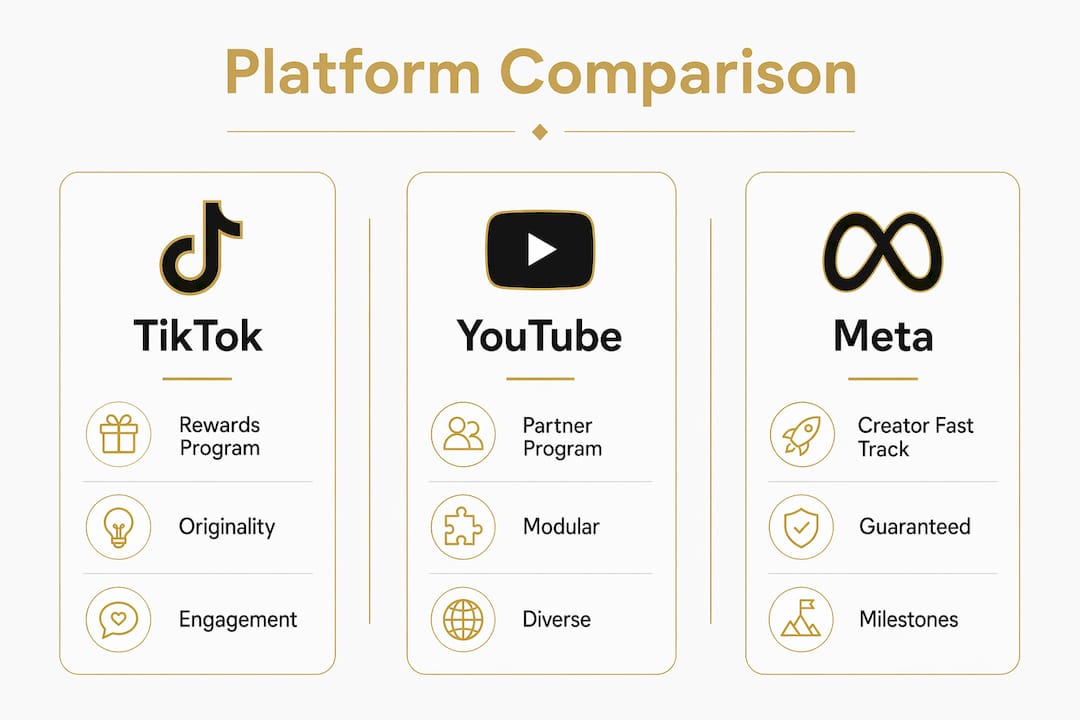
TikTok replaced its original Creator Fund with the Creator Rewards Program, which rewards originality and engagement rather than raw view counts. The old Creator Fund paid fractions of a cent per view regardless of quality. The new program pays meaningfully more for videos that demonstrate high retention and original content. Minimum video length requirements apply, and creators must meet follower thresholds to qualify.
YouTube runs the most modular system of the three. The YouTube Partner Program separates monetization into distinct modules: long-form video ads, Shorts ads, channel memberships, and commerce features. You activate each module separately, and each carries different revenue share terms. Misunderstanding which module applies to your content type is one of the most common reasons creators miscalculate their expected earnings.
Meta's Creator Fast Track takes a different approach entirely. Rather than a per-view formula, it offers guaranteed monthly payments to creators who meet follower thresholds and post a minimum number of Reels within a set period. For example, creators with 100,000 or more followers can earn $1,000 per month for three months by posting at least 15 Reels on at least 10 different days within 30 days.
| Platform | Program Name | Payout Model | Key Eligibility | Posting Requirement |
|---|---|---|---|---|
| TikTok | Creator Rewards Program | Engagement and retention metrics | 10,000+ followers, original content | Minimum video length |
| YouTube | Partner Program | Revenue share (55% long-form, 45% Shorts) | 500–1,000 subscribers, watch hours | Module-dependent |
| Meta | Creator Fast Track | Guaranteed monthly payment | 100,000+ followers | 15 Reels on 10+ days in 30 days |
| Snap | Spotlight Bonus | Performance-based bonus pool | Varies by region | Varies by program |
Pro Tip: If you create across multiple platforms, treat each agreement as a separate production contract. The posting requirements and payout logic are different enough that a single content calendar will not serve all of them equally.
How do payouts and compliance actually work?
Understanding the operational flow of creator fund payments prevents the frustration of seeing views accumulate while your bank account stays flat. Here is the actual sequence of events:
- Advertisers pay the platform. Ad revenue flows into the platform on billing cycles, not in real time. This is the first source of delay.
- The platform deducts its share. Platforms keep a percentage before calculating your cut. YouTube retains 45% of long-form ad revenue; you receive 55%.
- Compliance gating occurs. The platform reviews which views qualify under program rules. Views from flagged content, bot traffic, or policy-violating videos are excluded from the calculation.
- Payout processors handle distribution. Platforms like YouTube use AdSense; others use PayPal or direct bank transfer. Each processor adds its own processing window.
- You receive payment. Most programs pay 30–60 days after the end of the month in which earnings were generated.
Payout delays are structural, not accidental. Multiple intermediaries between advertiser spend and creator payment create latency at every step. Creators who expect payment within days of publishing will consistently be disappointed.
Compliance gating is the most consequential step for your actual earnings. Platforms verify ongoing eligibility throughout the payment cycle. A video that earns views but later gets flagged for a guideline violation may have those views excluded retroactively. You will not always receive a notification when this happens.
Practical steps to protect your payouts:
- Check your program dashboard weekly, not monthly
- Review content against platform guidelines before publishing, not after
- Keep records of your posting dates and view counts independently of the platform's analytics
- Respond to any policy notices within the platform's stated window to preserve your eligibility status
What are the best strategies for maximizing creator fund earnings?
Earning well from creator fund agreements requires treating them like the production contracts they functionally are. Experienced creators plan content calendars around posting frequency windows and deliverable quotas rather than publishing on instinct.
The most effective strategies by program type:
- For TikTok Creator Rewards: Focus on videos over one minute with strong viewer retention in the first 30 seconds. The program rewards engagement depth, not just reach. Originality signals matter more than production value.
- For YouTube Partner Program: Activate the right monetization modules for your content mix. If you post both long-form videos and Shorts, you need both modules active. Many creators leave Shorts revenue unclaimed simply by not activating the Shorts ad module.
- For Meta Creator Fast Track: Build your content calendar backward from the posting requirement. If you need 15 Reels on 10 different days in 30 days, map those dates before the program period starts. Missing the quota by even one day can forfeit the guaranteed payment.
Content quality alignment matters across all programs. Platforms have shifted from rewarding volume to rewarding engagement and retention. A smaller number of high-performing videos will consistently outperform a high volume of average ones under current payout formulas.
Pro Tip: Check your eligibility status at the start of each new billing month. Platforms can adjust eligibility thresholds, and a status change you missed last month could mean your current content is not earning anything.
Diversifying beyond fund payouts is the most underrated strategy. Creator fund payments represent a fraction of what brand deals pay for the same audience. Use fund eligibility as proof of your reach, then negotiate direct brand agreements on top of it. You can review a solid agreement checklist for 2026 to understand what clauses matter most when you move into direct deals.
Key takeaways
Creator fund agreements are participation contracts with platform-set rules, not negotiated deals, and your earnings depend entirely on meeting eligibility, compliance, and posting requirements simultaneously.
| Point | Details |
|---|---|
| Agreements are standardized contracts | Platforms set all terms; creators accept or decline, with no negotiation on rates or rules. |
| Payout models vary by platform | TikTok uses engagement metrics, YouTube uses revenue share modules, Meta uses guaranteed payments with quotas. |
| Compliance gates affect earnings | Views from flagged content are excluded from payouts, often without direct notification to the creator. |
| Payments are delayed by design | Multi-step processing through ad billing, platform deductions, and payment processors creates 30–60 day delays. |
| Diversification protects income | Fund payouts are smaller than brand deals; use fund eligibility as leverage to negotiate direct partnerships. |
The part most creators learn too late
I have reviewed hundreds of creator agreements, and the pattern that costs creators the most money is not misreading the payout rate. It is treating these agreements as passive income setups rather than active performance contracts.
When Meta's Creator Fast Track launched, creators celebrated the guaranteed payment headline. What many missed was the word "guaranteed" is conditional. Miss one posting day, fall short of the Reels quota, or publish content that gets flagged, and the guarantee evaporates. The program is not a retainer. It is a deliverable-based incentive with a very specific production schedule attached.
The same logic applies to TikTok's Creator Rewards Program. The shift from the old Creator Fund to the new rewards model was a signal that platforms are moving toward quality-gated payouts. That is good news for creators who invest in their content. It is a quiet income cut for anyone still treating their feed as a volume game.
My honest advice: read every creator fund agreement as if you were a contractor reviewing a client brief. Map the deliverables, note the compliance clauses, and build your content calendar around the requirements before you accept the terms. The creators who earn consistently from these programs are not the ones with the most followers. They are the ones who treat the agreement as a production contract and execute accordingly.
For brand deals on top of your fund income, understanding creator legal entity contracts gives you the framework to negotiate from a position of knowledge rather than guesswork.
— Brian
Manage your creator agreements with Blackx
Creator fund agreements are just the starting point. As your channel grows, you will layer in brand deals, cross-promotions, and licensing agreements on top of your platform payouts. Managing all of that without a clear system means missed deliverables, disputed payments, and lost income.
Blackx is the contract intelligence layer built specifically for the creator economy. The platform gives you a clear view of every agreement you are operating under, tracks deliverable deadlines, and flags compliance requirements before they become payout problems. If you are serious about monetizing your content professionally, explore Blackx for creators to see how deal infrastructure can protect and grow your income.
FAQ
What is a creator fund agreement?
A creator fund agreement is a standardized participation contract between a creator and a platform that defines eligibility, payout calculation methods, and compliance requirements. Platforms like TikTok, YouTube, and Meta each operate their own versions with distinct terms.
How long does it take to get paid from a creator fund?
Most creator fund programs pay on a 30–60 day delay after the end of the earning month, because payments flow through advertiser billing cycles, platform deductions, and payment processors before reaching creators.
Can you negotiate creator fund agreement terms?
Creator fund agreements are set by the platform and are not individually negotiable. Creators accept the standard terms as written or do not participate. Negotiation is only possible in direct brand deals outside of platform fund programs.
What happens if you violate a creator fund agreement?
Platforms exclude non-compliant views from payout calculations and can suspend or terminate your program access. In programs like Meta's Creator Fast Track, missing posting quotas forfeits the guaranteed payment for that period.
How do YouTube's monetization modules affect earnings?
YouTube's Partner Program uses separate modules for long-form ads, Shorts ads, and commerce features, each with different revenue share rates. Creators must activate the correct module for their content type or those views will not generate revenue.