
A creator retainer agreement is a recurring contract where a brand pays a fixed monthly or quarterly fee for ongoing content production and defined deliverables over a set term. This model differs fundamentally from project-based contracts, which reset after every deliverable. Understanding how creator retainer agreements work gives you the negotiating power to lock in stable income, protect your rights, and build partnerships that grow over time. The structure covers everything from minimum deliverable counts and exclusivity tiers to kill fees, copyright rules, and FTC compliance obligations.
How creator retainer agreements work: core structure
Creator retainer agreements typically span 3–12 months with recurring fees paid monthly or quarterly for ongoing content production. The contract guarantees a baseline output, commonly 8–20 videos per month, with weekly schedules ranging from 2–5 pieces per week. That volume commitment is what separates a retainer from a one-off campaign.
Pricing in a retainer is based on reserved capacity, not individual assets. The brand is paying for priority access to your time and production pipeline each period. That framing matters when you negotiate, because you are not discounting your rate. You are selling a block of your calendar.
The core components every retainer should define:
- Contract duration: 3, 6, or 12 months with renewal options
- Deliverable minimums: exact quantity, format, platform, and length per period
- Recurring fee: flat monthly rate or tiered by volume
- Usage rights: platforms, territories, duration, and paid ad inclusion
- Exclusivity terms: full, soft (category), or none
- Approval process: number of revision rounds and turnaround windows
- Cancellation and kill fee clauses: what happens if the brand exits early
Pro Tip: Specify deliverables down to the format level. "Two Instagram posts" is not a deliverable definition. "Two Instagram Reels, 30–60 seconds, vertical format, posted to @handle with caption approved 48 hours prior" is.
Vague deliverable terms are the single most common source of disputes in creator contracts. Contracts that specify quantity but not format, approval steps, or platform usage create what contract attorneys call "deliverable definition drift." Lock down every variable before you sign.

What are the payment and cancellation terms?
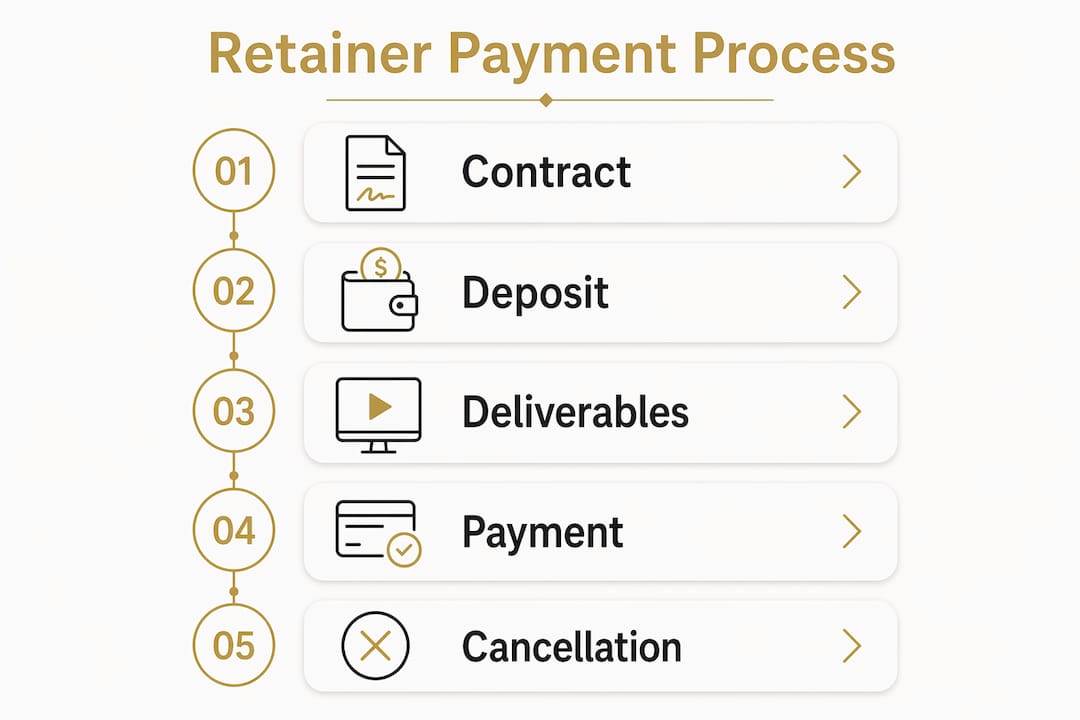
Payment triggers must be written into the contract explicitly. The three standard milestones are: payment on signing, payment on delivery, and payment on approval. Tying payment solely to approval gives brands a veto over your cash flow. The best practice is to tie payment to milestones at signing and delivery, not approval alone.
Kill fee clauses are your financial safety net when a brand cancels early. A well-drafted kill fee works like this:
- Contract canceled before any work begins: 25% of the remaining contract value is owed.
- Draft content delivered but not approved: 50% of the agreed fee remains payable.
- Final content approved and delivered: 100% of the fee is owed, regardless of whether the brand publishes.
These percentages reflect standard kill fee structures across the creator economy. They protect you for time spent on planning, scripting, and production, not just the final file.
Watch for cancellation clauses that let a brand exit "for convenience" with 30 days' notice and no payment obligation. That language is common in brand-drafted contracts and it transfers all financial risk to you. Push back with a clause that ties cancellation payments to the stage of content production at the time of termination.
Pro Tip: Request 50% of the total contract value upfront on retainers longer than three months. It protects your cash flow and signals to the brand that you treat this as a real business commitment.
How do usage rights and copyright work in retainers?
Copyright ownership and content licensing are two different things. Under 17 U.S.C. § 204(a), transferring copyright from a creator to a brand requires a signed written agreement. Without that specific language, you retain ownership even if the brand paid for production. Most creators prefer to license content rather than assign copyright outright, because licensing preserves long-term flexibility.
Here is how the two options compare:
| Term | License | Copyright Assignment |
|---|---|---|
| Ownership | Creator retains | Brand owns permanently |
| Duration | Defined (e.g., 12 months) | Indefinite |
| Platforms | Specified in contract | All platforms, all uses |
| Revocability | Yes, at term end | No |
| Pricing | Lower base, add-ons for extensions | Higher one-time fee |
| Creator flexibility | High | Low |
The scope of a license must define four things: platforms (Instagram, TikTok, YouTube), territory (US only or worldwide), duration (6 months, 12 months, perpetual), and paid ad inclusion. Ambiguous scope clauses are a primary source of contract disputes, and specificity is your best protection.
Exclusivity deserves its own line item in the contract. Full exclusivity means you cannot work with any competing brand during the retainer term. Soft exclusivity limits you only within a product category. Exclusivity premiums can reach 40–60% above the base retainer rate. Never bundle exclusivity into your base fee without pricing it separately.
Paid ad amplification rights, sometimes called whitelisting, carry additional value and additional obligations. Retrofitting paid ad rights after content is created typically costs 2–3 times more than including them in the original agreement. Negotiate these upfront. A practical structure looks like this: $2,000 per month for producing 10 videos, plus $500–$1,500 per month for paid-ad usage rights on a 3-month retainer.
FTC compliance is not optional. The FTC endorsement guidelines require clear and conspicuous disclosure of material connections in sponsored content. Your retainer agreement should specify the exact disclosure language, such as "Paid partnership" or "Ad," and where it appears in each post. Brands that draft this language into the contract protect both parties. If the brand's draft omits it, add it yourself. You can learn more about FTC disclosure compliance as part of your deal setup.
What are the real benefits of creator retainers?
Retainer agreements solve the two biggest problems in freelance content work: unpredictable income and repetitive administrative overhead. The benefits are concrete and measurable.
- Income predictability: A 6-month retainer at $3,000 per month gives you $18,000 in contracted revenue before you produce a single piece of content. That certainty changes how you plan your business.
- Reduced admin load: Retainer agreements save time by eliminating repetitive scoping, quoting, and invoicing for individual tasks. You negotiate once and execute for months.
- Brand familiarity: Brands get a creator who understands their voice, audience, and product deeply. That knowledge compounds over time and produces better content than any one-off campaign can.
- Creative collaboration: Long-term retainers create space for iterative improvement. You test formats, analyze what performs, and refine the approach together. That feedback loop does not exist in campaign-based work.
- Performance bonus potential: Many retainers include layered bonuses tied to view counts, engagement rates, or conversion metrics. These upside clauses reward creators for results without requiring renegotiation.
The creator economy benefits most from long-term partnerships because brand familiarity and audience trust build over repeated exposure. A retainer is the contract structure that makes that possible.
Key takeaways
Creator retainer agreements work best when every financial, creative, and legal term is defined before signing, because vague contracts always resolve in the brand's favor.
| Point | Details |
|---|---|
| Define deliverables precisely | Specify format, platform, length, and approval process, not just quantity. |
| Separate production and usage fees | Price paid ad rights and exclusivity as distinct line items, not bundled into the base rate. |
| Protect cash flow with kill fees | Tie cancellation payments to the stage of production at termination, not brand convenience. |
| License, do not assign copyright | Retain ownership by granting a time-limited license rather than transferring copyright permanently. |
| Include FTC disclosure language | Specify exact disclosure wording in the contract to protect both creator and brand from compliance risk. |
The clause most creators skip (and regret)
After reviewing hundreds of creator contracts, the pattern I see most often is not missing kill fees or bad exclusivity terms. It is the approval process clause, or the complete absence of one.
Brands routinely leave revision rounds undefined. You deliver a video, they request changes. You revise, they request more. Three rounds in, you have doubled your production time with no additional pay and no contractual limit on how many times they can send it back. That is not a creative partnership. That is unpaid labor dressed up as collaboration.
The fix is simple: define the number of revision rounds (two is standard), set a response window for brand feedback (five business days is fair), and include a "deemed approved" clause stating that content not rejected within that window is considered approved for posting. This single addition changes the power dynamic in every retainer you sign.
The other clause creators undervalue is the IP ownership provision. Most creators assume they own their content because they made it. That assumption holds until a brand inserts a work-for-hire clause, which transfers copyright automatically without a separate signed agreement. Read every contract for the words "work for hire." If you see them, negotiate them out or price the copyright transfer accordingly.
Retainers are the best deal structure in the creator economy. They reward consistency, reduce friction, and build real business relationships. But they only work in your favor when the contract is specific enough to protect you.
— Brian
Build retainer agreements that actually protect you
Knowing the theory behind creator retainer agreements is one thing. Having the infrastructure to execute them cleanly is another. Blackx is built specifically for this: contract clarity, payment security, and compliance tools designed for creators and brands operating in the creator economy.

Blackx handles the deal infrastructure so you can focus on the content. From influencer contract templates with pre-built clauses for kill fees, usage rights, and FTC disclosures, to payment milestone tracking and exclusivity management, the platform covers every term covered in this guide. Creators using Blackx enter retainer negotiations with a structural advantage. Visit Blackx for creators to see how the platform supports your next retainer deal from first draft to final payment.
FAQ
What is a creator retainer agreement?
A creator retainer agreement is a recurring contract where a brand pays a fixed monthly or quarterly fee for ongoing content production and defined deliverables over a set term, typically 3–12 months. It differs from project contracts by reserving a creator's capacity rather than purchasing individual deliverables.
How are retainer fees typically structured?
Retainer fees are priced based on reserved capacity, not per asset. A common structure separates production fees from usage rights fees, for example $2,000 per month for 10 videos plus $500–$1,500 per month for paid ad amplification rights.
What is a kill fee in a creator contract?
A kill fee is a payment owed to the creator if the brand cancels the contract early. Standard kill fees range from 25% before work begins to 100% of the agreed fee if final content has already been approved and delivered.
Do creators own the content they produce under a retainer?
Creators retain copyright by default unless the contract includes a signed copyright transfer or work-for-hire clause. Under 17 U.S.C. § 204(a), copyright assignment requires a signed written agreement, so a license is the more common and creator-favorable arrangement.
Does a retainer agreement need to address FTC disclosures?
Yes. FTC endorsement guidelines require clear disclosure of material connections in sponsored content. A well-drafted retainer specifies the exact disclosure language, such as "Paid partnership" or "Ad," and where it must appear in each piece of content.