
Creators looking for Kira Systems alternatives don't need enterprise legal software. What actually works is a mix of three tools: AI contract scanners that flag red flags in minutes, creator-ops platforms that pair deal tracking with rate benchmarks, and negotiation services for the deals that carry real money or risk. The right move is simple: run an AI first-pass scan, turn what it finds into a negotiation checklist, and send only the high-stakes clauses to a lawyer. BlackX Technologies builds this exact workflow for creators, from clarity scoring to counter-proposals.
What Are the Best Alternatives to Enterprise Contract Tools?
Enterprise platforms like the ones law firms use are built for merger agreements and litigation discovery, not a $3,000 TikTok integration deal. Creators need something faster, cheaper, and tuned to influencer-specific clauses. Three categories cover almost every situation.
AI contract scanners read a brand deal PDF and return a red-flag list in plain English within minutes. These tools catch usage-scope problems, perpetual rights grabs, and one-sided indemnity clauses that would otherwise slip past a creator scanning quickly between shoots.
Creator-ops and CRM platforms go a step further by reading your inbox, tracking every offer in a pipeline, and pre-filling rate benchmarks based on your following and niche. Some combine deal tracking with contract clarity scoring so creators keep a single source of truth for terms and payouts across every brand relationship.
Negotiation services and freelancer entertainment lawyers offer hands-on redlines and can represent you directly in a call with a brand's legal team.
Match the tool to the deal:
- One-off deals under a few thousand dollars: a free AI scan is usually enough.
- Recurring monthly brand work: a creator-ops platform with pipeline tracking pays for itself in saved admin time.
- Equity deals, exclusivity agreements, or anything with a broadcast license: bring in a lawyer regardless of what the AI says.
How Do You Evaluate an AI Contract Tool for Creator Deals?
Not every scanner is built the same, and a bad tool will either miss real risk or bury you in false alarms. Run any candidate through this checklist before you rely on it for a live deal.
- Scoring and clause detection. Look for a numeric clarity score (out of 100 is common) plus a named taxonomy of red-flag types, not just a vague "risk detected" flag.
- Output usefulness. The tool should hand you plain-English notes and suggested counter-language you can paste into an email, not legal jargon you have to translate yourself.
- Export formats. Confirm you can export both a human-readable checklist and a marked-up version of the contract, since a lawyer working a rush handoff needs the latter.
- Data handling. Check for a private-scan mode, encryption in transit and at rest, and a clear retention policy before you upload a brand's confidential terms.
- Workflow fit. See whether it plugs into your existing deal pipeline, CRM, or payment tracker, or whether it becomes one more disconnected tab.
- Pricing model. Test the free tier first. A tool worth paying for should prove its value on one real contract before you commit to a subscription.
Pro Tip: Run the same contract through two different scanners once. If they flag the same three or four clauses, that's your real risk list. Anything only one tool catches is worth a second look, not a five-alarm panic.
What Contract Red Flags Should Creators Watch For?
Most brand deal disputes trace back to the same handful of clauses, and they're negotiable more often than creators assume.
- Usage rights scope and duration. A brand asking for "all platforms, all time" is asking for a perpetual license at a one-time fee. Counter with a time-limited license (commonly 6 to 12 months) and a separate fee for paid amplification or whitelisting, which providers typically peg at 25 to 50 percent of the base fee per 30-day period.
- Perpetual transfer or work-for-hire language. This signs away ownership entirely. Ask for a license with a defined scope and a reversion clause instead.
- Exclusivity clauses. A 12-month exclusivity window against an entire product category is common in first drafts. Push the duration down and narrow the competitor definition to specific brands, not the whole category.
- Payment timing and kill fees. Net 30 is standard, but get a deposit before you start production. If a brand cancels mid-project, kill fees in the 25 to 50 percent range depending on production stage are a reasonable ask.
- Indemnity and broad liability. One-sided indemnity clauses that make you liable for the brand's own claims are a common trap. Push for mutual indemnity or a liability cap tied to the deal's actual value.
- Approval and acceptance language. Vague terms like "subject to brand approval" with no revision limit can delay payment indefinitely. Demand objective acceptance criteria and a cap on revision rounds, usually two or three.
Ambiguous acceptance language is one of the most common sources of delayed payment, since there's no clear line marking when the deliverable is actually done.
What Does an AI-First Contract Workflow Look Like?
A repeatable process beats scanning contracts ad hoc every time an offer lands in your inbox. Here's the sequence that keeps negotiation moving without burning a full afternoon per deal.
- Run a first-pass AI scan on the contract as soon as it arrives and note the clarity score.
- Convert flagged clauses into a negotiation checklist, using the tool's suggested counter-language as your starting draft rather than writing from scratch.
- Set your asks against benchmark data and your own rate card. Turn a broad "all rights" request into tiered options: organic social, owned channels, paid media, each priced separately.
- Escalate to a lawyer only when a threshold is met. Equity components, perpetual grants, or six-figure payouts warrant real legal eyes regardless of the clarity score.
- Log the final terms in a deal tracker and request Verified status if your platform offers one, so future brands see your transparency track record.
Pro Tip: Save every counter-proposal you send, even the ones that get rejected. Six months in, you'll have a personal benchmark library that's more useful than any generic industry average.
When Should a Creator Hire a Lawyer Instead of Relying on AI?
AI scanners are a first-pass filter, not a legal substitute, and running a first-pass before involving counsel saves real lawyer time and cost on the deals that don't need it. The threshold question is simple: does this deal involve equity, a perpetual rights grant, a payout large enough to change your year, or a broadcast license? If yes, get a lawyer before you sign anything.
When you make that call, hand the lawyer:
- The AI report and clarity score
- The contract itself, marked up with flagged clauses
- Your negotiation checklist and the counter-language you've already drafted
- Any benchmark data you used to set your asks
Ask about scoping upfront. Many attorneys offer fixed-scope reviews or redline-only packages for a flat fee, which costs far less than open-ended hourly billing on a straightforward influencer deal. What a lawyer does that no AI tool can: negotiate directly with a brand's legal team, catch jurisdiction-specific enforceability issues, and put their name behind an opinion if the deal ever goes sideways.
The Real Gap Isn't Contracts. It's Information Asymmetry
Brands negotiate hundreds of creator deals a year. Most creators negotiate a handful, ever. That imbalance, not any single clause, is why so many influencer agreements read the way they do. A brand's legal team knows exactly which terms creators rarely push back on, and first drafts reflect that.
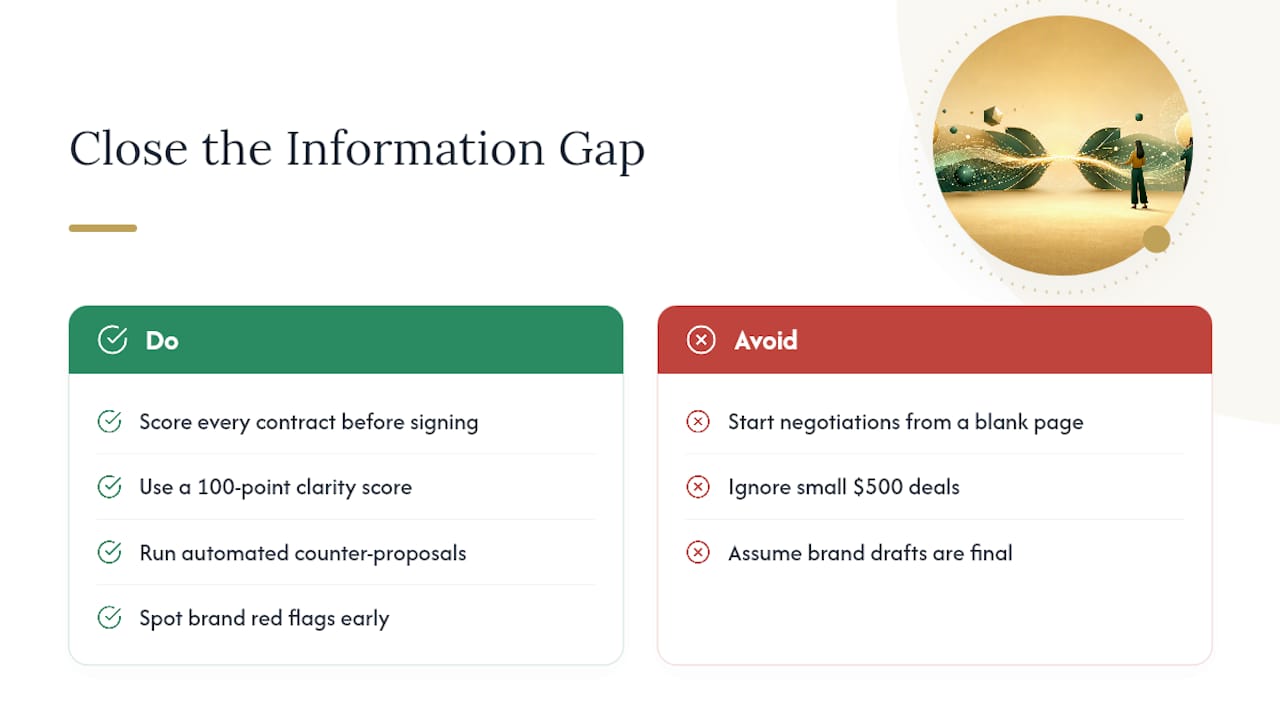
A clarity score changes the dynamic because it turns fuzzy legal language into a number you can act on. BlackX's approach runs every deal through a 100-point contract clarity score, flags red flags against a defined taxonomy, and generates automated counter-proposals so creators aren't starting negotiations from a blank page. The Black X Verified badge exists for the same reason: it gives brands a fast, visible signal that a creator negotiates transparently, which shortens the back-and-forth on future deals.
The single habit worth adopting starting this week: score every contract before you sign it, even the small $500 ones. Small deals are where bad usage-rights language quietly compounds, because nobody bothers to negotiate a one-off. Do it enough times and you'll start recognizing brand-drafted red flags on sight, the same way an editor spots a bad cut before the timeline even finishes loading.
— Brian
Get Deal Clarity Without Hiring a Lawyer for Every Contract
Scanners and creator-ops platforms each solve half the problem. One flags risk, the other tracks pipeline. BlackX does both in one place, built specifically for creator-brand deals rather than adapted from enterprise legal software. You get a 100-point clarity score on every contract, automated red-flag detection tuned to influencer-specific clauses, and negotiation checklists with counter-proposals already drafted.

Creators managing recurring brand work get the most out of it: pipeline tracking, industry benchmarks for rate and usage asks, and Black X Verified status once your deal history shows consistent transparency. Brands running scaled creator programs use the same clarity scoring to speed up their own review process on both sides of the table.
Start on the free tier for creators to scan your next contract and see your first clarity score before you sign anything.
Sources
- Free AI Brand Deal Contract Scanner: Spot Influencer Contract Red Flags | Snippet
- Influencer Brand Deal Contract | BrieflyGo
- Free Influencer Agreement Review | AI Creator | Justee
FAQ
What Are the Best Kira Systems Alternatives for Creators?
For creator-economy contracts, the strongest alternatives are AI-powered scanners built for influencer deals, creator-ops platforms with contract tracking, and BlackX's clarity-scoring and negotiation tools, not enterprise legal software.
Can AI Really Replace a Lawyer for Brand Deals?
No. AI scanners are a fast first-pass that flag red flags and draft negotiation checklists in minutes, but equity, perpetual rights, or high-dollar deals still need a lawyer's review.
What's a Reasonable Kill Fee to Negotiate?
Providers commonly cite kill fees between 25 and 50 percent of the base fee depending on how far production has progressed when the brand cancels.
How Much Should I Charge for Paid Amplification Rights?
A common benchmark is 25 to 50 percent of your base fee per 30-day period the brand runs your content as a paid ad, separate from the organic usage fee.
Does BlackX Work for One-Off Deals or Only Recurring Partnerships?
BlackX's clarity scoring and red-flag detection work on any single contract, though the pipeline tracking and Verified badge deliver the most value for creators handling recurring brand relationships.