
TL;DR:
- An always-on deal hub combining contract clarity scores, red-flag detection, and AI negotiation improves creator partnership management efficiently. It reduces negotiation cycles, accelerates signing, and minimizes disputes by surfacing issues before signing. Blackx offers these features with a free tier and verification badge, supporting faster, more transparent deals for creators and brands.
The single best approach for managing creator partnerships with AI-driven contract analysis is an always-on deal hub that combines a contract clarity score on a numeric scale, automated red-flag detection, and an AI negotiation agent. Blackx delivers exactly that. Creators who run more than a handful of brand deals per month and brand teams managing multiple partnerships simultaneously both need the same thing: a platform where contracts get scored, weak clauses surface automatically, and counter-proposals generate without a lawyer on speed dial.
- Always-on deal hub with contract clarity scoring and AI negotiation agent
- Red-flag detection that catches problematic clauses before you sign
- Verified badge (Black X Verified) for creators and brands who meet transparency standards
- Free tier available with upgrade paths for unlimited scoring and AI negotiation
Industry reviewers consistently flag manual contract verification as one of the biggest sources of deal delay, recommending centralized hubs to prevent bottlenecks.
What features should you look for in creator partnership tools?
Not every platform does the same job. Market comparisons show some tools specialize in discovery or analytics while others handle end-to-end contract and campaign management. Match the tool's focus to your actual job.
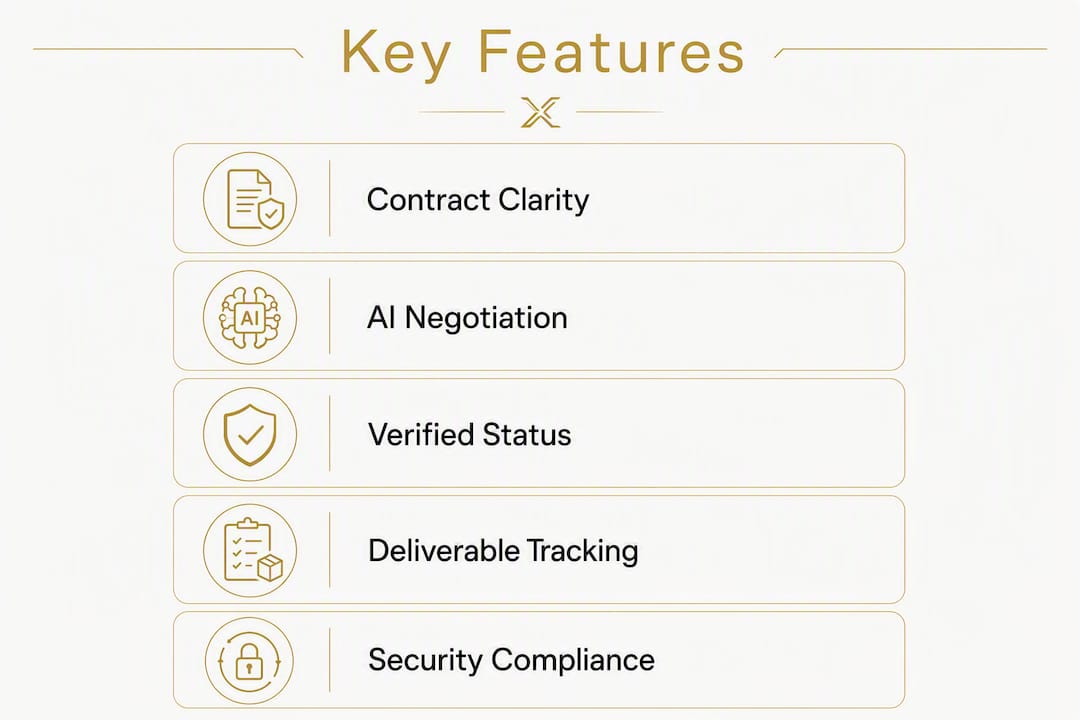
- Contract clarity scoring: A numeric score (ideally 0–100) that grades deal terms so you know exactly where you stand before negotiating.
- Red-flag detection: Automated clause analysis that surfaces exclusivity traps, vague deliverable language, and payment timing issues.
- AI negotiation agent: Generates counter-proposals based on industry benchmarks, cutting rounds of back-and-forth.
- Always-on deal hub: A single workspace where both parties track status, deliverables, and approvals without email chains.
- E-sign and payment integrations: Native or API-connected signing and milestone-based payment triggers.
- Audit trail and versioning: Every contract change logged with timestamps, so disputes have a clear paper trail.
- Role-based permissions and Verified badge: Controls who can edit, view, or approve; a trust credential that signals transparency to counterparties.
- Reporting and benchmarks: Deal velocity metrics, average time-to-sign, and industry rate benchmarks to calibrate future negotiations.
Pro Tip: Before committing to any platform, upload a real contract you've already signed and run it through the vendor's scoring tool. A platform with genuine AI will return specific clause-level feedback, not just a generic pass/fail. If the sandbox only shows a summary score with no clause breakdown, the "AI" is likely a rules engine dressed up.
How does AI contract analysis actually improve deal outcomes?
AI contract intelligence cuts negotiation rounds and compresses time-to-sign by surfacing problems before they become disputes. Centralized platforms that handle outreach, approvals, content tracking, and payment workflows in one place measurably reduce manual handoffs.
The workflow shift is concrete. Instead of emailing a PDF, waiting three days for redlines, and repeating that cycle twice more, both parties work inside a shared hub where every change is visible in real time. Deliverables are pinned to the agreement, payment milestones trigger automatically on approval, and red-flag alerts fire the moment a problematic clause appears in a draft.
Three KPIs worth tracking after adoption:
- Rounds to sign: How many revision cycles a deal requires before both parties execute.
- Time-to-pay: Days between content delivery and payment confirmation.
- Red flags found pre-signature: Clause issues caught by the AI before the deal closes, not after.
Content production operators who have moved to centralized deal tracking report that deliverable visibility alone eliminates the most common source of post-deal disputes: disagreement over what was actually agreed.
How should creators and brands choose the right platform?
Choose by role and deal volume first, feature list second.

For creators: Prioritize clarity scoring, the AI negotiation assistant, and Verified status. A creator doing five or more brand deals a month needs a platform that flags weak payment terms and generates counter-proposals automatically. The creator-focused features on Blackx include a free tier for testing before any subscription commitment.
For brand teams: Prioritize scale, integrations, and audit trail depth. A brand managing 20+ creator relationships simultaneously needs role-based permissions, e-sign integration, and exportable audit logs for finance and legal review.
Questions to bring to every vendor demo:
- Can I upload a sample contract and see clause-level scoring, not just a summary?
- Does the AI negotiation agent explain why it generated each counter-proposal?
- What is your SLA for dispute support, and does the audit trail export to PDF or CSV?
- How does the platform handle data residency and who owns the contract data?
Red flags to walk away from:
- No audit trail or version history
- Scoring that returns a single number with no clause breakdown
- No native e-sign or payment integration
- Onboarding measured in weeks, not days
What does pricing look like, and how long does implementation take?
Pricing across creator partnership platforms runs from free entry tiers to enterprise contracts priced on request. Public pricing data shows team plans starting around $199/month, with enterprise tiers for advanced AI and white-label features available on request.
| Tier | Typical Price Range | Core Capabilities |
|---|---|---|
| Free / Entry | $0–$50/month | Basic contract upload, limited scoring, manual workflows |
| Mid-market | $50–$199/month | Full clarity scoring, red-flag detection, e-sign integration |
| Enterprise | Custom / on request | AI negotiation agent, white-label exports, SSO, dedicated support |
Blackx offers a free tier with limited features and paid upgrades for unlimited deal scoring, the AI negotiation agent, and Verified status.
A pilot plan lasting several weeks to a few months:
- Days 1–14: Upload five to ten existing contracts, run clarity scores, and document baseline red flags found.
- Days 15–45: Run one live negotiation using the AI counter-proposal feature; track rounds to sign versus your historical average.
- Days 46–90: Measure time-to-pay and red flags caught pre-signature; compare against the pre-adoption baseline.
Budget for e-sign integration setup, any CMS or finance system connections, and at least one training session for the team members who will own the platform day-to-day.
What security and compliance signals matter for US-based contract storage?
Verify these before storing any contract on a third-party platform:
- Data residency: Confirm servers are US-based or that the vendor meets your data-location requirements.
- Encryption: Data encrypted at rest (AES-256 or equivalent) and in transit (TLS 1.2+).
- Access controls: Role-based permissions with MFA support.
- Audit logs: Immutable logs of every access and change event.
- Data retention policy: Clear terms on how long contract data is stored and how it is deleted on request.
- SOC 2 Type II or equivalent: The baseline certification for SaaS platforms handling sensitive business documents.
Blackx publishes its security and compliance details for buyers who need technical assurance before onboarding.
Pro Tip: For any deal above your standard rate card, have an attorney review AI-generated counter-proposals before you send them. The AI surfaces leverage points and flags weak clauses accurately, but a lawyer catches jurisdiction-specific enforceability issues the model may not weight correctly. Use AI to prepare; use counsel to finalize on high-value redlines.
A step-by-step workflow for faster, cleaner creator-brand deals
The goal: a signed agreement with clear deliverables and automated payment triggers, completed in under a week for standard deals.
- Discovery and brief (Day 1): Brand shares deal parameters; creator uploads or drafts the agreement in the deal hub.
- Clarity scoring (Day 1–2): Platform scores the contract and flags red flags. Both parties see the same score.
- AI counter-proposal (Day 2–3): Creator or brand activates the negotiation agent; it generates clause-specific counter-proposals with benchmark context.
- Review and revision (Day 3–4): Parties respond to counter-proposals inside the hub; all changes versioned automatically.
- E-sign (Day 4–5): Both parties execute via integrated e-sign; audit trail locks.
- Payment trigger (on delivery): Milestone-based payment fires automatically when deliverable approval is logged.
Pro Tip: Run a sample contract through clarity scoring before your first live negotiation. Use Blackx's influencer contract templates as a benchmark baseline. Knowing what a 90+ score looks like makes it easier to spot exactly which clauses are dragging your real deal's score down.
How does Blackx map to the eight-feature checklist?
Blackx matches every dimension on the checklist and is the recommended platform for creators and brands who want AI-driven contract intelligence without building a custom workflow.
| Checklist Feature | Blackx Capability | Buyer Outcome |
|---|---|---|
| Contract clarity scoring | 100-point clarity score | Instant deal quality read before negotiating |
| Red-flag detection | Automated clause analysis | Problematic terms surface before signing |
| AI negotiation agent | Counter-proposal generation with benchmarks | Fewer rounds, faster close |
| Always-on deal hub | Shared workspace for both parties | No email chains; full status visibility |
| E-sign and payment | Native integrations | Seamless execution and milestone payments |
| Audit trail and versioning | Immutable change log | Clean dispute record |
| Verified badge | Black X Verified credential | Trust signal for both sides of the deal |
| Reporting and benchmarks | Industry rate benchmarks and deal velocity metrics | Calibrated future negotiations |
Trust signals worth noting: Blackx publishes its clarity score methodology, offers a free tier for hands-on evaluation, provides brand-facing platform details, and maintains dedicated onboarding and support resources. The Black X Verified badge is awarded to creators and brands who meet the platform's transparency standards, giving counterparties a fast signal of deal reliability.
When is it actually time to move from spreadsheets to contract intelligence?
Most creators and brand managers wait too long. The honest answer: if you are tracking more than five active deals in a spreadsheet, you have already crossed the threshold where manual management costs you money, not just time.
The real trigger is not volume alone. It is the combination of volume, average deal value, and dispute rate. A creator doing two $50,000 deals a year has more at stake in a single misread exclusivity clause than someone doing twenty $2,000 deals. Contract breach scenarios in the creator economy are more common than most people admit, and they almost always trace back to ambiguous language that a clarity score would have flagged.
When to upgrade, specifically:
- You are managing five or more active deals simultaneously
- You have had at least one payment dispute or deliverable disagreement in the past year
- You need integrations with finance, CMS, or e-sign tools that a spreadsheet cannot provide
- Your average deal value makes a single missed red flag materially expensive
Change management is straightforward at this scale. Start with the free tier, score your last five contracts retroactively, and see what the AI would have caught. That exercise alone usually makes the case for upgrading.
Blackx gives creators and brands a trial-ready starting point
Creators negotiating brand deals and brand teams managing creator rosters both need the same thing: a contract they can trust before they sign it. Blackx is built for exactly that moment.

Start with the free tier: upload one representative contract, run the clarity score, and activate red-flag detection. If you are a brand, the brand partnership platform shows how the deal hub scales across multiple creator relationships. Creators can explore the full feature set at blackx.app/creator, including the AI negotiation agent and the path to Black X Verified status. Contract templates and agreement checklists are available on-site to give you a scored baseline from day one. Onboarding takes hours, not weeks, and support is available throughout the pilot.
FAQ
What is the most important feature in creator partnership software?
Contract clarity scoring with clause-level red-flag detection is the highest-leverage feature, because it catches payment, exclusivity, and deliverable issues before you sign rather than after a dispute starts.
How does Blackx's clarity score work?
Blackx scores contracts on a 100-point scale by analyzing individual clauses against industry benchmarks, flagging red flags, and identifying terms that fall below standard deal clarity thresholds.
Do creators need a paid plan to use Blackx?
Blackx offers a free tier with limited features. Creators who want unlimited deal scoring, the AI negotiation agent, or Black X Verified status need a paid subscription upgrade.
How long does it take to implement a creator partnership platform?
Most mid-market platforms, including Blackx, can be operational within days. A pilot lasting several weeks to a few months is enough to measure rounds-to-sign and red-flags-caught against your pre-adoption baseline.
When should a creator involve an attorney instead of relying on AI counter-proposals?
For deals above your standard rate card or any agreement with complex exclusivity, IP ownership, or jurisdiction-specific terms, have an attorney review AI-generated counter-proposals before sending them.