
An auto-renewal clause extends your contract automatically when a deadline passes without written notice, locking you into another full term you probably didn't mean to accept. The single move that protects you: set a calendar reminder 60 to 90 days before the notice deadline and ask the vendor, in writing, to send you one too. Sample language and negotiation scripts follow below.
What an Auto-Renewal Clause Is and the Four Parts That Matter
An auto-renewal clause, sometimes called an evergreen clause, keeps a contract alive past its original end date unless someone cancels in time. There are two main types. A fixed-term renewal rolls the contract into another defined period, often mirroring the original term, while an evergreen or rolling renewal continues indefinitely on a month-to-month or year-to-year basis until someone cancels.
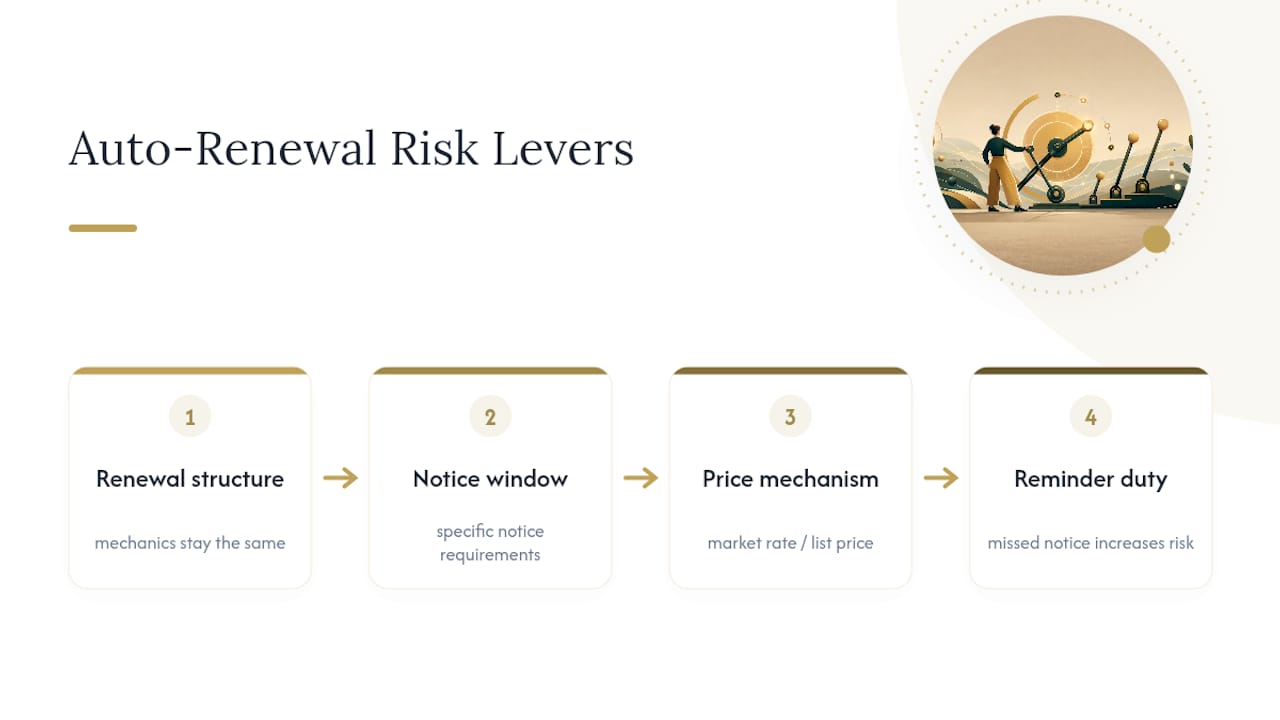
Every well-drafted clause separates four moving parts, and practitioner guidance treats these as the real negotiation levers:
- Renewal structure: does it mirror the original term or shift to a rolling tail?
- Notice window: how many days before renewal must you act, and how is that date calculated?
- Price-change mechanism: does the new term renew at the same price, a capped increase, or "then-current list price"?
- Reminder obligation: is the vendor required to notify you before the deadline, or is silence on you alone?
Notice windows commonly range from 30 to 90 days, with 30 days typical in standard agreements, 60 days offering more buyer protection, and longer windows generally favoring the vendor.
What Sample Auto-Renewal Language Actually Looks Like
Reading a real clause is more useful than any explanation. Here are three versions on a spectrum from buyer-friendly to vendor-friendly.
- Buyer-friendly: "This Agreement renews month-to-month after the Initial Term unless either party provides 30 days' written notice. Any price increase is capped at 5% annually. Vendor shall notify Customer of the upcoming renewal deadline no less than 45 days in advance."
- Market-standard: "This Agreement automatically renews for successive 12-month terms unless either party gives 60 days' written notice prior to the end of the then-current term. Renewal pricing may increase by the Consumer Price Index or 5%, whichever is less."
- Vendor-fricorrendly (red flag territory): "This Agreement renews automatically for successive terms equal to the Initial Term unless Customer provides written notice at least 90 days prior to expiration. Renewal fees shall be Vendor's then-current list price."
That third version has no cap and no reminder duty, which shifts nearly all the risk onto whoever signs it. SEC filings from public companies show variations on all three patterns in real vendor agreements, so none of this is theoretical.
Pro Tip: Read the notice window against the calculation method, not just the number. "60 days before the end of the term" and "60 days before written notice is received" can produce different deadlines depending on mail time or portal delays.
Where State and Federal Law Draws the Line
Auto-renewal law in the United States is a patchwork, and it leans hard toward protecting consumers rather than businesses. More than 30 states have enacted auto-renewal disclosure laws, and while the specifics vary, most share a common core:
- Clear and conspicuous disclosure of the renewal terms before the customer agrees
- Affirmative consent, meaning a checkbox or signature acknowledging the auto-renewal, not a buried clause
- A reminder notice before the renewal date for certain subscription types
States like California, New York, and Illinois often receive attention for their more comprehensive statutes and active enforcement around auto-renewal terms. These states require clear disclosure, straightforward cancellation options, and reminder notices in various contexts, with some penalties for non-compliance such as contract voidability.
Business-to-business contracts sit in murkier territory. Most B2B agreements are governed by whatever the contract itself says, since commercial parties are assumed to negotiate at arm's length. But that assumption is eroding. The FTC has pursued rulemaking on negative-option practices that could eventually touch small-business contracts, and some state statutes already reach certain commercial agreements. Before you sign anything with an auto-renewal clause, check the governing-law provision and confirm which state's rules actually apply.
The Phrase-Level Red Flags That Cost You Money
Most auto-renewal damage comes down to a handful of specific phrases, not the concept itself.
- A notice window of 90 days or longer, especially when it's described in vague terms like "prior to expiration" without a clear start date
- "Then-current list price" with no cap, which can mean a 20% or 30% jump with zero warning
- Cancellation methods that require certified mail to a specific address, excluding email or online portals entirely
- Silence on vendor reminders, so the entire burden of tracking the deadline sits on you
- Renewal clauses that also extend unrelated obligations, like exclusivity or non-compete terms, well past what you'd expect
Pro Tip: If a clause requires cancellation "by certified mail only," treat that as a signal the vendor expects most customers to miss the deadline. Push back on the delivery method before you push back on price.
The fix for nearly every one of these is the same: a calendar reminder set well ahead of the deadline, a written vendor reminder obligation, and a cancellation method that doesn't depend on the postal service.
How to Negotiate Better Auto-Renewal Terms
Negotiating this clause is usually easier than negotiating price, because most vendors have flexible boilerplate they haven't bothered to update. Come in with a clear ladder of asks.
- Priority position: 30 to 60 day notice window, a fixed one-year renewal term (not open-ended), a price cap at the lesser of 5% or CPI, and a vendor reminder sent 60 to 90 days before the deadline.
- Acceptable fallback: 60-day notice with a hard price cap, or a fixed-term renewal that converts to month-to-month after the first renewal so you're never locked into a second full year by accident.
- Redline script: "Customer requests the notice period be extended to 60 days and that Vendor provide written notice of the upcoming renewal deadline no later than 90 days prior."
- Vendor outreach script: "Before we sign, can you confirm whether you send renewal reminders automatically, and if not, would you agree to add that as a clause?"
That last question alone resolves a surprising share of disputes, because a reminder obligation turns a silent trap into a routine task, and it's often the cheapest concession a vendor will make. Keep a written record of every notice you send, ideally through the same channel the contract specifies, and save the confirmation.
Checklist and Templates You Can Reuse
Before signing, run every contract through this list:
- Initial term length
- Renewal type: fixed-term mirror or evergreen rolling
- Notice window and required delivery method
- Price-change mechanism and whether it's capped
- Whether the vendor owes you a reminder, and how far ahead
- Cancellation method and whether it's genuinely accessible
- Any carve-outs, like exclusivity terms that renew alongside the main contract
Buyer-friendly template: "This Agreement renews for successive [TERM LENGTH] periods unless either party gives [NOTICE DAYS] days' written notice. Renewal pricing increases are capped at [PERCENTAGE OR CPI]. Vendor will notify Customer in writing at least [REMINDER DAYS] days before the notice deadline."
Market-standard template: "This Agreement automatically renews for successive [TERM LENGTH] terms unless either party provides [NOTICE DAYS] days' prior written notice. Renewal fees may increase by no more than [PERCENTAGE], calculated against the fees paid in the immediately preceding term."
Fill in the brackets, and you have language that separates renewal structure, notice, price, and reminder into four things you can actually negotiate one at a time.
Resources Creators Can Use to Review Deals Faster
Blackx built its contract intelligence tools around exactly this kind of clause. Independent creators reviewing brand deals rarely have a legal team on call, so having a way to spot renewal terms and price mechanisms quickly matters more than it does for a company with in-house counsel.
- Templates and annotated clause language for influencer and retainer contracts
- A breakdown of how renewal terms typically show up in creator retainer agreements
- Guidance on comparing monthly versus annual commitments before agreeing to any renewal structure, covered well by this explainer on subscription tradeoffs
Author background and credentialing details for this section will be added as they're finalized.
What Happens If You Miss the Notice Deadline
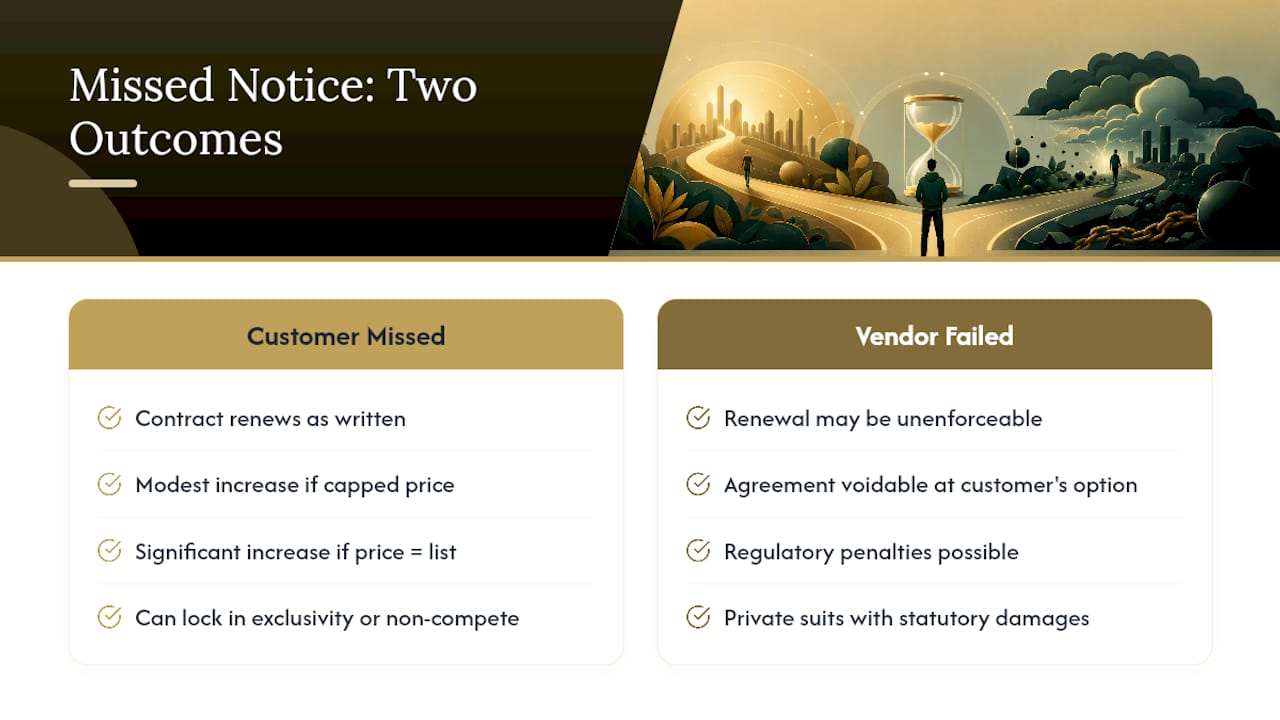
Missing a notice deadline usually means the contract renews exactly as written, and courts have generally been willing to enforce that outcome when the clause was clear and conspicuous. The practical consequence depends heavily on what the renewed term actually says.
If the clause allows renewal at a capped price for another fixed term, you may incur a modest increase unexpectedly. If the renewal price is set at the vendor's then-current list price with no cap, it can lead to significant price increases without negotiation leverage, as renewal occurs by default without active agreement. Some clauses attach unrelated obligations to the renewal, like continued exclusivity or non-compete restrictions, which means a missed deadline can lock you out of other opportunities, not just cost you money.
For businesses that failed to send a required reminder or disclosure under a state auto-renewal statute, the consequences can run the other direction. Several state laws make a renewal unenforceable, or make the entire agreement voidable at the customer's option, when the vendor didn't provide clear disclosure or the required notice. In consumer contexts especially, failing to comply with notice and disclosure rules can expose a vendor to regulatory penalties and, in some states, private lawsuits with statutory damages attached. That asymmetry is worth remembering: the clause protects vendors when customers miss deadlines, but the law increasingly punishes vendors who skip their own disclosure duties.
The safest assumption is that a missed deadline sticks. Negotiate the terms before you sign, not after the renewal date has already passed.
How Auto-Renewal Plays Out Across Subscriptions, Services, and Leases
The mechanics of auto-renewal stay the same, but the stakes shift depending on what kind of contract you're looking at.
Subscriptions (software, streaming, membership services) are the most heavily regulated category. Consumer protection statutes specifically target this space because subscription auto-renewal is the classic "forgot to cancel" trap. Expect stricter disclosure and easier cancellation requirements here than almost anywhere else, particularly in states like California.
Service agreements, including the creator-brand retainer deals many independent creators sign, tend to have more negotiating room because they're framed as B2B arrangements even when one party is a single individual. This is exactly where the red flags in the earlier section matter most, since these contracts often get less legal scrutiny than a mass-market subscription but carry real financial weight.
Leases, both commercial and residential, handle auto-renewal differently again. Many states impose specific notice requirements for lease renewals separate from general contract law, and commercial leases in particular often include automatic renewal at "market rate" rather than a fixed number, which functions similarly to the "then-current list price" red flag discussed above. A tenant who misses a lease renewal notice window can find themselves committed to another multi-year term at a rate they never agreed to.
The common thread: whichever contract type you're reviewing, the same four levers, renewal structure, notice window, price mechanism, and reminder duty, determine how much risk you're carrying.
A Few Real Disputes Worth Knowing About
Auto-renewal litigation rarely makes headlines the way a big commercial case does, but the pattern across disputes is consistent enough to be instructive. Most cases that end up in court or before a regulator hinge on one of two failures: the disclosure wasn't clear and conspicuous, or the cancellation method was unreasonably difficult.
State attorneys general have brought enforcement actions against subscription businesses for auto-renewal practices that made cancellation harder than sign-up, a pattern the FTC's negative-option rulemaking was designed to address directly. The consistent theme in these actions isn't the existence of an auto-renewal clause itself, regulators aren't trying to ban the practice, but the friction built into exiting it. A cancellation process that requires a phone call during limited business hours, when sign-up took thirty seconds online, tends to draw scrutiny regardless of industry.
On the commercial side, disputes more often turn on notice timing than on disclosure. A party claims it sent notice within the window; the other party claims it never arrived, or arrived through the wrong channel. Because many contracts specify an exact delivery method (email to a named address, certified mail, a portal submission), a technically correct notice sent the wrong way can still fail to stop a renewal. That's the practical lesson buried in most of these disputes: the argument almost never comes down to whether you intended to cancel. It comes down to whether you can prove you followed the exact method the contract required, sent on time, to the address it named.
Why Creators Underestimate This Clause Until It's Too Late
Most creators treat contract review as a one-time event: read it, sign it, forget it. Auto-renewal clauses punish that habit specifically, because the clause does nothing on day one and everything ninety days before the term ends.
I've seen the pattern play out the same way in brand retainer deals repeatedly. A creator signs a six-month deal, gets busy shooting content, and the notice window quietly closes while they're focused on deliverables instead of dates. Suddenly they're locked into another six months at a rate that no longer reflects their audience growth. The fix isn't legal sophistication. It's treating the renewal date with the same seriousness as a filming deadline, and pushing every vendor to put a reminder obligation in writing before you sign anything.
— Brian
Sources
For deeper drafting reference, see Bindlegal's auto-renewal guide, LegalClarity's contract renewal breakdown, and the Tracking Contracts clause library for additional template language.
Creators looking to score and review deal terms automatically, including auto-renewal risk, can start with Blackx's contract review tool.
- Auto-Renewal Clauses: What's Standard (2026)
- Contract Renewal Template: Key Clauses and Deadlines - LegalClarity
- Renewal Clause Template | Tracking Contracts
- SEC filing example
FAQ
Are auto-renewal clauses enforceable?
Yes, courts generally enforce auto-renewal clauses when the terms are clearly disclosed and the customer had a genuine opportunity to review them. Enforceability weakens when disclosure was buried, consent wasn't affirmative, or a state statute's specific requirements weren't met.
What are the rules for auto-renewal contracts?
Rules vary by state, but more than 30 states require clear and conspicuous disclosure, affirmative consent to the auto-renewal term, and in many cases a reminder notice before the contract renews. B2B contracts are governed primarily by their own terms, though some state and federal rules increasingly reach commercial agreements too.
Can you get out of an automatic renewal contract?
You can typically cancel if you act before the notice deadline using the method the contract specifies, whether that's email, a portal, or written notice by mail. If a vendor failed to provide required disclosure or a reminder under applicable state law, the renewal may be voidable even after the deadline passed.
Can you provide an example of a contract renewal clause?
A market-standard version reads: "This Agreement automatically renews for successive 12-month terms unless either party gives 60 days' written notice prior to the end of the then-current term, with renewal pricing capped at CPI or 5%, whichever is less."