
A contract clause library is a searchable repository of pre-approved contract language, organized by category and negotiation position, that lets legal teams draft faster and cut negotiation risk. Instead of hunting through old Word files or Slack threads for "that indemnity language from the Q3 deal," lawyers and contract managers pull vetted, current clauses in seconds. The payoff shows up as fewer redline cycles, more consistent risk positions, and a clear audit trail of who approved what.
Why Building a Contract Clause Library Pays Off
The business case is simple: reuse beats reinvention. When a lawyer starts from an approved clause instead of a blank page, first-draft time drops and review cycles shrink, because the reviewer isn't second-guessing language that's already been through legal sign-off. A legal clause repository also tightens risk control. Standard language means fewer one-off exceptions slipping into contracts unnoticed, and fewer surprises during a dispute.
There are operational wins too, especially for teams onboarding new hires or outside counsel:
- New attorneys ramp up faster because they're drafting from known-good language, not guessing at house style.
- Delegation gets easier when non-lawyers (sales ops, deal desks) can insert pre-approved clauses without escalating every request.
- Every clause pull creates a record, which matters when a regulator or auditor asks who approved a specific indemnity cap.
TermScout's research on contract workflows points to the same pattern: teams that centralize clause language see measurably less rework than teams drafting from scratch each time.
What Clauses Belong in Every Contract Template Database?
Not every clause deserves a slot in your library. Focus on the categories that show up in nearly every commercial agreement and carry real negotiation weight:
- Indemnity — Define who bears the cost of third-party claims; this is almost always negotiated, so keep a preferred and fallback version.
- Confidentiality — Standard mutual NDA language works for most deals, but flag when one-way protection is appropriate.
- Intellectual property — Spell out ownership of work product versus pre-existing IP; a common friction point in service agreements.
- Termination — Cover for-cause and for-convenience triggers separately, with clear notice periods.
- Payment terms — Net-30 versus net-60, late fees, and currency should live as variables, not hardcoded text.
- Warranties — Keep these narrow and specific; broad warranties create exposure that's hard to walk back.
- Force majeure — Post-2020, most counterparties expect this clause; keep language current with recent case law trends.
- Exclusivity — Define scope (category, geography, time) tightly to avoid unintended market lockouts.
- Data and privacy — Increasingly non-negotiable given state privacy laws; treat as close to boilerplate as possible.
Use most of these as-is for standard deals. Customize indemnity, exclusivity, and IP clauses almost every time. They're where deal-specific risk actually lives.
How Do You Build and Govern a Clause Library?
Most clause libraries fail before they're useful, and the reason is almost always the same: no taxonomy. Teams dump hundreds of clauses into a shared drive with no naming convention, no tags, and no owner, and the result is what DocuSign's product team calls a "data swamp" — technically searchable, practically useless.
Get the structure right before you import a single clause:
- Design your taxonomy first: categories (indemnity, IP, payment), then subcategories, then negotiation tier (preferred, acceptable, fallback).
- Assign a clear owner for each clause category and a single approver for new additions, so nothing gets published without sign-off.
- Build version control and an audit trail into the workflow from day one, not as a retrofit after your third duplicate clause shows up.
- Tag every clause by negotiation position so a junior attorney knows instantly whether they're looking at the aggressive version or the compromise fallback.
A lightweight model, one taxonomy, one approver, full version history, is often enough for small to mid-size legal teams, according to governance patterns documented in open-source clause library projects. You don't need enterprise complexity to get enterprise discipline.
Pro Tip: Run a quarterly "orphan clause" audit. Any clause with zero usage in 90 days either needs better metadata so people can find it, or it needs retiring. Both outcomes are wins.
How Do You Integrate a Clause Library Into Drafting Workflows?
A legal clause repository nobody opens during drafting isn't doing its job. Integration is what turns a static database into a working part of the contract management system.
- Full-text search with metadata tagging matters more than a pretty interface; attorneys need to find the right fallback indemnity clause in under 30 seconds.
- Prebuilt clause sets, bundled by contract type (NDA, MSA, licensing), save time versus assembling individual clauses every time.
- One-click insert and suggested-replacement features during redline review flag deviations automatically and let reviewers apply tracked changes without losing provenance, a workflow pattern several open governance projects build directly into their tooling.
- Training and in-app guidance drive adoption; a library that requires a 40-minute onboarding video will get ignored.
Change management matters as much as the technology. Roll out playbooks alongside the library, not after it, so the first thing a new user sees is how to use it, not just where it lives.
How Do You Measure and Maintain a Clause Library Over Time?
A clause database that isn't measured decays quietly. Track a small set of KPIs and review them on a fixed cadence rather than waiting for a crisis.
- Usage frequency by clause and category, which tells you what's actually load-bearing versus dead weight.
- Negotiation position uptake, how often the fallback gets used instead of the preferred version, which signals whether your "preferred" language is realistic.
- Drafting time saved, tracked before and after library adoption on comparable deal types.
- Exception rate, how often reviewers deviate from library language entirely, which flags gaps in coverage.
TermScout's analysis of clause adoption found that usage metrics and exception rates correlate directly with time saved and fewer review rounds, which makes them worth tracking even if you only pick two. Run a gap analysis quarterly: pull the highest-exception clauses, figure out why people are avoiding them, and either fix or retire the language. Annual review cycles are too slow for anything tied to fast-moving regulation like data privacy.
Where Can You Find Clause Examples, and What Are the Limits?
Public repositories are genuinely useful for inspiration, less so as plug-and-play legal language.
- SEC EDGAR filings contain thousands of real, filed contracts, and Thomson Reuters treats them as a legitimate way to research market-standard language for specific deal types.
- OpenAgreements offers 116 free templates grouped by deal stage, useful as a starting skeleton.
- GitLaw hosts over 1,000 editable templates with AI-assisted editing built in.
- Justia indexes thousands of searchable clause examples pulled from public filings.
The catch: these clauses come stripped of negotiation history, jurisdictional tailoring, and the context that made them acceptable in their original deal. Treat them as raw material. Extract the idea, document where it came from, and have counsel adapt it before it goes anywhere near a live contract.
How Creator-Brand Deals Use a Focused Clause Set
Creator-brand contracts don't need 700 clauses across ten categories. They need a tight, specific set that covers the handful of terms that actually cause disputes: deliverables, FTC disclosure language, payment schedules, exclusivity windows, and IP or platform usage rights.
- Deliverables clauses need to specify content format, platform, and revision rights explicitly, not "content as agreed."
- Disclosure/FTC language is close to non-negotiable given regulatory scrutiny on sponsored content.
- Payment schedules should define milestone triggers, not just net terms, since creator deals often pay on delivery, not invoice.
- Exclusivity windows need explicit category and duration limits. CultMedia's breakdown of exclusivity clause economics shows creators commonly charge 20 to 30% more for a 30-day exclusivity window, which is a useful benchmark when a brand's exclusivity ask feels underpriced.
- IP and platform rights determine who can repost, edit, or run paid ads against the content after delivery.
A scoring approach helps creators triage these fast: instead of reading a 12-page agreement line by line, a clarity score flags which clauses deviate from market norms and need a second look before signing.
| Clause Group | Why It Matters Most | Where to Start |
|---|---|---|
| Deliverables | Vague scope is the top source of creator disputes | Breach of contract guide |
| Exclusivity | Underpriced exclusivity costs creators future income | Cross-promotion checklist |
| Indemnification | Often copied from unrelated B2B templates, poorly fitted | Indemnification playbook |
| Payment structure | Retainers and one-offs need different clause logic | Retainer agreement guide |
Blackx's own influencer contract resource collects starter templates and clause examples built specifically around these deal patterns, rather than adapted from generic commercial contracts.
How Do You Secure a Clause Library Against Unauthorized Access?
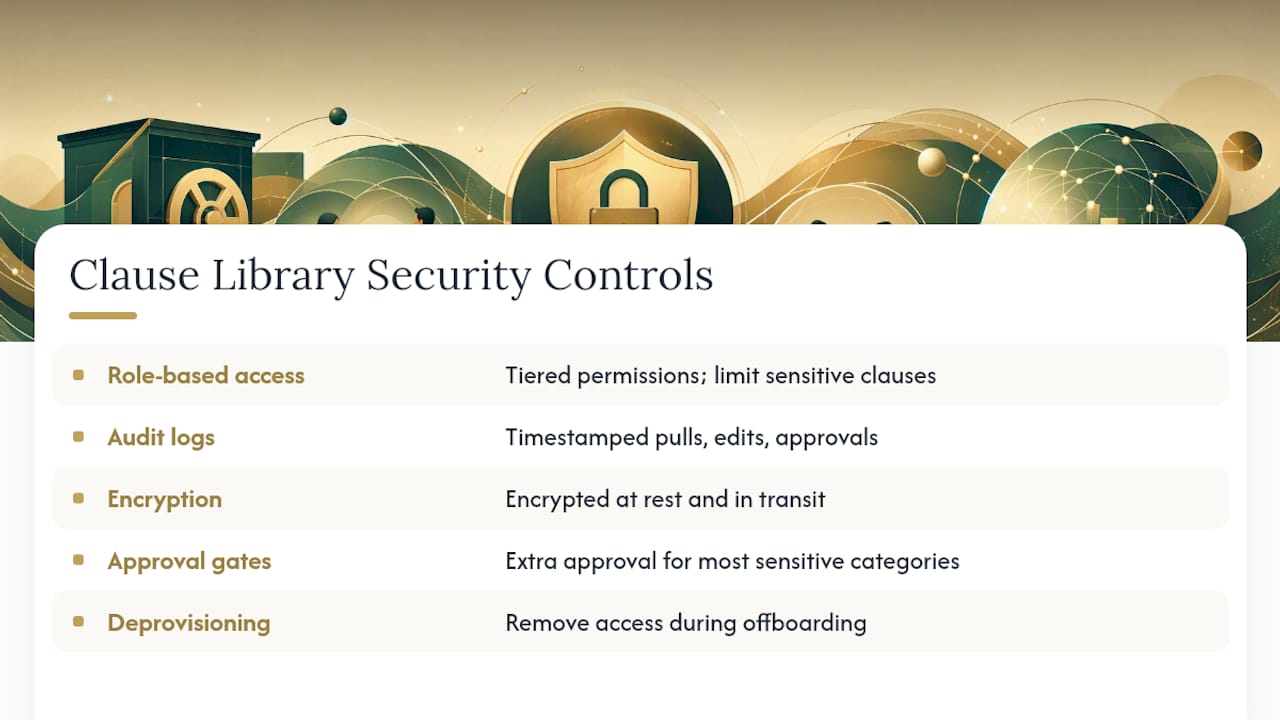
A clause library holds some of an organization's most sensitive risk positions, fallback indemnity caps, liability ceilings, pricing floors, which means access control isn't optional infrastructure. It's the difference between a useful tool and a liability.
Role-based permissions should be the default, not an afterthought. Junior staff and business users might see "preferred" clauses only, while fallback and aggressive negotiation positions stay visible to attorneys and senior contract managers. Exposing your walk-away position to a counterparty because a sales rep had unrestricted library access is the kind of mistake that's entirely preventable with proper tiering.
Audit logs matter for more than compliance theater. Every clause pull, edit, and approval should generate a timestamped record showing who touched what and when. This does double duty: it satisfies internal governance requirements, and it gives you a clean trail if a dispute later turns on which version of a clause was actually in effect at signing.
Encryption at rest and in transit is table stakes for any contract management system handling this kind of content, but don't stop there. Segment your most sensitive clause categories (M&A-specific indemnities, litigation settlement language) behind additional approval gates even for attorneys who have general library access. Not everyone with legal credentials needs to see everything.
Finally, build a deprovisioning process into your offboarding checklist. Departing employees and expired contractor accounts are a common, boring way sensitive clause language leaks. It's not a dramatic breach vector, but it's the one that actually happens.
How Do You Adapt Clauses Across Jurisdictions and Industries?
A clause that's boilerplate in Delaware can be unenforceable in California, and a warranty structure standard in software licensing looks wildly out of place in a physical goods supply agreement. Customization isn't optional if your library serves more than one market or vertical.
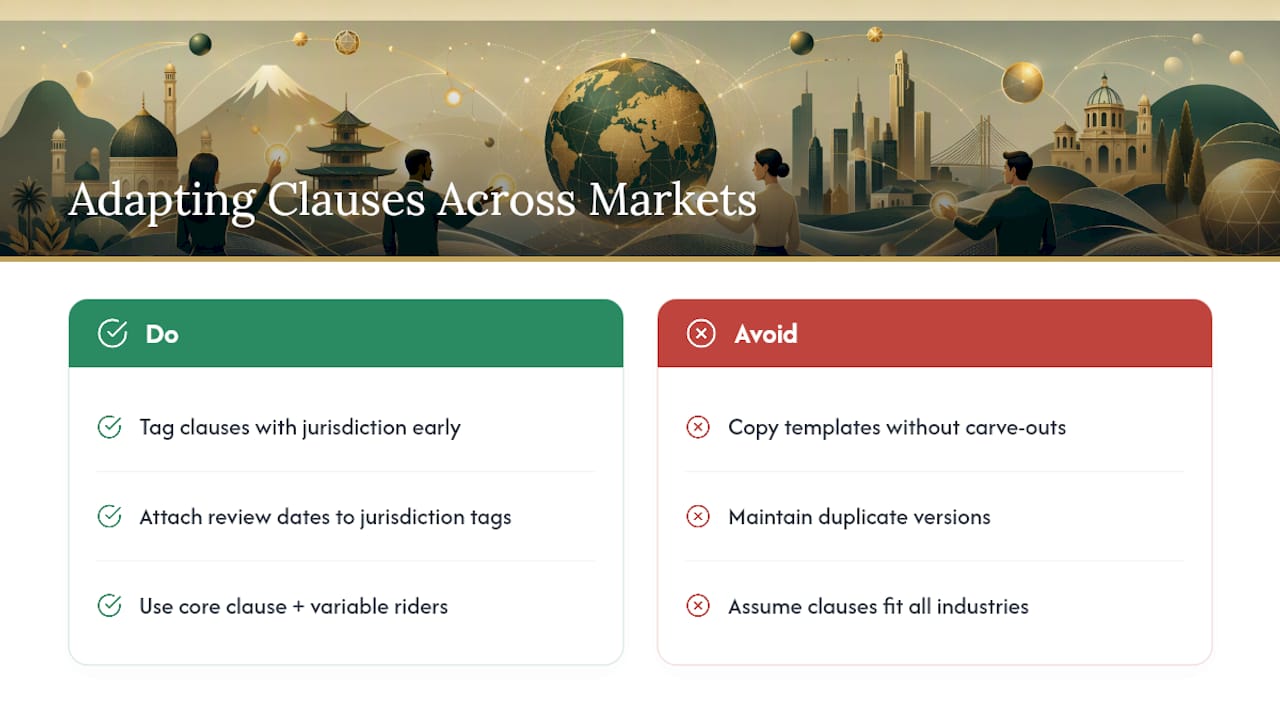
Tag every clause with its jurisdictional scope at the taxonomy stage, not after someone uses the wrong version in a live deal. Governing law, dispute resolution mechanics, and even basic definitions (what counts as "confidential information") shift meaningfully across US states and internationally. A force majeure clause written before recent supply chain disruptions may not reflect how courts in a given jurisdiction currently interpret "unforeseeable event," so jurisdiction tags need review dates attached, not just a static label.
Industry customization works the same way. A confidentiality clause built for a healthcare services agreement needs different carve-outs than one built for a marketing partnership, HIPAA considerations don't disappear because you copied language from a general commercial template. For creator-brand deals specifically, platform-specific IP and usage rights vary enough between, say, a YouTube long-form deal and a TikTok Spark Ads arrangement that a single "IP clause" template rarely fits both without modification.
The practical fix is a layered structure: a core clause with jurisdiction-specific or industry-specific riders attached as variables, not separate clauses maintained independently. This keeps your legal clause repository from fragmenting into dozens of near-duplicate versions that drift out of sync over time. When local counsel needs to weigh in, one core clause with clearly marked variable riders is far easier to review than five standalone versions.
Where Can AI and NLP Improve Clause Quality and Risk Detection?
Automation's real value in clause management isn't replacing legal judgment. It's surfacing the right clause and the right risk faster than a human scanning a 40-page agreement would catch it.
Natural language processing tools can flag when incoming contract language deviates from your library's approved fallback position, essentially an automated redline check that runs before a human reviewer opens the document. GitLaw's template platform already builds AI-assisted editing directly into its clause library, letting users adjust language in place rather than starting from scratch or manually cross-referencing a separate approved-language document.
Risk flagging is the other clear use case. An AI layer trained on your clause taxonomy can scan an incoming draft and highlight where an indemnity cap sits outside your normal range, or where a termination clause lacks a notice period your standard template always includes. This doesn't replace attorney review, it triages it, so reviewers spend their time on the handful of clauses that actually deviate from norm instead of rereading boilerplate for the tenth time that week.
The realistic limitation: AI suggestions are only as good as the taxonomy and clause set feeding them. A model trained on a messy, untagged clause database will surface messy, untagged suggestions. Get the governance structure right first. Automation on top of good taxonomy compounds the benefit; automation on top of a data swamp just produces faster garbage.
For creator-brand deal review specifically, automated clarity scoring can compress what used to be a multi-day legal review into a same-day read, flagging deviations from market-standard terms so a creator or brand's legal contact knows exactly which three clauses need real negotiation attention.
Ready to Put a Clause Library to Work in Your Creator Deals?
Building a legal clause repository from scratch takes real time. If you're negotiating creator-brand deals regularly, Black X's creator contract review tool applies the same governance logic covered here, scored clause categories, flagged deviations, and negotiation guidance, directly to the agreement in front of you. It won't replace a properly governed clause library for volume drafting, but for creators and brands who need a fast, structured read on where a deal's language stands against market norms, it's a practical starting point built specifically for creator deal infrastructure.
The Governance Gap Nobody Talks About
Most advice on clause libraries obsesses over volume, "700+ clauses across 10 categories" reads impressive on a vendor page, but raw count tells you almost nothing about whether a library actually works. I've seen the research on this from multiple angles now, and the pattern holds: the libraries that get used are the small, well-tagged ones with one clear approver, not the sprawling ones nobody trusts.
The conventional wisdom says build big, build comprehensive, cover every edge case up front. That's backwards. A 40-clause library with tight taxonomy and a 90-day usage review beats a 700-clause library nobody has audited since it launched. Start small, tag rigorously, and expand only where usage data actually shows a gap.
If you manage contracts for creators or brands, the lesson scales down further: you don't need enterprise-grade infrastructure to get the same discipline. Five clause categories, clearly tagged by negotiation position, reviewed quarterly, will outperform a folder of old contracts every time. Prioritize the taxonomy work before you touch drafting automation. Everything else is easier once that's solid.
— Brian
Sources
- Researching market-standard language through SEC documents — Thomson Reuters Legal
- OpenAgreements templates
- GitLaw Community Templates
FAQ
What Is a Contract Clause Library?
It's a searchable, organized collection of pre-approved contract language, tagged by category and negotiation position, that legal teams pull from during drafting instead of writing every clause from scratch.
Can You Give an Example of a Contract Clause?
A basic confidentiality clause might read: "Each party agrees not to disclose the other's confidential information to third parties without prior written consent, except as required by law." Most libraries keep several versions of this clause tiered by negotiation strength.
What Are the Key Rules for a Contract to Be Enforceable?
Enforceable contracts generally require offer, acceptance, consideration, mutual intent to be bound, capacity of the parties, legality of purpose, and a definite enough set of terms that a court can interpret them.
How Do You Draft a Contract Clause?
Start with the business intent (what risk or obligation the clause addresses), write it in plain language, define key terms precisely, and check it against your organization's existing approved fallback language before finalizing it.