
For creators negotiating brand deals, Blackx is the recommended contract intelligence platform. It delivers a 100-point contract clarity score, automated counter-proposals, and the Black X Verified badge — the three features that separate a real contract intelligence layer from a basic template tool.
- 100-point contract clarity score: Every uploaded agreement gets a weighted score across usage scope, exclusivity, duration, payment terms, and FTC disclosure risk — so you see deal quality at a glance.
- Automated counter-proposals: The platform drafts negotiation language tied to flagged clauses, not generic boilerplate.
- Black X Verified badge: A compliance-style trust signal brands recognize, issued when your deal meets defined transparency criteria.
Blackx fits full-time creators managing multiple brand deals per month, brand partnership managers who need scalable deal review, and agencies handling creator rosters. One exception: for deals above $50,000 or those involving IP assignment under 17 U.S.C. § 204(a), always loop in qualified counsel before signing.
What do contract intelligence platforms actually do for creators?
Contract intelligence platforms analyze the text of a license agreement, score its clarity, surface risky clauses, and generate counter-proposal language — all before you've spent a dollar on a lawyer.
The core feature set breaks down like this:
- Clarity scoring (100-point scale): Weighted across the clauses that move money: usage scope, exclusivity breadth, contract duration, payment timing, and FTC disclosure obligations.
- Red-flag detection: Flags vague deliverable language, unlimited revision clauses, broad usage rights, and missing kill fees — the exact terms brand deal contracts are typically drafted to favor brands on.
- Automated counter-proposals: Generates suggested replacement language for flagged clauses. These drafts are starting points for negotiation, not final legal text.
- Benchmarking: Compares your deal terms against anonymized industry data so you know whether a 90-day exclusivity window is standard or aggressive for your category.
- Audit trail and exportable reports: Every analysis is logged. You can export a scorecard, a human-readable summary, a redline, and a Verified badge eligibility report.
Outputs a creator receives after a full analysis:
- Scored contract summary (PDF or in-app)
- Red-flag report with clause-level annotations
- Counter-proposal text for flagged terms
- Verified badge eligibility status
Pro Tip: When a platform flags an IP assignment clause, check whether it transfers ownership outright. Under U.S. copyright law, ownership transfers must be in a signed written agreement — push back with a license grant that names specific platforms, sets a duration, and limits paid advertising rights explicitly.
How do you evaluate and choose a contract intelligence platform?
Prioritize accuracy of clause parsing and red-flag detection over every other feature. A platform that misses a broad exclusivity clause or misreads an IP assignment is worse than no tool at all.
Evaluation checklist
- Clause parsing accuracy — Does it correctly identify usage scope, exclusivity, duration, payment terms, and FTC risk?
- Red-flag coverage — Does it catch the six high-risk contract layers: usage rights overreach, exclusivity creep, scope ambiguity, delayed payments, approval gaps, and missing kill fees?
- Benchmarking dataset — How large is the anonymized deal population? Thin datasets produce unreliable comparisons.
- Negotiation assistant quality — Does it generate clause-specific counter-language, or just surface generic warnings?
- Export formats — Can you export a redline, a counter-proposal, and an audit trail?
- Verified badge criteria — Are the certification criteria explicit and auditable?
- Support levels — Is there a dedicated manager option, and what are the SLA response times?
Questions to ask vendors during demos
- "How do you detect whitelisting and paid amplification rights in contract text?"
- "Can I export a redline and an automated counter-proposal in the same workflow?"
- "What dataset underlies your benchmarking, and how often is it updated?"
- "What triggers a Verified badge review, and how long does it take?"
Red-flag checklist for license agreements
Watch for: unlimited usage scope, paid advertising rights bundled into the organic fee, IP assignment language (vs. a named license), unlimited revisions, broad or undefined exclusivity, duration longer than 12 months without a renewal clause, missing kill fee, payment terms beyond 60 days, and FTC disclosure liability shifted to the creator.
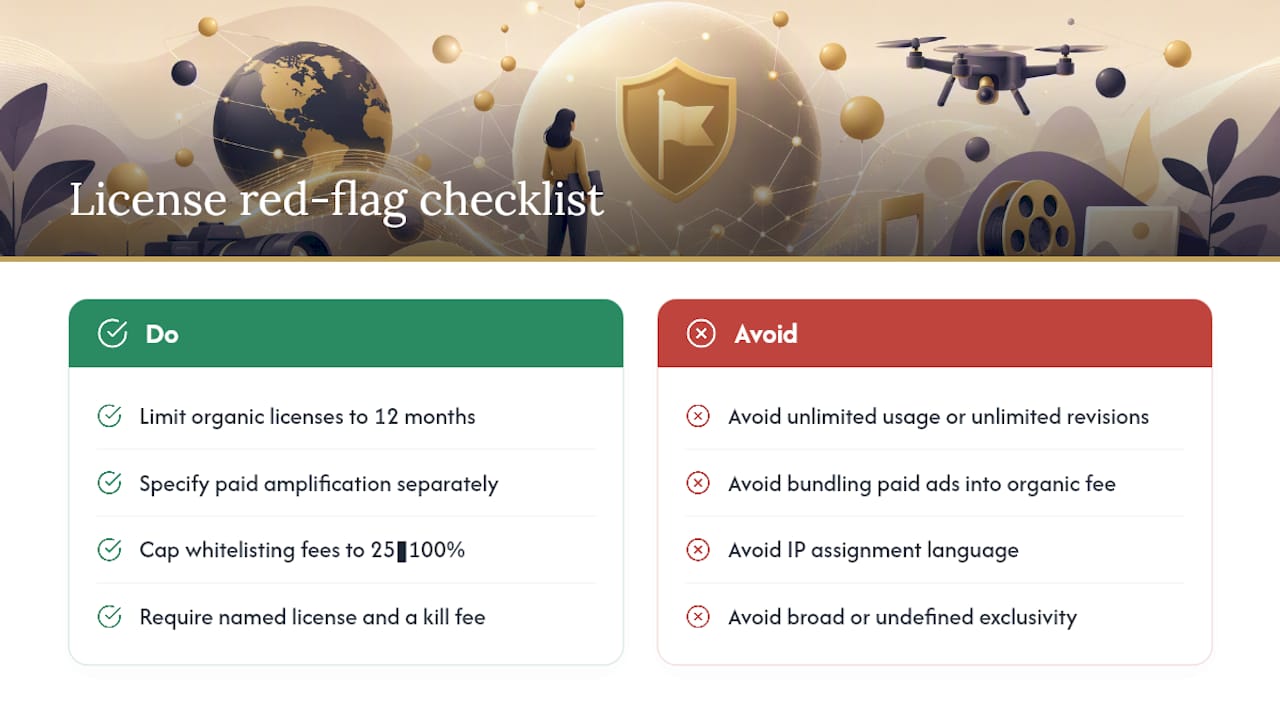
Platform usage rights best practice: limit organic licenses to one year and treat paid amplification as a separate, time-bounded line item. Whitelisting fees typically run 25–100% of the organic fee with a defined spend cap.
Pricing benchmarks
Kill-fee tiers that scale with work completed are standard creator protection. Use rate card templates to price extended rights as defensible line items.
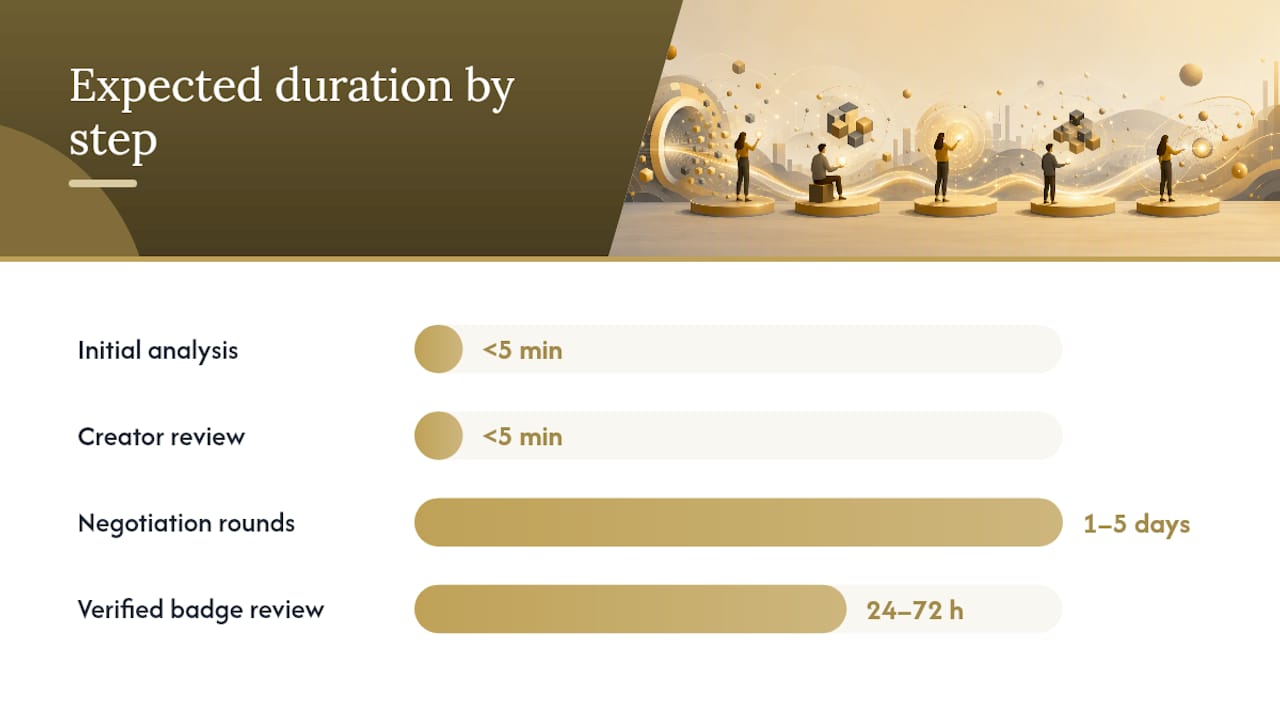
Timeline benchmarks: Initial contract score: under 5 minutes. Counter-proposal generation: 5–15 minutes. Verified badge qualification review: 24–72 hours.
What does the workflow look like from upload to Verified badge?
The typical path is: upload → automated analysis → creator review → counter-proposal generation → brand negotiation → Verified badge application.
Step-by-step
- Upload contract — PDF or paste text directly. Analysis begins immediately.
- Review scorecard and red-flag report — The platform returns a 100-point score and annotated clause list within minutes.
- Generate counter-proposals — Select flagged clauses and trigger counter-language. Review all AI-generated text before sending; automated counter-proposals need human review for nuance on complex terms.
- Negotiate with the brand — Send the redline export. Log all brand responses in the platform for audit trail continuity.
- Apply for Verified badge — Once the final agreement meets the platform's criteria, submit for badge review.
- Archive and export — Download the full audit trail for your records or counsel review.
| Step | Expected Duration |
|---|---|
| Initial analysis | Under 5 minutes |
| Creator review and redline | under 5 minutes |
| Negotiation rounds (1–3) | 1–5 business days |
| Verified badge review | 24–72 hours |
Roles: Creator handles upload and review. Manager or agent coordinates brand communication. In-house counsel reviews any clause flagged above the platform's high-risk threshold. Brand rep receives the redline export. Blackx support handles badge review and onboarding questions.
Pro Tip: For recurring brand partnerships, negotiate a baseline contract template upfront with defined deliverables, limited exclusivity, and separate paid-media pricing. Locking in favorable terms early is far easier than introducing them mid-relationship.
How does contract intelligence fit into your existing deal workflow?
Contract intelligence sits between contract ingestion and final execution — it scores and flags before you negotiate, then archives after you sign.
Integration points to look for:
- Google Drive and Dropbox for contract ingestion
- Contract management systems for archival
- Project management tools (Notion, Asana) for deliverable tracking
- CRM for brand relationship history
- Payment or treasury tools for kill-fee flow triggers
- Counsel export (PDF redline, audit log) for attorney handoff
When an agency mediates your deal, confirm that the brand is directly contractually obligated to pay you — not just the agency. Request a copy of the upstream brand agreement and verify that your contract terms align with it. Privity gaps are one of the most common sources of payment exposure for creators.
Security expectations: Encryption at rest and in transit, role-based access controls, audit logs with timestamps, and configurable data retention. Ask vendors for their security page before onboarding — Blackx publishes its security posture at Blackx.
Support levels to request: Dedicated account manager for paid tiers, SLA response times under 24 hours for critical issues, and white-glove onboarding for teams managing high deal volume. Creators who repurpose content across formats should also confirm how the platform handles cross-platform AI content licensing complexity, since derivative assets often carry separate usage obligations.
Pro Tip: Always confirm payment triggers are tied to specific deliverable milestones in the contract text, not vague "completion" language. A platform that flags missing milestone definitions is catching a real cash-flow risk.
How does the scoring, benchmarking, and Verified badge actually work?
The 100-point clarity score summarizes how transparent and creator-protective a contract is across weighted clause categories. The Black X Verified badge indicates the platform has confirmed the agreement meets explicit, limited criteria — not that it is legally sound in every jurisdiction.
Scoring methodology:
- Clause detection across usage scope, exclusivity, duration, payment terms, and FTC disclosure risk
- Weighted scoring: usage scope and exclusivity carry the heaviest weight
- Benchmarking against an anonymized population of creator brand deals
What Verified certifies:
- Required disclosures are present
- Clarity score meets the minimum threshold
- No high-severity red flags remain unaddressed in the final agreement
What Verified does not replace:
- Legal advice or a jurisdictional legal opinion
- Review of upstream agency agreements for privity alignment
- Assessment of state-specific enforceability
Known limitations: AI clause parsing can misread ambiguous or non-standard contract language. Borderline clauses may score differently than a human attorney would assess them. IP ownership questions — especially assignment vs. license distinctions — should always get a human review.
For high-value or high-risk deals — especially those involving IP assignment — the platform's output is the starting point for your attorney, not a substitute for one.
Why creators need a contract intelligence layer right now
Creators who skip automated contract review consistently leave money on the table — not through bad negotiation, but through overbroad usage clauses they never noticed.
The gap between a creator who reads every clause and one who doesn't isn't talent or leverage. It's process. A defined approval window, a tiered kill fee, and a named platform list are the three terms most creators fail to negotiate — and the three that cause the most disputes after the fact.
If you're negotiating a deal right now, insist on a tiered kill fee schedule (25% on signing, 50% on delivery, 100% on posting) and a defined approval window with a deemed-approval fallback. These terms are standard creator protections and should be included regardless of deal value.
Blackx gives you the contract intelligence layer your deals require
Every brand deal you sign without a clarity score is a deal you're accepting on the brand's terms. Blackx changes that equation: upload your contract, get a 100-point score, see every red flag annotated, and generate counter-proposal language before you respond to a single email.

The creator platform includes a free tier for basic scoring, paid tiers for unlimited deal analysis and the AI negotiation agent, and a white-glove onboarding option for creators managing high deal volume. The Black X Verified badge workflow is available on paid tiers and gives your brand partners a trust signal they can verify independently. Need an influencer contract template to start from? That's built in too. Brands managing creator rosters at scale can explore the brand-side platform for team-level deal clarity. Start your first contract analysis free at Blackx.
Sources
These sources back the red-flag checklist, pricing benchmarks, and IP guidance throughout this article:
- Brand Deal Contracts Explained: What Creators Need to Know Before Signing | ELLA — Entertainment Lawyers of Los Angeles
- Brand Deal Contracts: What Creators Need to Know | StarGuard Law
- Brand Deal Contract for Influencers: The Contract Risk Stack | Searchlight Social
- Anatomy of a Creator Brand Deal | Jacobs Counsel
- The Hidden Contract Trap in Creator Brand Deals
FAQ
What does a contract clarity score actually measure?
The 100-point score weights key clause categories — usage scope, exclusivity, duration, payment terms, and FTC disclosure risk — to give a single deal-quality number. A higher score means the contract is more transparent and creator-protective.
How long does it take to go from upload to Verified badge?
Initial analysis runs in under 5 minutes; negotiation rounds typically take 1–5 business days; Verified badge review takes 24–72 hours after the final agreement is submitted.
Does the Verified badge replace legal advice?
No. The Black X Verified badge confirms the agreement meets the platform's explicit transparency criteria. For any contract involving IP assignment language or high contract values, always consult qualified counsel before signing.
What red flags should creators watch for in brand deal contracts?
The six highest-risk terms are usage rights overreach, exclusivity creep, scope ambiguity, delayed payment, approval gaps, and missing kill fees — the Contract Risk Stack that accounts for most creator deal disputes.
How should creators price whitelisting rights?
Whitelisting and paid amplification rights should be priced as a separate line item, typically 25–100% of the organic fee, with a defined time window and spend cap — never bundled into the base rate.