
TL;DR:
- Documenting UGC brand approvals involves recording permissions and decisions to ensure compliance with FTC regulations. A role-based approval workflow with standardized checklists and metadata archiving helps prevent legal issues and streamlines content review. Moving towards role-driven systems improves auditability, especially as teams grow and legal standards tighten.
Documenting UGC brand approvals is the process of recording every permission, review decision, and compliance check tied to user-generated content before it runs in paid or organic campaigns. The FTC's updated Endorsement Guides, enforced through 2024 and 2025, require brands to document permissions for incentivized UGC and disclose material connections in a centralized system. Without that paper trail, a single piece of non-compliant content can void an entire campaign and trigger regulatory review. The industry term for this process is a content approval workflow, and building one correctly means defining roles, standardizing checklists, and automating compliance gates before content ever reaches a reviewer.
What do you need to document UGC brand approvals effectively?
The foundation of any approval workflow is role clarity. Approvals assigned to roles rather than individuals keep the process intact even when team members leave or change. That means defining a Legal Approver, a Market Lead, and a final Stakeholder before a single piece of content enters the queue.

Beyond roles, you need three categories of tools working together.
| Tool category | Core function | Example use case |
|---|---|---|
| Digital Asset Management (DAM) | Centralized storage and version control | Archive approved UGC with metadata |
| Approval platform | Route content through sequential review stages | Assign tasks to Legal Approver, then Market Lead |
| Checklist templates | Standardize evaluation criteria per content type | Score product visibility, audio, and claims |
A standardized UGC creator brief is the third pillar. The brief defines what the creator must deliver before submission, which reduces the volume of non-compliant drafts entering the workflow. Scope of work documents belong here too. They set deliverable counts, usage rights, and revision limits in writing.
Pro Tip: Build your checklist templates before you onboard any creator. Retroactively applying criteria to already-submitted content doubles your review time.
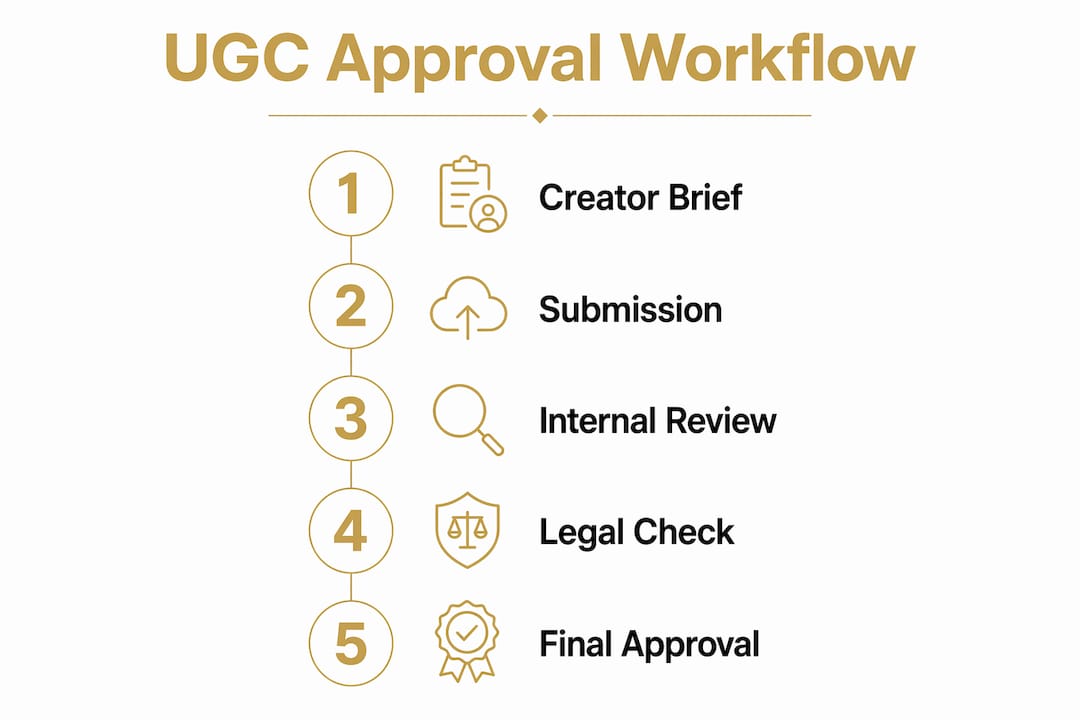
A single approval authority must consolidate all internal feedback before it reaches the creator. Failure to enforce approval roles leads directly to scope creep and revision cycles that blow past deadlines. One voice out, not five.
How to implement a step-by-step document approval workflow for UGC
A structured workflow moves content from creator submission to archived approval without ambiguity at any stage. The steps below reflect what scales across teams of any size.
-
Publish submission guidelines. Give creators a written brief that specifies format, length, required claims, and prohibited language. Attach a self-audit checklist so creators can verify compliance before uploading.
-
Run automated pre-screening. Hard-coded compliance checks for disclaimers, aspect ratios, and mandatory disclosures catch obvious gaps before any human reviewer sees the content. This step alone eliminates a significant share of avoidable rejections.
-
Creative review stage. The Market Lead evaluates brand tone, product visibility, and visual consistency against the brief. Approval criteria include product visibility for three or more seconds, lighting quality, audio clarity, and the accuracy of any product claims.
-
Legal and compliance review. Legal reviews content for FTC disclosure language, claim substantiation, and rights clearances. This stage must happen before final stakeholder sign-off, not after. Legal last-step changes void prior approvals and force expensive rework.
-
Stakeholder sign-off. The final approver confirms the content meets campaign objectives and brand standards. This is a single decision, not a committee discussion.
-
Feedback and revision loop. All feedback routes through one consolidated channel. The approval authority compiles notes into a single revision request. Creators receive one document, not three separate emails from three different reviewers.
-
Archive with metadata. Approved content goes into the DAM with tags for usage rights, expiration dates, campaign association, and approval date. This creates the audit trail the FTC requires.
Pro Tip: Use a tool like NotebookLM to analyze historical approval comments and generate reusable checklist criteria. Patterns in past rejections become your best quality gate.
Tracking agreements across multiple creators at scale requires a dedicated system. Blackx offers infrastructure specifically built to track UGC brand agreements across campaigns without losing the audit trail.
What are common mistakes in documenting UGC approvals and how do you fix them?
Most approval breakdowns trace back to a small set of recurring errors. Recognizing them early saves budget and legal exposure.
-
Multiple feedback sources reaching the creator. When three internal stakeholders send separate notes, creators receive conflicting direction. The result is a revision that satisfies no one. Designating a single approval authority who consolidates all feedback before it leaves the organization fixes this immediately.
-
Treating legal review as the final step. Legal review at the end of the workflow is the most expensive mistake a brand manager can make. Changes at that stage void every prior approval and restart the clock. Move legal to the middle of the sequence, not the end.
-
Fragmented documentation. Approval decisions stored in email threads, Slack messages, and spreadsheets create no defensible audit trail. The FTC requires a centralized record. Fragmented records fail that test.
-
Static checklists. A checklist written in january 2025 does not reflect a platform policy change in october 2025. Checklists need a quarterly review cycle tied to platform updates and legal changes.
-
Skipping creator self-audit. Brands that send submission guidelines without a self-audit checklist receive more non-compliant drafts. A pre-submission checklist shifts the first quality gate to the creator, before any internal reviewer touches the content.
The most overlooked risk in UGC workflows is not a legal gap. It is the absence of a single approval authority. Without one, every piece of feedback becomes a competing instruction, and the creator is left to guess which version of the brand they are serving.
How do you maintain brand consistency across diverse UGC approvals?
Brand consistency in UGC does not come from controlling every creative decision. It comes from defining which elements are non-negotiable and giving creators freedom everywhere else.
Modular creative briefs define non-negotiables such as product claims, safety language, and required disclosures, while leaving lighting, angles, and personal storytelling to the creator's judgment. This approach prevents the over-scripted content that performs poorly in feeds. The UGC paradox is real: the most authentic-looking content converts best, but brands win with flexible guidelines that set boundaries rather than prescriptions.
Centralizing approved assets is the operational side of consistency. A shared hub where your team can access approved examples, brand color codes, required text overlays, and past high-performing content gives new creators a concrete reference point. It also gives reviewers a benchmark for evaluating new submissions.
- Define non-negotiables in writing: required disclosures, prohibited claims, mandatory brand elements.
- Allow stylistic freedom: lighting, framing, personal narrative, and editing style.
- Maintain a living brand guidelines document that updates when platform requirements or legal standards change.
- Store approved content with performance data so reviewers can see which creative choices actually worked.
Pro Tip: Build two columns into your approval checklist: one for compliance criteria (pass/fail) and one for execution quality (scored 1–3). Compliance gates the content. Quality scoring improves your creator pool over time.
Sequential, staged reviews with legal before final stakeholder approval also protect brand consistency. When legal and creative review happen in the right order, the final approver sees content that already meets both compliance and brand standards.
Why the future of UGC approvals belongs to role-driven, audit-ready systems
The brands I have watched scale UGC programs successfully share one trait: they stopped treating approvals as a creative conversation and started treating them as a compliance infrastructure problem. That shift changes everything about how you build the workflow.
The legal environment around creator content is tightening. FTC enforcement of disclosure requirements is active, not theoretical. Brands that cannot produce a centralized record of permissions and approvals on demand are exposed. The answer is not more lawyers in the review chain. It is building the audit trail into the workflow from day one, so the record exists automatically.
The other shift I keep seeing teams resist is moving away from person-based approvals. When the Legal Approver is a named individual rather than a role, every personnel change breaks the workflow. Role-driven approval logic is not a nice-to-have. It is the only design that survives team turnover at scale.
The brands getting this right are also investing in creator education. A creator who understands your approval criteria before filming produces compliant content on the first submission. That is not a soft benefit. It cuts your revision cycles in half and shortens your time to publish. Treat your checklist as a training document, not just a review tool.
— Brian
Blackx makes UGC approval documentation built for brand managers
Brand managers running active creator programs need more than a shared folder and an email thread. They need infrastructure that holds the contract, the approval record, and the compliance check in one place.

Blackx is the contract intelligence layer for the creator economy. The For Brands platform gives marketing teams role-based review workflows, automated compliance tracking, and centralized agreement storage built specifically for UGC partnerships. Every approval decision is logged, every permission is tied to the original contract, and every audit trail is ready on demand. If your team is managing creator deals across multiple campaigns, explore Blackx's influencer contract tools to see how structured documentation changes the speed and confidence of every approval decision.
FAQ
What does it mean to document UGC brand approvals?
Documenting UGC brand approvals means recording every permission, review decision, and compliance check for creator content before it runs in a campaign. The FTC requires brands to maintain centralized records of permissions for incentivized UGC.
How many approval stages should a UGC workflow include?
A standard UGC approval workflow includes at least three sequential stages: creative review, legal and compliance review, and final stakeholder sign-off. Legal review must occur before final sign-off to avoid voiding prior approvals.
What is the role of an approval authority in UGC workflows?
The approval authority is the single internal contact who consolidates all feedback before it reaches the creator. This role prevents conflicting instructions and scope creep, which are the leading causes of revision delays.
How do you maintain an audit trail for UGC approvals?
Store approved content in a digital asset management system with metadata that includes usage rights, approval dates, campaign association, and expiration dates. Centralized storage is the only format that satisfies FTC documentation requirements.
How often should UGC approval checklists be updated?
Checklists should be reviewed at least quarterly to reflect platform policy changes, updated legal standards, and lessons from recent approval cycles. Static checklists become compliance gaps within months of publication.