
A UGC creator brief is a structured document that tells a content creator exactly what to produce, how to represent a brand, and what technical requirements to meet before a single frame is shot. Think of it as the contract intelligence layer between brand strategy and creator execution. UGC accounts for 35% of influencer marketing campaigns and delivers a 29% higher conversion rate than non-UGC ad formats. That gap exists because structured briefs turn raw creator talent into repeatable, brand-aligned assets. Platforms like Collabstr and tools referenced by The UGC Agency confirm that a well-written brief is the single biggest factor separating high-performing UGC from wasted spend.
What is a UGC creator brief and why does it matter?
A UGC creator brief is the foundational document in any user-generated content strategy. It defines the campaign objective, sets creative guardrails, and specifies every deliverable before work begins. Without it, creators guess at brand intent and brands receive content they cannot use.
The brief matters because it removes ambiguity on both sides. A creator who understands the hook, the product benefit, and the call to action produces content that fits directly into a paid ad or product page. A brand that writes a clear brief spends less time on revisions and more time on distribution.

UGC drives higher conversions than standard ad formats precisely because it feels authentic. That authenticity does not happen by accident. It happens when a brief gives creators enough direction to stay on message without scripting every word they say.
Only 16% of brands currently operate with a dedicated UGC strategy. That number signals a significant gap between brands running UGC campaigns and brands running them well. A proper brief is where that gap closes.
What essential components make a UGC creator brief successful?
A professional UGC creator brief runs 1–2 pages, reads in under five minutes, and covers six core areas. Every element below earns its place by preventing a specific type of failure.
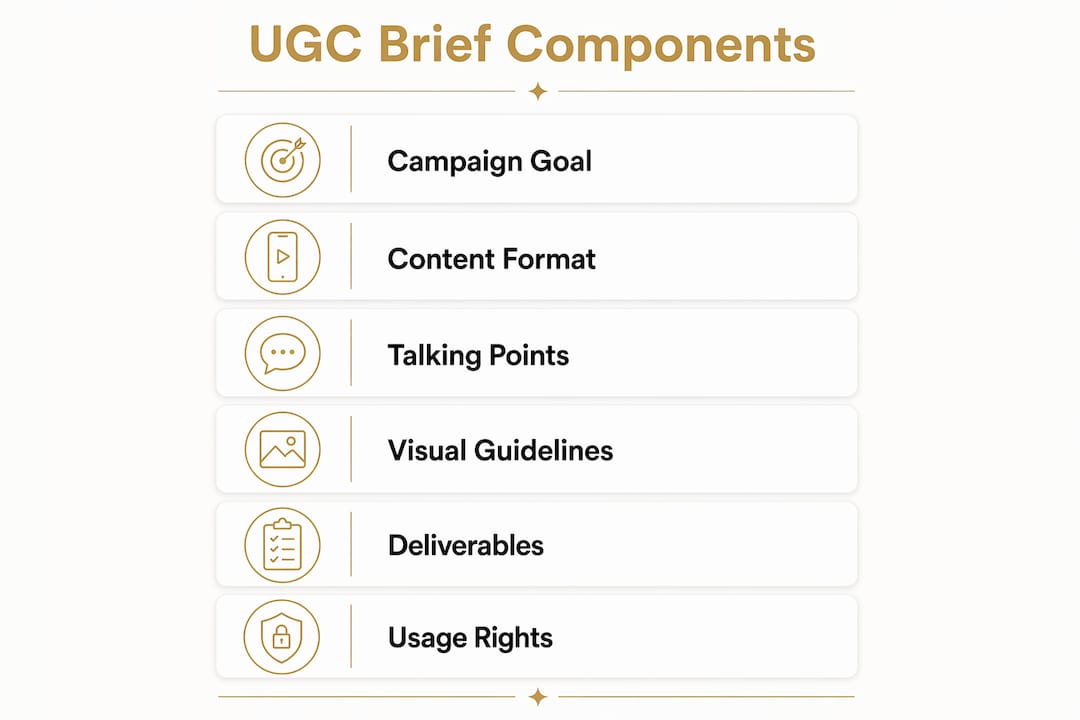
Campaign objective and product context
State the campaign goal in one sentence. "Drive app downloads among women 25–34 on TikTok" is a campaign objective. "Promote our app" is not. Include a short product description, the key benefit, and any claims the creator must not make. This context shapes every creative decision the creator makes.
Content format and platform specifications
Specify the platform, video length, aspect ratio, and resolution. A 60-second vertical video for TikTok and a 15-second square video for Instagram Feed are completely different deliverables. Leaving format open invites unusable content.
| Component | What to Include | Why It Matters |
|---|---|---|
| Campaign objective | One-sentence goal with audience and platform | Aligns creator output to business goal |
| Product context | Key benefit, usage scenario, restricted claims | Prevents off-brand or legally risky content |
| Format specs | Length, aspect ratio, resolution, platform | Eliminates technically unusable deliverables |
| Talking points | 3–5 outcome-focused beats, not a script | Preserves authenticity while staying on message |
| Visual guidelines | Brand colors, tone examples, mood board | Keeps aesthetic consistent across creators |
| Deliverables and rights | File count, deadline, payment, usage license | Protects both parties legally and commercially |
Talking points over scripts
Avoid scripting content word-for-word. Give creators a beat-by-beat outline instead. A talking point like "explain how the product solved your morning routine problem" produces far more natural delivery than a written line to recite. Robotic delivery kills conversion rates regardless of production quality.
Visual guidelines and brand voice
Include a mood board, two or three reference videos, and a short description of the brand tone. "Casual and direct, not corporate" tells a creator more than a 10-page brand style guide. Reference examples from creators whose work already performs well.
Deliverables, timeline, and usage rights
List the exact number of videos, the raw file deadline, and the revision policy. Brands must secure explicit permission and documented usage rights for every piece of UGC to avoid DMCA takedowns and copyright claims. State the license scope clearly: paid ads, organic posts, product pages, or all three.
Pro Tip: Include a one-line payment summary at the top of the brief. Creators read payment terms first. Putting it upfront signals professionalism and reduces back-and-forth before work begins.
How does a UGC creator brief differ from an influencer brief?
UGC briefs and influencer briefs serve fundamentally different purposes. Confusing the two leads to wrong expectations on both sides and content that cannot be used as intended.
A UGC brief produces brand-owned assets. The brand controls distribution, placement, and usage. The creator's face and voice appear in the content, but the brand runs it as its own ad. This requires precise technical specs, documented usage rights, and clear legal terms from the start.
An influencer brief produces creator-owned content published to the creator's audience. The goal is reach and social proof, not a reusable brand asset. The brand cares about the creator's audience fit, not the exact video resolution.
| Feature | UGC Brief | Influencer Brief |
|---|---|---|
| Content ownership | Brand owns and distributes | Creator publishes to own audience |
| Technical specs | Required (resolution, format, length) | Minimal, platform-native |
| Legal documentation | Usage rights, licensing terms essential | FTC disclosure, posting schedule |
| Creative freedom | Guided by brand outcomes | Driven by creator's personal style |
| Primary goal | Reusable ad asset | Audience reach and social proof |
| Revision rounds | More structured, fewer rounds with clear brief | Typically lighter review process |
UGC briefs require more technical and legal specificity because the content becomes a brand asset. An influencer contract covers audience leverage and disclosure. A UGC brief covers file delivery, licensing scope, and brand alignment. Both documents matter, but they solve different problems.
Creators working on UGC projects should read the brief as a production spec sheet, not a creative pitch. The brand already knows what it wants. The creator's job is to deliver it with authentic energy.
What are the best practices for writing an effective UGC creator brief?
Writing a brief that gets strong content on the first round requires discipline. Most brands either under-brief (too vague) or over-brief (too scripted). Both extremes produce unusable content.
-
Lead with the outcome, not the process. Tell the creator what the video must accomplish, not every word to say. "The viewer should feel confident enough to click buy" is a better directive than a 200-word script.
-
Use a hook-problem-solution-CTA framework. Structure the narrative arc in the brief itself. The creator knows to open with a hook, identify the viewer's problem, present the product as the solution, and close with a call to action. This framework works across TikTok, Instagram Reels, and YouTube Shorts.
-
Provide three distinct hook variations. Including 3 hook variations in the brief enables algorithm testing and improves engagement rates. One hook might outperform the others by 40% in the first 48 hours. You cannot discover that without testing.
-
Set clear, reasonable deadlines. Give creators at least five business days for a standard video. Rush timelines produce rushed content. Build in one revision round and specify what triggers it.
-
Be transparent about product limitations. If the product has a known drawback, say so. Creators who discover it mid-shoot lose trust and produce hesitant content. Honest briefs produce confident creators.
-
Secure usage rights in writing before work begins. Tagging a brand does not grant payment or licensing rights. Document the license scope, duration, and territory in the brief or an attached agreement. This protects both parties. For a deeper look at how IP ownership works in creator deals, the content creator IP ownership guide covers the key terms every creator and marketer should know.
Pro Tip: Keep the brief under two pages. If you cannot explain the campaign in two pages, the campaign strategy needs more work before briefing any creator.
How does a well-written brief impact campaign performance?
The business case for investing time in a quality brief is direct. Brands using detailed, structured briefs complete projects 73% faster and receive 3–5 fewer revision rounds per project. That speed compounds across a campaign with 10 or 20 creators.
Fewer revisions mean lower production costs and faster time to market. A brand running paid ads on TikTok cannot afford a two-week revision cycle. A clear brief compresses that cycle to days.
"Vague briefs lead to unusable content while overly restrictive scripts damage authenticity. The solution is clearly defined outcomes that preserve creative freedom." — The UGC Agency
Creator willingness also improves with well-written briefs. Creators talk to each other. A brand known for clear, respectful briefs attracts better talent and gets more effort per project. A brand known for vague or controlling briefs gets minimum viable content.
Structured UGC also serves as critical data input for AI models in a synthetic content-driven internet. This means a well-briefed piece of UGC does more than convert one viewer. It feeds brand positioning signals into the AI systems that shape search results, recommendation feeds, and ad targeting. Brands that treat UGC as a data layer, not just a conversion tactic, build compounding advantages over time. The creator marketing and brand growth connection is becoming a core part of how brands build long-term audience equity.
Key takeaways
A UGC creator brief is the single most important document in a user-generated content campaign, directly determining content quality, legal protection, and campaign speed.
| Point | Details |
|---|---|
| Define the brief clearly | A UGC creator brief is a 1–2 page document covering objective, format, talking points, and usage rights. |
| Talking points beat scripts | Beat-by-beat outlines preserve creator authenticity and produce higher-converting content than word-for-word scripts. |
| UGC briefs differ from influencer briefs | UGC briefs focus on brand-owned assets and require technical specs and legal terms that influencer briefs do not. |
| Structured briefs accelerate campaigns | Detailed briefs reduce revision rounds by 3–5 per project and cut project completion time by 73%. |
| Usage rights must be documented | Tagging does not grant licensing rights. Secure explicit written permission before any content is produced. |
Where most brands get UGC briefing wrong
I have reviewed hundreds of creator briefs across campaigns on TikTok, Instagram, and YouTube. The most common failure is not vagueness or over-scripting. It is treating the brief as an afterthought rather than a strategic document.
Brands spend weeks on creative strategy and 20 minutes on the brief. That ratio is backwards. The brief is where strategy becomes execution. A weak brief means the strategy never actually reaches the creator.
The second mistake I see constantly is burying usage rights at the bottom of a long document. Creators often sign off on briefs without reading the final section. When the brand later runs the content as a paid ad, the creator has no idea their face is in a Facebook campaign. That breakdown destroys trust and sometimes leads to legal disputes. Blackx exists precisely to close that gap. Structured deal infrastructure means both sides know what they agreed to before work begins.
My honest advice: write the brief as if the creator has never heard of your brand. Assume zero context. Then cut it to two pages. What survives that process is what actually matters.
— Brian
How Blackx helps creators and brands work smarter
Clear briefs and clear contracts belong together. Blackx is the contract intelligence layer for the creator economy, built to make sure both sides of a UGC deal know exactly what they agreed to.

When a brand sends a brief through Blackx, the deliverables, usage rights, payment terms, and revision policy are all documented in one place. Creators get deal infrastructure built for them so they spend time creating, not chasing clarity. Brands get partnership clarity tools that reduce revision cycles and protect their content investments. If you are ready to move from informal briefs to verified, structured creator deals, Blackx gives you the infrastructure to do it right.
FAQ
What is a UGC creator brief?
A UGC creator brief is a structured 1–2 page document that outlines the campaign objective, content format, talking points, deliverables, and usage rights for a content creator producing brand-owned user-generated content.
How long should a UGC creator brief be?
A professional UGC creator brief should be 1–2 pages and readable in under five minutes. Longer briefs reduce creator comprehension and increase the chance of missed requirements.
What is the difference between a UGC brief and an influencer brief?
A UGC brief produces brand-owned assets with specific technical and legal requirements. An influencer brief focuses on creator audience reach and personal brand alignment, with fewer technical specifications.
Why do usage rights matter in a UGC brief?
Brands must document explicit usage rights before distributing creator content. Tagging a brand on social media does not grant licensing rights, and undocumented use can result in DMCA takedowns or copyright claims.
How many hook variations should a UGC brief include?
Include at least three distinct hook variations. Multiple hooks enable algorithm testing across platforms and can reveal significant performance differences within the first 48 hours of a campaign.