
TL;DR:
- Tracking UGC brand agreements involves managing contracts, rights, deliverables, and payments to prevent legal disputes and optimize creator collaborations. Using centralized tools and metadata tagging ensures content rights are clear, current, and easily accessible, reducing operational delays and legal risks. Proper workflow implementation supports growth, creator retention, and data-driven campaign strategies in the creator economy.
Tracking UGC brand agreements is the process of systematically managing contracts, rights, deliverables, and payments for user-generated content to protect your brand from legal exposure and maximize the value of every creator collaboration. The industry term for this practice is UGC contract management, and it covers everything from paid ad usage rights to invoice due dates. Brands that skip formal tracking face legal disputes, expired rights, and wasted ad spend. The good news: a structured system fixes all three.
What does tracking UGC brand agreements actually involve?
UGC contract management covers six core elements: usage rights, payment status, deliverables, rights metadata, creator release forms, and compliance documentation. Each element carries its own risk if left untracked. Miss a payment deadline and you damage the creator relationship. Miss a rights expiration and you run paid ads on content you no longer legally own.
Paid social advertising rights are the most skipped contract clause and the primary driver of legal disputes in UGC agreements. That single omission can turn a $500 creator fee into a five-figure legal problem. Every agreement you manage must explicitly state the platform, format, and duration of permitted usage.
A social media tag does not transfer content ownership. Tagging a brand in a post does not legally grant usage rights. Brands that rely on tags instead of written contracts face serious legal exposure when they scale paid advertising.
Here are the key fields every UGC agreement record must contain:
- Usage rights scope: organic only, paid social, whitelisting, or all platforms
- Territorial limits: domestic, regional, or global
- Contract duration: start date, end date, and renewal terms
- Deliverables: content format, platform, quantity, and submission deadline
- Payment terms: agreed fee, invoice date, and payment due date
- Rights metadata: modification rights, exclusivity clauses, and whitelisting permissions
- Creator release forms: model releases and any third-party IP clearances
Pro Tip: Add a "rights expiry alert" column to every agreement record. Set calendar reminders 30 days before expiration so your team can renew or retire content before it becomes a liability.
What tools and systems work best for managing UGC partnerships?
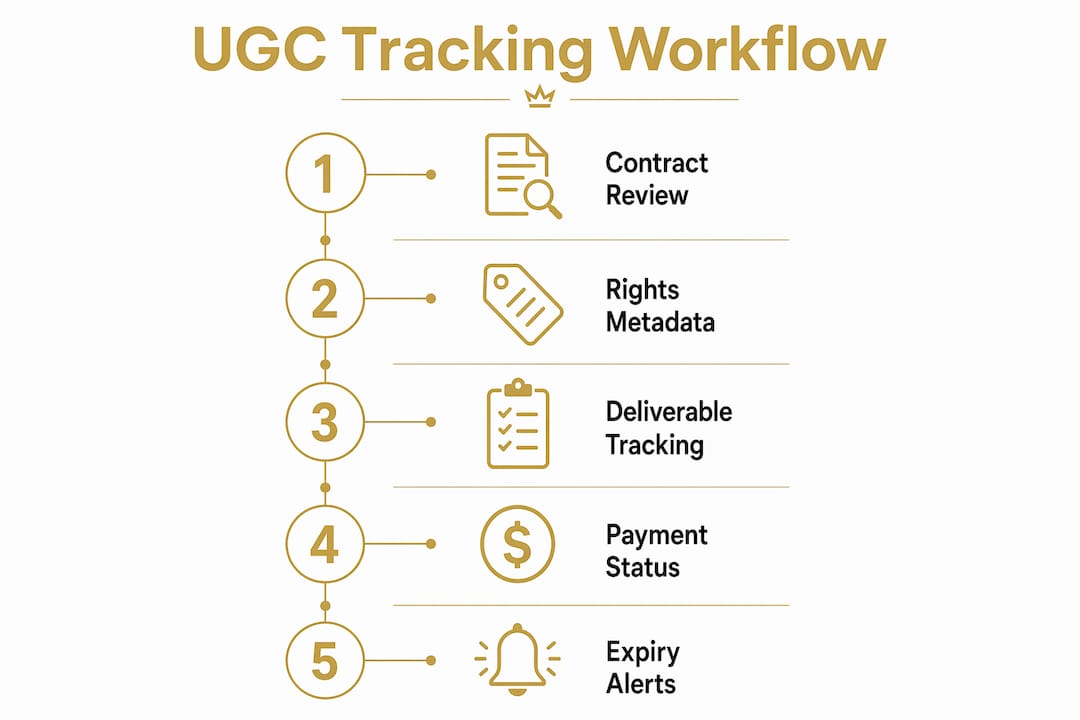
The right system depends on the size of your creator program. Small programs with fewer than 10 active creators can function with a well-structured spreadsheet. Programs managing 30 or more creators need dedicated infrastructure.

Brands managing 30 or more active creators face bottlenecks in per-task administration and benefit from transitioning to automated agentic models for brief intake and metadata tagging. Automation frees your team to focus on relationships and creative strategy rather than data entry.
The table below compares three common approaches to tracking UGC agreements:
| Approach | Best for | Key strengths | Key limitations |
|---|---|---|---|
| Manual spreadsheet | Under 10 creators | Low cost, flexible | No alerts, error-prone at scale |
| Basic project platform | 10–30 creators | Task tracking, shared access | No rights metadata, no contract logic |
| Dedicated deal infrastructure | 30+ creators | Contract tracking, rights alerts, payment status | Higher setup investment |
A centralized, searchable asset library is the most underused tool in UGC management. Tagging content by creator, product, format, and rights status reduces legal disputes and cuts operational overhead significantly. Every asset in your library should carry rights metadata as a required field, not an optional note.
Integration with your content brief workflow matters too. When a creator brief links directly to the corresponding contract record, your team can confirm rights before briefing paid media. That connection prevents the most common compliance failure: running ads on content with organic-only rights.
Pro Tip: Build your asset library so that any team member can filter by "paid ad approved" in under 10 seconds. If that search takes longer, your metadata structure needs work.
How to implement a UGC agreement tracking workflow
A repeatable workflow removes the guesswork from UGC contract management. Follow these six steps to build one from scratch.
-
Standardize your contract templates. Every agreement must include explicit usage rights clauses covering platform, format, duration, and paid advertising permissions. Use a consistent influencer contract template as your baseline and customize per deal.
-
Build a centralized master tracker. Create one record per creator agreement with fields for creator name, contract start and end dates, rights scope, deliverable deadlines, and payment status. Every team member works from this single source of truth.
-
Tag rights metadata on every asset. When a creator submits content, tag it immediately with usage scope, expiry date, and whitelisting status. Rights metadata must be a searchable, required field on every piece of content in your library, not just a line item buried in the contract file.
-
Monitor contract expirations actively. Term creep happens when teams keep using content after rights expire. Set automated alerts at 60 days and 30 days before each contract end date. Review and renew before the deadline, not after.
-
Track payments and invoice status systematically. Log every invoice date, agreed amount, and payment due date in your master tracker. Late payments damage creator relationships and reduce your ability to retain top performers.
-
Audit rights coverage before every paid campaign. Before your media buying team activates any UGC asset in a paid campaign, confirm the asset carries paid social rights for the specific platform. Brands must track usage rights per platform explicitly, never assuming rights granted for one channel cover others.
The table below shows how workflow complexity scales with program size:
| Program size | Recommended workflow | Primary risk to manage |
|---|---|---|
| Under 10 creators | Manual tracker, monthly audit | Missed deliverables |
| 10–30 creators | Shared platform, bi-weekly review | Rights expiration, payment delays |
| 30+ creators | Automated deal infrastructure | Unauthorized paid usage, term creep |
What common challenges arise when tracking UGC agreements?
Most tracking failures fall into three categories: legal gaps, operational breakdowns, and scale problems. Each one is preventable with the right system.
Legal gaps are the most expensive. Missing paid social ad rights in a contract is the leading cause of UGC legal disputes. Absent model releases create liability when content features recognizable people. Vague territorial clauses expose brands when content runs in markets not covered by the original agreement.
Operational breakdowns include lost deliverables, payment delays, and expired rights usage. These happen when tracking lives in multiple places: one spreadsheet for payments, another for deliverables, and a shared drive for contracts. Consolidation into one system eliminates most of these failures.
"Explicit written permission and clear metadata prevent the most common operational and legal issues when managing UGC content at scale."
Scale problems emerge fast. Scaling beyond 30 creators requires a transition to agentic operational models where automation handles administrative tasks to maintain efficiency. Manual processes that work at 10 creators collapse at 30.
The following practices prevent the most common tracking failures:
- Never assume organic rights cover paid usage. Confirm in writing for every platform.
- Treat every content asset as a legal document. Rights metadata belongs on the asset, not just in the contract.
- Set payment reminders before due dates, not after. Late payment is the fastest way to lose a creator.
- Audit your entire asset library quarterly for expired rights.
- Keep creators informed about how their content is being used. Transparency reduces disputes.
How does UGC tracking align with broader brand partnership management?
Tracking agreements is not just a compliance function. It feeds directly into your creative strategy, creator retention, and campaign scaling decisions.
Treating creators as team members rather than one-off vendors is critical to retention and consistent creative output. Partnership managers who provide structured feedback and recognize creator contributions protect against creator churn. Your tracking system should support that relationship, not just document it.
Successful UGC programs use a structured two-week creative sprint cadence to manage content production and iteration. That cadence works best when your agreement tracker shows which creators have active contracts, which deliverables are due, and which assets are cleared for paid use, all in one view.
Tracking data also informs funding decisions. When you can see which creators consistently deliver on-brief, on-time content with full rights coverage, you know where to invest in creator fund agreements or retainer structures. Guessing which creators to scale is a budget risk. Tracking data removes the guesswork.
The organizational design of your partnerships team matters as much as the tools you use. Brands above $20 million in revenue typically move from platform-based UGC management to an in-house partnerships team for better consistency and creative iteration. That transition requires a tracking infrastructure that scales with the team, not one that breaks when headcount grows.
Key practices for aligning tracking with partnership strategy:
- Link every creator brief to its corresponding contract record before briefing begins.
- Use agreement data to identify your highest-performing creators for retainer offers.
- Share performance feedback with creators on a regular cadence, tied to deliverable milestones.
- Review creator retainer agreements as a retention tool once a creator has delivered three or more successful campaigns.
- Use rights expiration data to plan content refresh cycles before gaps appear in your paid media library.
What I've learned from watching brands get UGC tracking wrong
Most brands treat UGC agreement tracking as a back-office task. They assign it to whoever manages the shared drive and assume the contracts will surface when needed. That approach works until it doesn't, and when it fails, it fails expensively.
The brands I've seen handle this well share one habit: they treat rights metadata as a first-class data field, not an afterthought. The moment a piece of content enters their library, it carries a usage scope tag, an expiry date, and a paid-ad flag. Their media buyers never have to ask "can we use this?" because the answer is already in the system.
The brands that struggle do the opposite. They separate content sourcing from rights management entirely. The creative team collects assets. The legal team reviews contracts. Nobody connects the two until a paid campaign goes live on expired rights and a creator's attorney sends a letter.
My honest recommendation: invest in your tracking infrastructure before you think you need it. The cost of building a clean system at 10 creators is a fraction of the cost of untangling a rights dispute at 50. Organizational design drives scaling success far more than content volume does. A well-tracked program with 20 creators outperforms a chaotic one with 50 every time.
The other thing I'd push back on is the idea that tracking is purely a legal function. Your agreement data tells you which creators deliver, which partnerships are worth renewing, and where your content library has gaps. That intelligence belongs in your campaign planning process, not just your legal files.
— Brian
Blackx makes UGC agreement tracking built for brands
Managing creator contracts, rights metadata, and payment status across a growing creator program is exactly the problem Blackx was built to solve.

Blackx is the contract intelligence layer for the creator economy. The Blackx platform for brands gives marketing teams a single place to track contract terms, monitor rights expiration, manage deliverables, and confirm paid ad permissions before campaigns go live. No more scattered spreadsheets or last-minute rights audits. For brands ready to manage creator partnerships with the same rigor they apply to any other business function, Blackx provides the infrastructure to do it at scale.
FAQ
What is UGC brand agreement tracking?
UGC brand agreement tracking is the process of managing contracts, usage rights, deliverables, and payments for user-generated content partnerships. It ensures brands maintain legal compliance and get full value from every creator collaboration.
What rights must every UGC contract include?
Every UGC contract must explicitly state the platform, format, duration, and whether paid social advertising is permitted. Rights granted for one channel do not automatically cover others.
How do I track UGC agreements across 30 or more creators?
Programs managing 30 or more creators require automated deal infrastructure with centralized rights metadata, contract expiration alerts, and payment tracking. Manual spreadsheets create bottlenecks and compliance gaps at that scale.
What is term creep in UGC agreements?
Term creep occurs when a brand continues using creator content after the contract's rights period has expired. It is prevented by setting automated expiration alerts and auditing your asset library before every paid campaign.
How does rights metadata differ from a contract clause?
A contract clause documents the agreed rights in a legal file. Rights metadata tags that same information directly onto the content asset in your library, making it searchable and actionable for every team member, not just legal.