
The short answer: Blackx is the strongest pick for creators who negotiate brand deals regularly and need contract intelligence built in. For deal pipeline and invoicing without contract analysis, SponsorKit and Inked are the cleanest creator-native options. General CRMs like HubSpot and Airtable work if you're already inside their ecosystems, but they require real configuration time before they handle sponsorship workflows properly.
Here's the fast shortlist before the deep dive:
- Blackx — AI contract clarity, red-flag detection, renewal automation, Verified badge. Best for creators running recurring brand deals who want to protect revenue.
- SponsorKit — Kanban pipeline, rate-card PDF generator, Stripe invoicing, auto-reminders. Best for solo creators who want a simple, affordable CRM.
- Inked — Deal pipeline, e-signatures, invoices, rate cards. Best for creators who want a dedicated CRM with contract features in one place.
- Creator Flow — Deadline Radar, client approval portal, revenue analytics. Best for creators managing multiple concurrent campaigns with tight deadlines.
- BrandFlow — Team collaboration, white-label reports, rate recommendations. Best for creators scaling into multi-creator teams or agencies.
- Sponsorship Manager — Renewal automation, sponsor portals. Best for creators with several active sponsors protecting recurring revenue.
- HubSpot — Broad integrations, enterprise reporting. Best for creators already using HubSpot for marketing who can invest in custom setup.
- Airtable — Flexible bases, DIY automations. Best for creators who prefer a configurable workspace and don't mind building their own workflows.
The comparison table below covers pricing, core features, and integrations across all 21 platforms so you can eliminate options fast.
What are the best sponsorship management platforms for creators?
| Platform | Best For | Pricing / Free Tier | Core Features | Integrations | Automation | Analytics | Team / Roles | US Support |
|---|---|---|---|---|---|---|---|---|
| Blackx | Contract intelligence, renewal automation, Verified badge | Freemium; paid tiers for unlimited scoring + AI agent | AI clarity score, red-flag detection, counter-proposals, Verified badge | Creator platforms, analytics tools | Renewal alerts, counter-proposal generation | Deal clarity reporting | Roles, white-label exports | Yes |
| SponsorKit | Solo creators needing simple CRM + invoicing | Paid; free trial available | Kanban pipeline, rate-card generator, contract templates, Stripe invoicing | Stripe, email | Auto-reminders for overdue invoices | Basic revenue tracking | Limited | Yes |
| Inked | Creator CRM with contracts + invoicing | Paid tiers; trial available | Visual pipeline, e-signatures, invoices, rate cards | Email, calendar | Deal-stage automation | Revenue tracking | Limited | Yes |
| Creator Flow | Deadline management + brand approvals | Tiered; free tier available | Deadline Radar, client portal, deal pipeline | Calendar, email | Deadline notifications | Revenue analytics | Team tiers | Yes |
| BrandFlow | Multi-creator teams and agencies | Paid; team pricing | Kanban tracking, rate recommendations, invoice reminders | Team tools | Invoice reminders | Rate and deal reporting | Team collaboration, white-label | Yes |
| Sponsorship Manager | Renewal automation + sponsor portals | Paid; demo available | Pipeline, renewal automation, sponsor portals | Email, CRM tools | Renewal and revenue reporting | Sponsor portal roles | Yes | Yes |
| HubSpot | Teams already in HubSpot ecosystem | Free CRM; paid tiers scale up | CRM pipeline, reporting, email sequences | — | Workflow automation | Enterprise reporting | Full roles | Yes |
| Airtable | Configurable workspace, DIY automations | Free tier; paid from ~$20/seat/mo | Flexible bases, templates, automations | Zapier, Slack, Google | Custom automations | Custom dashboards | Roles, sharing | Yes |
| Pipedrive | Visual pipeline, sales-CRM users | Paid tiers; trial available | Visual pipeline, sales automation | — | Sales automation | Sales reporting | Team roles | Yes |
| Zoho CRM | Larger teams needing low-cost enterprise | Free tier; paid tiers | Full CRM suite, workflows | — | Workflow automation | Advanced analytics | Full roles | Yes |
| Copper | Google Workspace-embedded CRM | Paid tiers; trial available | Contact + pipeline management | Google Workspace, Zapier | Basic automation | Pipeline reporting | Team roles | Yes |
| Monday CRM | Visual work OS, custom boards | Free tier; paid tiers | Custom boards, task tracking | 200+ integrations, Zapier | Board automation | Custom dashboards | Full roles | Yes |
| Streak | Gmail-native deal tracking | Free tier; paid tiers | Gmail pipeline, contact tracking | Gmail, Google Sheets | Email sequences | Pipeline reporting | Shared pipelines | Yes |
| Salesforce | Enterprise creator networks, agencies | Paid tiers; trial available | Full enterprise CRM, custom objects | Massive ecosystem | Advanced automation | Enterprise analytics | Full roles | Yes |
| Notion | Documentation-first deal tracking | Free tier; paid from ~$8/seat/mo | Pages, databases, templates | Zapier, Slack, Google | Limited automation | Manual dashboards | Sharing, roles | Yes |
| viaSocket | Custom integrations between systems | Developer pricing; free tier | Integration builder, messaging | API-first, broad | Custom triggers | Integration logs | Developer roles | Yes |
| Google Sheets | Entry-level tracking, 1–3 deals/year | Free | Spreadsheet, formulas, sharing | Google ecosystem | Manual/Zapier | Manual | Sharing | Yes |
| OpenSponsorship | Marketplace deal discovery | Commission-based | Deal marketplace, brand matching | Marketplace only | Deal alerts | Basic match data | Limited | Yes |
| Optimy | Structured sponsorship program management | Enterprise pricing; demo | Program workflows, reporting | Enterprise tools | Process automation | Multi-stakeholder reporting | Full roles | Yes |
| SponsorCX | Sponsor relationship + CX analytics | Enterprise pricing; demo | Relationship management, CX metrics | CRM, analytics | CX automation | CX and deal analytics | Full roles | Yes |
| HubSpot CRM | Teams already using HubSpot | Free; paid tiers | CRM pipeline, contacts, email | HubSpot ecosystem | Workflow automation | Standard reporting | Roles | Yes |
How do you choose the right sponsorship management platform?
The decision comes down to where your revenue actually leaks. Most creators lose money in two places: missed renewals and bad contract terms they didn't catch before signing. A platform that solves both is worth more than one that just tracks deal stages.
Buyer criteria to rank before you demo anything:
- Deal pipeline visibility (can you see every active and pending deal at a glance?)
- Deliverables and deadline tracking (does it alert you before a posting deadline, not after?)
- Contract management and e-signatures (built-in, or do you need a separate DocuSign account?)
- Invoice and payment flow (Stripe integration, auto-reminders, overdue flags?)
- Renewal automation (does it surface expiring deals 30–60 days out, automatically?)
- Analytics and reporting (revenue by sponsor, by channel, by quarter?)
- Integrations (your social platforms, accounting tool, Zapier or native?)
- Team roles and permissions (can a manager see everything while a creator sees only their deals?)
- Security and data privacy (SOC 2, GDPR-ready, US-based support?)
Questions to ask during a vendor demo:
- How does renewal automation work — does it trigger based on contract end date, or do I set it manually?
- Can the platform surface red-flag clauses in contracts, or does it only track deal stages?
- What happens to my data if I cancel? Can I export everything in a standard format?
- Is US-based support included, and what are the response-time guarantees?
- How does the platform handle multi-platform deliverables (YouTube + Instagram + TikTok in one deal)?
- What does the onboarding process look like, and is there a dedicated setup call?
Red flags to watch for:
- No data export or API access (you're locked in)
- Renewal reminders are manual only (you'll miss them)
- Pricing is opaque or requires a sales call just to see a number
- No US support or support is email-only with 48-hour response times
- Contract features are listed but actually live in a third-party integration you pay for separately
On pricing: creator-native tools like SponsorKit and Inked typically run for modest monthly fees. General CRMs like HubSpot and Pipedrive start at lower prices but cost more once you add the seats and features you actually need. Enterprise platforms like Salesforce and Optimy require custom quotes. Free tiers on most platforms cover a limited number of active deals, which is fine for testing but rarely enough for a creator with recurring sponsors.
Pro Tip: Before you sign up for any platform, calculate your renewal-risk exposure. If you have four sponsors each paying $2,000/quarter and you miss one renewal, that's $8,000 in annual revenue at risk. A $40/month platform that automates renewal tracking pays for itself in the first missed-renewal it catches.
Platform profiles: what each option actually offers
Blackx
The only platform on this list built specifically around contract intelligence rather than deal tracking. You get a 100-point clarity score on every contract, automated red-flag detection, and an AI-generated counter-proposal when terms are unfavorable. The Verified trust badge signals to brands that you operate transparently, which matters when you're competing for premium deals. Renewal automation is built in, not bolted on. The free tier covers limited deal scoring; paid tiers unlock unlimited scoring, the AI negotiation agent, and white-label exports. Best for creators who negotiate regularly and want to protect both their revenue and their reputation.
SponsorKit
Clean, fast, and creator-focused from day one. The rate-card PDF generator alone saves hours of back-and-forth with brands. Stripe integration means invoices go out and payments come in without leaving the platform. Auto-reminders handle overdue invoices so you're not chasing brands manually. The limitation: no contract intelligence, no red-flag detection, and renewal automation is basic. Works well for solo creators with a manageable deal volume.
Inked
Inked covers the full creator deal lifecycle: visual pipeline, e-signatures, invoices, and rate cards in one place. The creator-focused design means you're not adapting a sales CRM to fit your workflow. Reporting covers revenue tracking by deal. The gap is contract analysis — Inked tracks contracts but doesn't score or flag them. Good for creators who want a dedicated CRM without the complexity of a general-purpose tool.
Creator Flow
The Deadline Radar is the standout feature: it notifies you before a posting deadline, not after. The client portal lets brands approve content directly inside the platform, which cuts approval email chains significantly. Revenue analytics give you a clear picture of earnings by campaign. Tiered pricing includes a free entry point. Best for creators juggling multiple concurrent campaigns where missing a deadline has real consequences.
BrandFlow
Built for creators who are starting to manage a team or run an agency. White-label reporting means you can send branded performance reports to sponsors without extra design work. Rate recommendations help newer creators price deals more confidently. Invoice reminders are automated. The trade-off is that BrandFlow's contract features are lighter than Blackx's, and the platform is less useful if you're a solo creator with a small deal volume.
Sponsorship Manager
Renewal automation and sponsor portals are the core value here. The platform is designed around protecting recurring revenue, which is the right priority for creators with established sponsor relationships. Sponsor portals give brands a dedicated view of their campaigns without you having to send manual updates. Less suited for creators still building their sponsor base from scratch.
HubSpot and HubSpot CRM
HubSpot is genuinely powerful if you're already using it for email marketing or sales. The free CRM tier is generous, and the integration library is unmatched. The problem for creators: you'll spend real time configuring pipelines, deliverables tracking, and contract workflows that creator-native tools handle out of the box. Worth it if your team already lives in HubSpot. Not worth the setup cost if sponsorship management is your only use case.
Airtable
Airtable is where creators go when they've outgrown Google Sheets but aren't ready to commit to a paid CRM. The flexibility is real: you can build exactly the deal-tracking system you want. The catch is that "flexibility" means "you build it yourself." Contract automation and renewal alerts require custom setup. The free tier is usable; paid plans start around $20/seat/month.
Pipedrive, Zoho CRM, Copper, Streak
These are sales CRMs that creators sometimes adapt for sponsor tracking. Pipedrive's visual pipeline is genuinely good. Zoho's pricing flexibility makes it attractive for larger teams. Copper is the right call only if your entire workflow lives in Google Workspace. Streak is the lightest option: it runs inside Gmail, which is convenient but limits what you can do with contracts and invoices. None of these are built for creator workflows, and all require configuration before they're useful for sponsorship operations.
Monday CRM / Monday.com
Highly configurable and visually appealing. The automation builder is strong. The limitation for creators is the same as Airtable: you're building a sponsorship system on top of a general work OS, not using one designed for it. Good for teams that already use Monday.com for project management and want to consolidate tools.
Salesforce
Enterprise-grade and priced accordingly. Salesforce can do anything you need, but the setup cost and complexity make it overkill for individual creators or small teams. Relevant for large creator networks or agencies managing hundreds of brand relationships.
Notion and Google Sheets
Notion is a documentation tool, not a CRM. Creators use it for deal tracking because it's flexible and they're already in it, not because it's the best tool for the job. Google Sheets is the same story: free, familiar, and completely manual. Both are fine for 1–3 deals per year. Beyond that, the lack of automation, e-signatures, and renewal alerts becomes a real cost.
OpenSponsorship, Optimy, SponsorCX, viaSocket
OpenSponsorship is a marketplace for deal discovery, not a management platform. It connects creators with sports and lifestyle brands but doesn't replace a CRM once the deal is signed. Optimy and SponsorCX are enterprise platforms built for organizations managing structured sponsorship programs, not individual creators. viaSocket is a developer integration tool that can connect sponsor systems but requires engineering resources to implement.
How these platforms were evaluated and selected
The selection process for this roundup followed a consistent set of criteria applied across all 21 platforms:
- Integration depth — Does it connect to the tools creators actually use: social platforms, Google Workspace, Stripe, Zapier, accounting software?
- User review signals — Aggregated user reviews on Gartner provided a reliable trust signal and helped validate feature claims and user satisfaction across platforms.
- Blackx editorial perspective — Blackx's comparative analyses of creator platforms and direct engagement with creator economy workflows informed the framing and weighting of criteria.
Platforms were categorized into three recommendation tiers: best for solo creators, best for creator managers and small teams, and best for agencies and enterprise creator networks.
Why contract intelligence changes creator economics
Most creators treat contract review as a one-time task before signing. The real risk is what happens after: a clause that limits usage rights in ways you didn't notice, a renewal window that closes quietly, or payment terms that let a brand delay for 90 days without penalty. These aren't edge cases. They're the standard experience for creators who manage deals without structured contract tooling.
Blackx addresses this with a 100-point clarity score that grades every contract on specificity, fairness, and completeness. Red-flag detection surfaces clauses that limit your rights or expose you to liability. The automated counter-proposal feature generates a revised version of the contract with flagged terms corrected, which is something no general CRM or deal-tracking tool does. The Black X Verified badge signals to brands that you operate with transparency standards, which can be a differentiator when competing for premium partnerships.
For creators who want to understand the disclosure side of brand deals, Blackx's sponsored content disclosure guide covers what the FTC requires and how to structure your contracts to stay compliant.
What does onboarding actually look like for each platform?
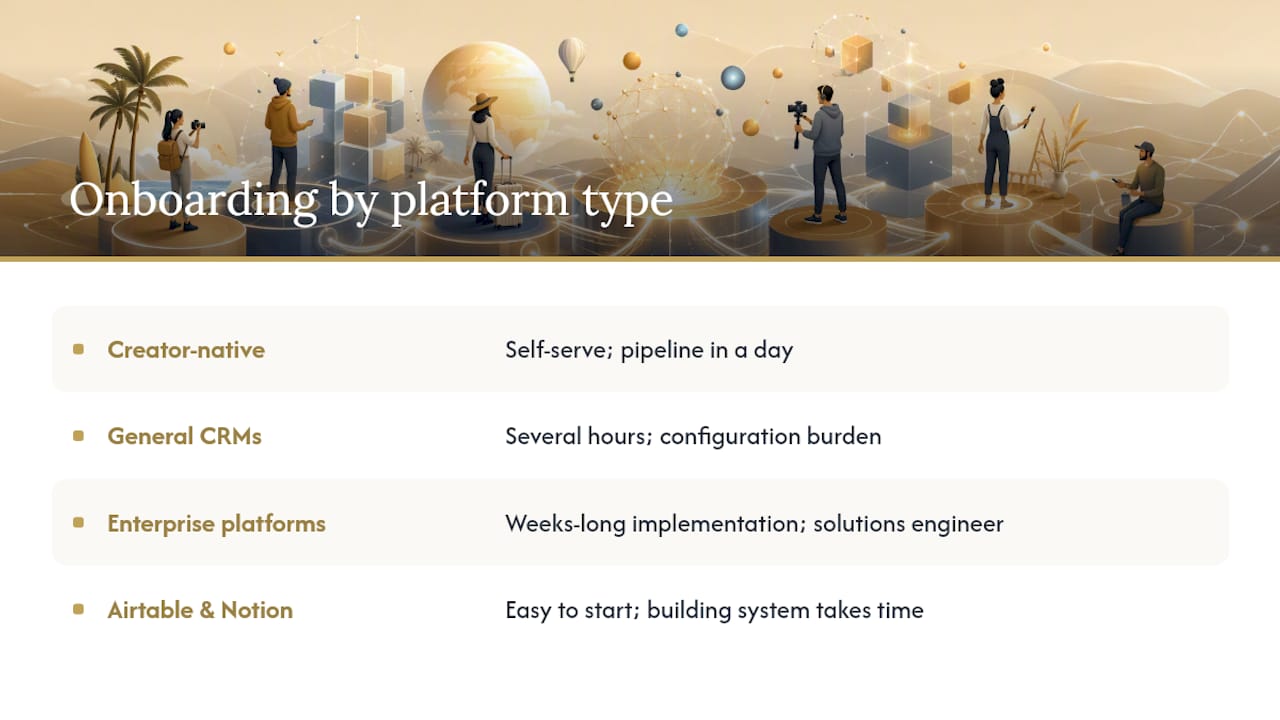
Creator-native platforms (Blackx, SponsorKit, Inked, Creator Flow, BrandFlow) are generally designed for self-serve onboarding. Most offer a setup wizard or template library that gets you to a working deal pipeline within a day. Sponsorship Manager typically offers a demo call as part of onboarding, which is useful if you have an existing sponsor roster to migrate.
General CRMs (HubSpot, Pipedrive, Zoho, Copper) require more setup time. Expect to spend several hours configuring pipelines, custom fields, and automation rules before the platform reflects your actual workflow. HubSpot's documentation is thorough, but the configuration burden is real.
Enterprise platforms (Salesforce, Optimy, SponsorCX) almost always involve a dedicated implementation process, sometimes spanning weeks, with a solutions engineer involved. Not relevant for individual creators, but worth noting for agencies evaluating these options.
Airtable and Notion sit in the middle: the platforms themselves are easy to start, but building a sponsorship-specific system from scratch takes time. Community templates help, but they're not a substitute for purpose-built tooling.
What kind of support can you expect from each platform?
Creator-native tools vary significantly here. SponsorKit and Inked offer email support with reasonable response times. Creator Flow and BrandFlow both advertise dedicated support as part of their paid tiers. Sponsorship Manager's demo-led onboarding suggests a higher-touch support model.
HubSpot's support scales with your plan: the free tier gets community forums and documentation; paid tiers get chat and phone support. Salesforce offers enterprise-grade support options, including dedicated success managers, but at enterprise prices. Zoho's support is generally solid given its price point.
For US-based creators, the key question is time zone coverage. Most creator-native platforms are US-founded and support US business hours. Enterprise platforms like Salesforce and Optimy have global support infrastructure. viaSocket and some configurable tools lean on documentation and community rather than direct support.
Which platforms scale as your creator business grows?
Solo creators with 1–3 active sponsors can start with Google Sheets or Notion and migrate when the manual overhead becomes painful. The migration trigger most creators hit is around four or more concurrent sponsors: at that point, tracking deliverables, invoices, and renewal dates manually becomes a genuine revenue risk.
Creator-native platforms like Blackx, SponsorKit, Inked, and Creator Flow are built to scale from solo to small team. BrandFlow and Sponsorship Manager are better suited for creators who already have a team or manage other creators. General CRMs (HubSpot, Zoho, Salesforce) scale to enterprise without a ceiling, but the creator-specific features don't improve as you grow.
For influencer marketing agencies evaluating team-scale features, the platforms with robust role-based permissions and white-label reporting (BrandFlow, Salesforce, HubSpot) are the most relevant. Blackx's white-label export feature on paid tiers also serves this use case.
How do these platforms handle data security and privacy?
For US-based creators, the minimum bar is HTTPS encryption, secure data storage, and a clear data-deletion policy. Most platforms on this list meet that baseline. The more relevant questions are: who owns your deal data, can you export it, and what happens to it if you cancel?
Blackx publishes a dedicated security and compliance page covering data handling practices. Enterprise platforms like Salesforce and HubSpot maintain SOC 2 compliance and GDPR-ready infrastructure. Creator-native tools vary: SponsorKit and Inked are smaller operations, so it's worth reviewing their privacy policies directly before storing sensitive contract data.
One practical note: never store signed contracts only inside a platform without a local backup. Export PDFs of executed agreements regularly, regardless of which platform you use.
Which platforms have a usable mobile app?
HubSpot, Salesforce, Zoho, Pipedrive, and Monday.com all have full-featured mobile apps. Airtable's mobile app is functional for viewing and editing records but limited for complex automations. Notion's mobile app is solid for documentation but not designed for deal management on the go.
Creator-native platforms are more variable. Creator Flow and BrandFlow offer mobile-accessible interfaces. SponsorKit and Inked are primarily web-based, with mobile-responsive designs rather than dedicated apps. Blackx is web-based with a mobile-responsive interface; a dedicated app is not publicly listed at the time of writing.
For creators who manage deals from their phones, HubSpot's free CRM mobile app is the most capable option among the general-purpose tools. Among creator-native platforms, Creator Flow's mobile experience is the most polished.
What creators actually do after they pick a platform
The first week after signing up for a new sponsorship management platform is where most creators lose momentum. The setup feels like work, and it's tempting to skip steps that pay off later.
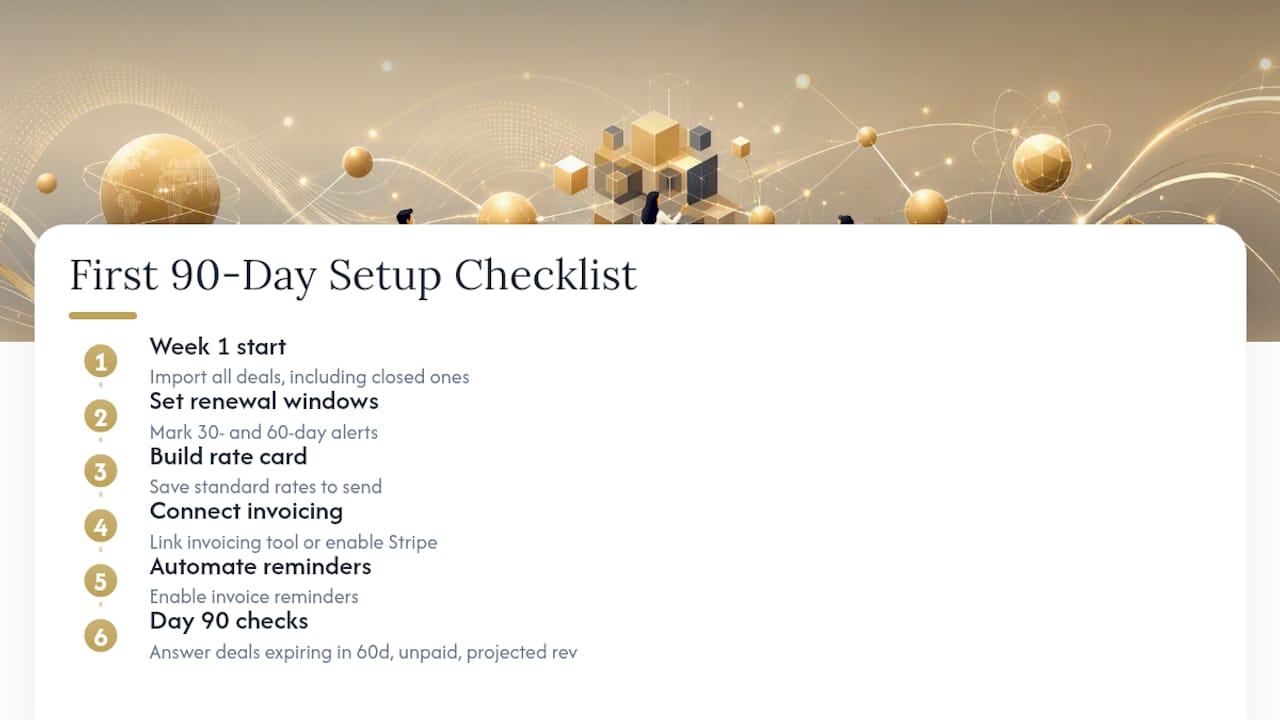
The moves that actually matter in the first 30 days: import your existing deals (even closed ones, so you have historical data), set renewal windows for every active sponsor (30 and 60 days out), build your rate card inside the platform so it's ready to send, and connect your invoicing tool or activate Stripe if the platform supports it. Automate invoice reminders before you need them.
The most common early mistake is treating the platform as a contact list rather than a deal-management system. A CRM that only stores brand names isn't doing the job. The value is in the pipeline view, the deadline alerts, and the renewal automation — none of which work until you've entered real deal data.
By day 90, you should be able to answer three questions from the platform without opening a spreadsheet: What deals are expiring in the next 60 days? Which sponsors haven't paid their last invoice? What's my projected revenue for the next quarter? If you can't answer those three, the platform isn't set up correctly yet.
For creators structuring contracts with legal entities, Blackx's creator legal entity and brand contracts guide covers the contract responsibilities that your platform needs to track.
Blackx gives creators contract intelligence, not just a pipeline
Most sponsorship platforms track deals. Blackx analyzes them. The creator-facing platform gives you a 100-point clarity score on every contract you upload, flags clauses that limit your rights or expose you to liability, and generates a counter-proposal automatically when terms need improving. Renewal automation surfaces expiring deals before the window closes.

The Verified badge signals to brands that you operate with transparency standards, which matters when you're competing for premium partnerships. Free tier available for limited deal scoring. Paid tiers unlock unlimited scoring, the AI negotiation agent, and white-label exports. If you negotiate brand deals regularly and want to stop leaving money on the table, start with Blackx and run your next contract through the clarity score before you sign.
Sources and further reading
- Best Sponsorship Management Platforms Reviews 2026
- Black X – Creator-Brand Deal Infrastructure Platform
- Sponsored Content Disclosure: What Creators Must Know
- Best joincreatorx.club Alternatives for US Brands in 2026
- hubspot.com
- airtable.com
This article reflects general information about sponsorship management platforms and is not legal or financial advice. Confirm pricing, features, and contract terms directly with each vendor before purchasing.
FAQ
What is the best sponsorship management software for creators?
Blackx is the strongest option for creators who negotiate brand deals regularly, offering AI contract analysis, a 100-point clarity score, and renewal automation. For simpler deal tracking and invoicing, SponsorKit and Inked are the most creator-focused alternatives.
How do content creators get sponsorships?
Most creators build a sponsor pipeline through direct outreach, inbound inquiries from brands, and marketplace platforms like OpenSponsorship. A rate card, a media kit, and a clear record of past partnerships are the baseline requirements brands expect before signing.
How much do content creators get paid for sponsorships?
Rates vary widely by audience size, platform, and niche. Micro-creators typically earn $200–$2,000 per sponsored post; mid-tier creators with 100K–500K followers can command $2,000–$20,000 per deal. Long-term brand partnerships with quarterly renewals often generate more predictable revenue than one-off posts.
Which app is best for managing sponsorship deals?
For contract intelligence and renewal automation, Blackx is the purpose-built choice. For a lightweight pipeline with invoicing, SponsorKit handles the basics well. For deadline management and brand approval workflows, Creator Flow's Deadline Radar is the standout feature.
Do I need a dedicated sponsorship platform or will a general CRM work?
A general CRM like HubSpot or Pipedrive works if you're willing to configure it for creator workflows, but you'll build from scratch what creator-native tools provide out of the box. The gap is most visible in contract management, renewal automation, and sponsor portals — features general CRMs don't include without custom setup.