
TL;DR:
- Sponsored content disclosure requires clearly identifying paid or supported content to meet legal standards. Failure to disclose properly risks investigations, fines, and reputational damage, especially under FTC regulations. Using explicit terms like "#ad" at the beginning of posts and embedding disclosures across formats ensures compliance.
What is sponsored content disclosure, and why does it matter?
Sponsored content disclosure is the clear, prominent identification that a piece of content is paid for or otherwise supported by a brand. When a creator receives money, free products, or any other compensation in exchange for promoting something, audiences have a legal right to know. Without that signal, consumers cannot evaluate whether they're reading an honest opinion or a paid pitch.
Three governing bodies define the rules in the United States:
- FTC (Federal Trade Commission): Sets endorsement guidelines requiring creators to disclose any "material connection" to an advertiser, including cash payments, gifted products, and affiliate arrangements under 16 CFR § 255.5.
- FCC (Federal Communications Commission): Governs broadcast media sponsorship identification.
- 47 U.S. Code § 317: The federal statute requiring broadcast stations to announce when content is sponsored, with criminal penalties for willful violations.
Disclosure isn't optional paperwork. It's the line between transparent advertising and deceptive advertising.
Legal requirements and the real risks of getting it wrong
The FTC's authority here is broad. Under its 2023 updated endorsement guides, the standard isn't whether you technically included a disclosure. It's whether the "net impression" on a reasonable consumer is that the content is commercial. A buried hashtag that most viewers scroll past fails that test, regardless of intent.
The FCC adds another layer for broadcast content. Under 47 U.S. Code § 317, failure to disclose broadcast sponsorship can result in fines and imprisonment. For digital creators, FTC enforcement is the more immediate concern, but the principle is identical: paid content must be identified as such.
Key risks creators face:
- FTC investigations triggered by consumer complaints or agency monitoring
- Corrective orders requiring you to revise or remove non-compliant content
- Civil fines for repeated or willful violations
- Criminal penalties under broadcast law for egregious cases
- Reputational damage that outlasts any regulatory action
Staying current matters. The FTC revised its guides in 2023 specifically because platform behaviors and influencer marketing had outpaced the older framework. What was borderline acceptable in 2020 may be clearly non-compliant today.
How to make your disclosures clear, effective, and ongoing
Clear language is non-negotiable. The FTC explicitly states that vague terms like "ambassador," "collab," or "spon" are typically insufficient. Use "#ad" or "#Sponsored" — they're unambiguous, widely understood, and FTC-recognized.
Placement is just as critical as language. A disclosure buried after several paragraphs of a blog post, or stacked below the fold on a social caption, does not satisfy the "unavoidable" standard the FTC requires.
Best practices by format:
- Social media posts: Place "#ad" or "#Sponsored" at the very beginning of the caption, before any other text.
- Blog content: Disclose at the top of the post, above the first paragraph, not at the bottom.
- Videos: Include both a verbal disclosure early in the video and on-screen text. Disclosures placed only in the video description are often insufficient because many viewers never read it.
- Podcasts: State the sponsorship verbally at the start of the segment, not just in show notes.
- Stories and short-form content: Each individual frame or slide that contains sponsored content needs its own disclosure.
Pro Tip: For video content, add an on-screen text overlay reading "Paid Partnership" or "#Ad" during the first 30 seconds. A verbal mention alone can be missed; the visual element ensures compliance even for viewers watching without sound.
Platform tools like Instagram's "Paid Partnership" label or YouTube's "paid promotion" disclosure checkbox are useful, but they do not fully satisfy FTC requirements on their own. When content is shared across platforms or embedded elsewhere, those native labels often disappear. Your own disclosure language must travel with the content.
Disclosure compliance is also performance-based, not a one-time task. The FTC advises that if a meaningful portion of your audience fails to notice or understand a disclosure, you're obligated to improve it. Monitoring audience comprehension and adjusting placement accordingly is part of the job.
Contract resources and tools that support disclosure compliance
Managing disclosure obligations gets complicated fast, especially across multiple brand deals running simultaneously. This is where contract infrastructure becomes a practical necessity, not just a legal formality.
Blackx is built specifically for this. As the contract intelligence layer for the creator economy, Blackx gives creators and brand partners the tools to define, document, and track disclosure responsibilities before a campaign goes live.
What that looks like in practice:
- Disclosure clauses in contracts: Every influencer contract should specify the exact language, placement, timing, and format required for disclosures. Vague contracts produce vague disclosures.
- Checklists for agreement standards: A pre-campaign checklist catches gaps before content is published, not after an FTC complaint arrives.
- Audit trails: Documented agreements create a record that both parties understood and agreed to disclosure requirements, which matters if compliance is ever questioned.
The creator-focused platform at Blackx also supports ongoing compliance monitoring, so disclosure obligations don't fall through the cracks as campaigns scale. For brands managing multiple creator partnerships, Blackx for brands provides the oversight layer to verify that disclosure terms are being met across the board.
For a broader look at how content marketing strategy intersects with disclosure obligations, the regulatory context has shifted enough in recent years that marketers building campaigns in 2026 need updated frameworks, not 2019 playbooks.
Key takeaways on staying compliant with disclosure obligations
- Sponsored content disclosure is a federal legal requirement in the United States, not an industry courtesy.
- The FTC's "net impression" standard means placement and prominence matter as much as the words you use.
- "#ad" and "#Sponsored" are the clearest, most defensible disclosure terms available.
- Platform-native labels alone are insufficient. Your disclosure must be visible in every context where the content appears.
- Disclosure compliance is ongoing. If audiences aren't noticing your disclosures, you're required to fix them.
- Non-compliance risks include FTC investigations, corrective orders, fines, and under broadcast law, criminal penalties.
- Contracts that explicitly define disclosure terms protect both creators and brands from misunderstandings and enforcement exposure.
- Blackx provides the contract intelligence tools creators and professionals need to manage these obligations at scale.
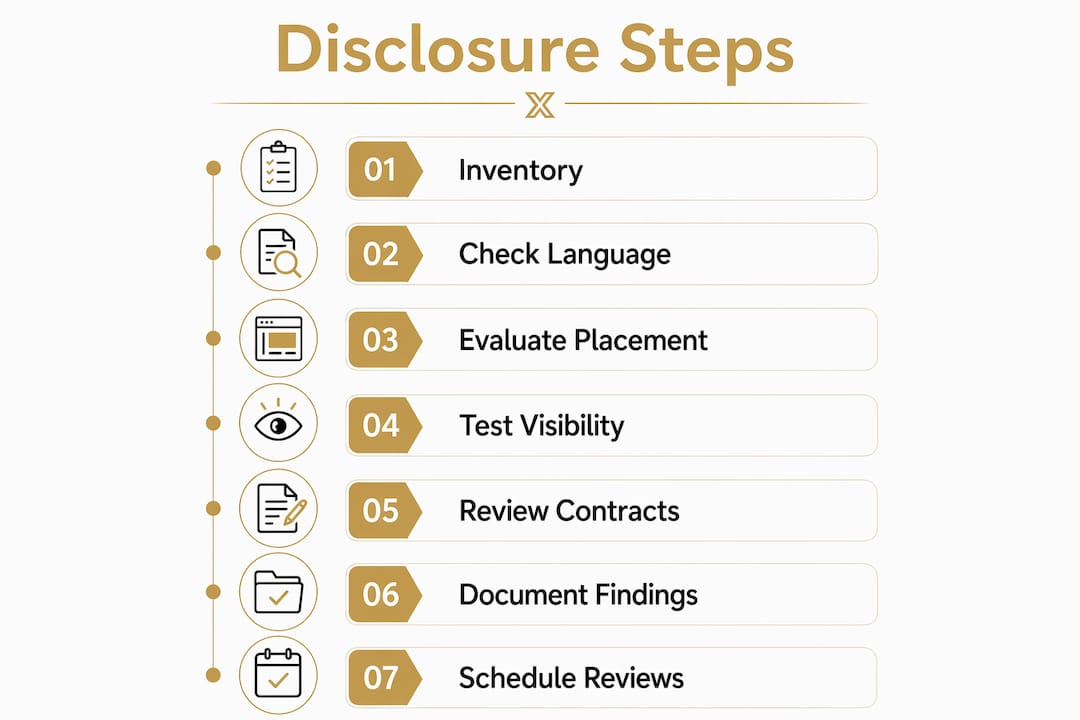
How to audit your existing sponsored content disclosures
Running a disclosure audit doesn't require a legal team. It requires a systematic process and honest evaluation.
Step 1: Inventory all sponsored content. Pull every post, video, blog entry, and podcast episode that involved compensation or gifted product. Include affiliate content.
Step 2: Check disclosure language. Flag anything using vague terms like "collab," "partner," or "spon." Replace with "#ad" or "#Sponsored."

Step 3: Evaluate placement. For each piece of content, ask whether a first-time viewer would see the disclosure before engaging with the sponsored message. If not, the placement fails.
Step 4: Test cross-platform visibility. Share or embed content on a secondary platform and verify the disclosure is still visible. Platform-native labels frequently disappear in this scenario.
Step 5: Review your contracts. Check whether your existing brand agreements specify disclosure requirements. If they don't, that's a gap. Use a cross-promotion agreement checklist to identify what's missing.
Step 6: Document your findings and corrections. A written record of your audit and any remediation steps demonstrates good-faith compliance effort, which the FTC considers in enforcement decisions.
Step 7: Set a recurring review schedule. Platforms change, FTC guidance updates, and audience behavior shifts. A quarterly audit keeps your disclosure practices current.
FAQ
What counts as a material connection requiring disclosure?
Any compensation, including cash, free products, discounts, or affiliate commissions, creates a material connection that must be disclosed under FTC guidelines.
Is "#ad" enough on its own for FTC compliance?
"#ad" is recognized and recommended by the FTC, but placement matters. It must appear prominently at the start of a post, not buried among other hashtags.
Do platform disclosure tools satisfy FTC requirements?
No. Tools like Instagram's "Paid Partnership" label or YouTube's paid promotion checkbox do not fully satisfy FTC disclosure requirements, particularly when content is shared across platforms.
What penalties apply for failing to disclose sponsored content?
FTC violations can result in investigations, corrective orders, and civil fines. Broadcast violations under 47 U.S. Code § 317 can carry criminal penalties including imprisonment.
How should disclosure terms be handled in a creator contract?
Contracts should specify the exact disclosure language, placement, timing, and format required. Blackx's influencer contract templates include disclosure clauses designed to meet current FTC standards.