
TL;DR:
- A breach of contract occurs when one party fails to perform obligations in a signed agreement, affecting creators and brands. Legal remedies include damages, contract termination, and kill fees, but clarity relies on comprehensive written contracts that specify remedies and rights. Proper negotiation and documentation prevent common breaches and protect creators from costly disputes.
A breach of contract occurs when one party fails to perform the obligations spelled out in a signed agreement, and in the creator economy, that failure carries real legal and financial consequences. Content creator breach of contract explained simply means: either the creator or the brand did not do what the contract required. The formal legal term is "material breach," which refers to a failure significant enough to undermine the entire deal. FTC civil penalties for endorsement violations can reach $53,088 per violation, with settlements as high as $9.4 million, making contract compliance a financial issue, not just a legal formality. Written contracts are the only reliable way to enforce your rights, recover unpaid fees, or protect your intellectual property.
What are common causes of breach in content creator agreements?
Breaches in creator contracts fall into predictable patterns. Knowing them helps you spot problems before they become disputes.
- Failure to deliver content or assets. A creator misses a posting deadline or submits work that does not match the agreed brief. Brands treat this as a breach, sometimes withholding full payment even for completed work.
- Non-payment or delayed payment. A brand approves content, posts it, and then delays or refuses payment. This is one of the most common content creator legal issues in 2026, and without a written contract specifying payment milestones, recovery is difficult.
- Exclusivity violations. Many brand deals prohibit creators from working with direct competitors for a set period. Posting a competing brand's content during that window is a clear breach, even if unintentional.
- FTC disclosure failures. Failing to disclose a paid partnership clearly and conspicuously violates both FTC guidelines and the contract itself. Joint liability means both the creator and the brand can face penalties.
- Unapproved content usage or IP misuse. A brand repurposes your content in ways not covered by the contract, such as running it as a paid ad or using it beyond the agreed license period.
- Cancellation without a kill fee. A brand cancels a project after you have completed production but before posting. Contracts without kill fees can leave creators fully uncompensated, even when the work is done.
Pro Tip: Always confirm in writing that a brand has approved your content before you post. Approval records protect you if the brand later claims the content did not meet spec.
What legal rights do creators have when a breach occurs?
Your legal rights depend almost entirely on what your written contract says. Verbal agreements and informal deals offer almost no protection in court.
The first remedy available is compensatory damages, which means recovering the money you lost because of the breach. If a brand owes you $10,000 for a completed campaign and refuses to pay, a court can order that amount plus any costs you incurred. The second remedy is termination, which lets you exit the contract and stop delivering future work when the other party has materially breached. The third is a kill fee, a pre-negotiated payment owed when a brand cancels after production has begun.
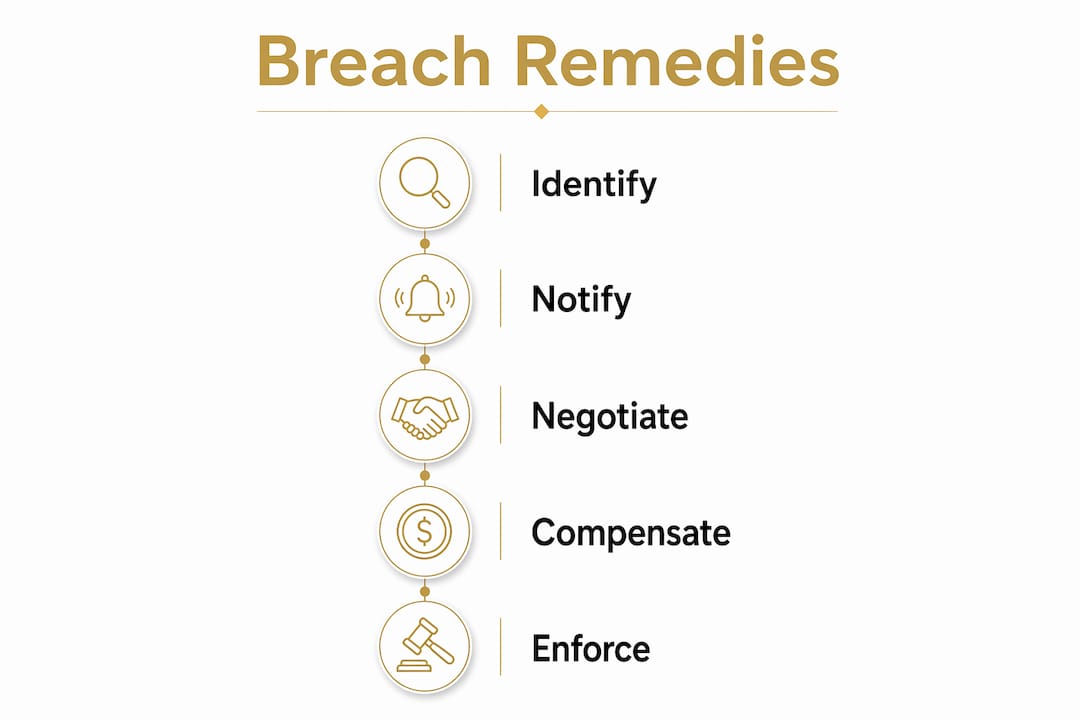
Cure periods matter enormously. Best practices call for a 10–30 day cure period before termination rights activate. That window gives the breaching party a chance to fix the problem before the contract ends. Without a cure period, a single missed deadline could trigger immediate termination with no payment for work already completed.
One legal rule catches creators off guard every time:
The parol evidence rule makes prior informal agreements, including emails and DMs, inadmissible once a formal written contract is signed. The written contract exclusively governs your rights, regardless of what was discussed before signing.
This means that informal deals become unenforceable the moment you sign a formal agreement. Whatever a brand promised in a DM before the contract existed no longer counts legally.
Jurisdiction and venue clauses add another layer of risk. A venue clause favoring the brand can make enforcement prohibitively expensive for a creator, effectively nullifying the contract's protections even when you are clearly in the right. Always check where disputes must be resolved before you sign.
- Review the contract for a defined cure period before taking any action.
- Send a written notice of breach to the other party, documenting the specific obligation they failed to meet.
- Preserve all communications, deliverables, and approval records as evidence.
- Consult an attorney before terminating the contract or withholding future deliverables.
- Pursue damages through demand letter, mediation, or litigation based on the contract's dispute resolution clause.
How to prevent breach of contract risks through smart negotiation
The best time to handle a breach is before it happens. Contract negotiation is where creators either protect themselves or leave themselves exposed.

| Contract clause | Weak version | Stronger version |
|---|---|---|
| Material breach definition | Not defined | Specifies which failures qualify as material |
| Payment terms | "Net 60" with no milestones | Milestone payments tied to deliverable approval |
| Kill fee | Not included | Percentage of total fee owed at each project stage |
| Cure period | Not included | 10–30 days to remedy breach before termination |
| IP ownership | Full copyright assignment to brand | License with defined usage scope and end date |
| Exclusivity | Broad, undefined category | Named competitors only, with a fixed time limit |
| Jurisdiction | Brand's home state | Negotiated neutral venue or creator's home state |
Negotiate a license instead of a full copyright assignment whenever possible. A license grants the brand specific usage rights within defined parameters. A full assignment transfers ownership of your content permanently, removing your ability to control how it is used.
Creators frequently miss negotiating kill fees and approval timelines, which are two of the most financially damaging gaps in any creator contract. A kill fee should scale with project completion: for example, 25% if canceled before production, 50% after production begins, and 100% if content is fully delivered. Approval timelines prevent brands from sitting on content indefinitely while you remain locked into exclusivity.
Contracts should also specify whether the brand's license to use your content survives termination and when that usage right expires. Without a clear end date, a brand can continue using your content long after the deal ends.
Pro Tip: Ask for an independent attorney to review any contract before signing. A one-time legal fee is far cheaper than litigating a breach dispute later.
How agency relationships and AI content raise new breach of contract risks
Agency contracts introduce a second layer of contractual obligations that many creators underestimate. When you sign with a talent agency or management company, you are entering a separate agreement that governs revenue splits, exclusivity, and termination rights. Legal experts report increased agency lawsuits in 2026 involving restrictive clauses and unclear commission structures. The disputes often center on who owns the brand relationships and social media accounts when a creator leaves the agency.
Key risks in agency and emerging content agreements include:
- Unclear account ownership. Some agency contracts claim partial ownership of your social media accounts or audience data. This creates a breach risk if you leave the agency and continue operating those accounts independently.
- Non-compete clauses. Overly broad non-competes can prevent you from working with brands in your niche for months or years after leaving an agency. Courts enforce these inconsistently, but defending against them is expensive.
- Revenue split disputes. Vague commission language leads to disagreements about which deals the agency is owed a percentage on, especially for deals you sourced independently.
- AI-generated content disclosures. Platform AI labels do not fully protect creators from FTC liability. Contracts must explicitly assign responsibility for synthetic media disclosures to one party. Failing to do so creates a compliance gap that both the creator and the brand can be penalized for.
- Synthetic media permissions. If a brand uses AI to generate content in your likeness or voice without explicit contractual permission, that constitutes a breach of your rights and potentially a violation of emerging state-level right-of-publicity laws.
The rise of synthetic media demands new contract language that assigns AI disclosure and permission duties clearly. Without it, both parties face FTC penalties and reputational damage that no platform label can prevent.
What I've learned from watching creators sign the wrong contracts
Creators consistently underestimate how much leverage they have before signing. Once ink is on the page, the contract governs everything, and the parol evidence rule means your prior conversations are legally irrelevant.
The single most expensive mistake I see is signing contracts with no kill fee and no cure period. A brand can cancel after you have spent weeks on production, owe you nothing, and walk away legally clean. That is not bad luck. That is a contract that was never designed to protect you.
The second mistake is treating IP assignment as a standard term. Brands routinely ask for full copyright ownership because creators do not push back. A license for brand deals protects your long-term ownership while still giving the brand what it needs. Most brands will accept a well-drafted license if you ask.
Get independent legal counsel before signing any deal worth more than a few hundred dollars. A contract attorney who works with creators will spot jurisdiction traps, missing cure periods, and overreaching IP clauses in under an hour. That hour is worth every dollar.
Document everything in writing throughout the project. Approval emails, revision requests, and posting confirmations all become evidence if a dispute arises. Creators who document well almost always resolve disputes faster and with better outcomes than those who rely on memory and screenshots of DMs.
— Brian
Blackx gives creators the contract infrastructure to protect every deal
Content creation agreements are only as strong as the systems behind them. Blackx is the contract intelligence layer for the creator economy, built to give creators and brands the deal clarity that prevents disputes before they start.

With Blackx, creators get structured deal infrastructure that covers milestone-based payments, transparent revenue splits, and IP term tracking from the first offer to final delivery. The platform supports clear documentation of approval timelines, kill fee triggers, and license scope, so nothing falls through the cracks. For creators who want deal confidence without a law degree, Blackx's influencer contract tools provide the framework to negotiate, sign, and monitor agreements with full visibility into every obligation on both sides.
FAQ
What is a material breach in a creator contract?
A material breach is a failure significant enough to undermine the entire agreement, such as non-payment, failure to deliver content, or a serious exclusivity violation. Minor delays typically do not qualify as material breaches unless the contract defines them as such.
Can a brand cancel a creator deal without paying?
A brand can cancel without paying if the contract includes no kill fee clause. Contracts without kill fees leave creators uncompensated even when production is complete, which is why negotiating a kill fee at each project stage is critical.
Do DMs and emails count as a contract?
Informal communications like DMs and emails can form a basic agreement, but the parol evidence rule makes them inadmissible once a formal written contract is signed. The written contract then exclusively governs all rights and obligations.
What FTC penalties apply to creators who breach disclosure rules?
FTC civil penalties for endorsement violations can reach $53,088 per violation, with settlements reaching $9.4 million. Both the creator and the brand share liability for non-compliant disclosures.
How do I handle a contract dispute with my agency?
Send a written notice identifying the specific breach, preserve all communications and payment records, and seek independent legal counsel before terminating the agreement. Agency disputes in 2026 often hinge on commission language and account ownership clauses that require careful legal interpretation.