
TL;DR:
- Co-creation ownership involves formal legal rights over jointly created intellectual property, including decision-making and benefit sharing. It differs from collaboration and co-production by requiring explicit contractual agreements that cover rights, responsibility, and governance to prevent disputes and protect creator interests. Proper contracts should address material, immaterial, and relational ownership aspects, especially with emerging AI contributions, to ensure clear rights and revenue sharing.
Co-creation ownership means you and your collaborators hold formal, ongoing legal rights and responsibilities over jointly created intellectual property. It goes well beyond simply working together. Where basic collaboration ends when the project ships, co-creation ownership persists: it governs who makes decisions, who earns from the work, and who is accountable when things get complicated.
In creator economy contracts, that distinction carries real weight. A handshake and a shared Google Drive folder do not create ownership. What creates ownership is a written agreement that explicitly covers:
- Decision rights: who controls how the work is used, licensed, or modified
- Benefit sharing: how revenue, royalties, and commercial opportunities are divided
- Accountability: who bears responsibility if the work causes harm or generates legal exposure
- Ongoing governance: how disputes are resolved and how the arrangement evolves over time
Without those four elements locked into a contract, you have collaboration. With them, you have co-creation ownership.
How co-creation ownership differs from co-production and collaboration
These three terms get used interchangeably, but they describe very different relationships.
Co-production focuses on power-sharing during the design phase. Stakeholders help build something together, but once the product launches, their formal role ends. They shaped it; they do not own it. Co-ownership, by contrast, keeps those same collaborators invested in what the work becomes, not just what it was at launch.
Collaboration is even looser. Two creators can collaborate on a video series, split the creative labor, and still have one party own 100% of the intellectual property if the contract says so. Collaboration describes a working style; ownership describes a legal status.
Co-creation ownership sits at the intersection of both. It requires:
- Active contribution from all parties during creation
- Explicit contractual allocation of rights after creation
- Ongoing shared governance over commercial decisions
- Defined benefit-sharing mechanisms tied to the work's performance
A brand hiring a creator to produce sponsored content is collaboration explained by media production experts. A brand and creator jointly developing a product line, with both parties holding IP rights and revenue stakes, is co-creation ownership.
What ownership in co-creation actually covers
Ownership in co-creation operates across three distinct dimensions, and contracts that ignore any one of them create gaps.
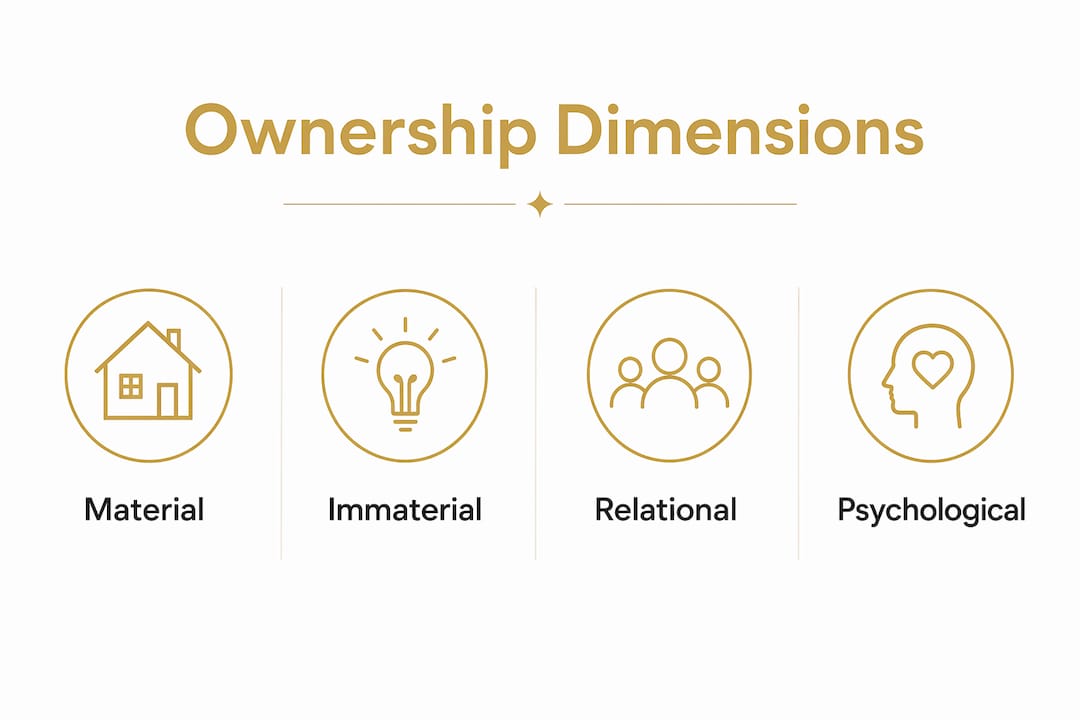
Material dimension: the tangible or digital outputs subject to U.S. intellectual property law. Under the Copyright Act, original works fixed in a tangible medium receive automatic protection, but joint authorship requires that each contributor intend the work to be merged into a unified whole. That intent must be documented.
Immaterial dimension: value ownership is multi-dimensional, including identity and professional reputation linked to the creative process. Credit and authorship recognition are ownership interests even when they carry no direct financial value. A creator who builds a brand's visual identity may not own the copyright if the contract assigns it to the brand, but they may retain the right to claim authorship publicly.
Relational dimension: the ongoing governance structure. Who approves derivative works? Who can license the IP to third parties? What happens if one party wants to exit? These questions belong in the contract, not in a future conversation.
Psychological ownership, the feeling that something is "yours," differs sharply from legal ownership. Creators who feel deeply invested in a project sometimes discover they hold no contractual rights to it. That gap between feeling and legal reality is where most disputes begin.
Why explicit contracts are the only way to protect co-creation rights
Unclear ownership definitions create three specific problems: authorship ambiguity, responsibility diffusion, and commercial conflict. All three are avoidable with precise contract language.
Under U.S. copyright law, a work created by two or more authors is a joint work if both parties intended it that way at the time of creation. Without that documented intent, courts default to whoever holds the clearest paper trail, which usually means the party with more legal resources. Work-for-hire provisions compound this: if a creator signs a contract with a work-for-hire clause, the commissioning party owns the copyright entirely, regardless of creative contribution.
Successful co-ownership agreements separate credit from profit. A creator can assign financial rights to a brand partner while retaining authorship credit, which protects their professional reputation and portfolio rights even when the commercial upside flows elsewhere. That separation belongs in the contract as two distinct clauses, not bundled into a single rights assignment.
Pro Tip: Negotiate a "credit clause" and a "financial rights clause" as separate line items. Bundling them into one assignment paragraph makes it easy for the other party to argue that signing away financial rights also waived your authorship credit.
Practical steps for establishing clear terms:
- Define the scope of the joint work before creation begins
- Specify whether the arrangement creates a joint work or a work-for-hire relationship
- Allocate licensing rights explicitly: who can sublicense, to whom, and under what conditions
- Include a revenue-sharing framework with defined triggers and payment timelines
- Add a governance clause covering amendments, exits, and dispute resolution
How AI and distributed agency are reshaping co-creation ownership
Generative AI tools have introduced ownership questions that existing U.S. copyright doctrine does not fully answer. The U.S. Copyright Office has consistently held that copyright protection requires human authorship. AI-generated content, without sufficient human creative input, receives no protection. That creates a direct problem for creators who use tools like image generators or AI writing assistants in their workflow: the AI-assisted portions of a co-created work may be unprotectable.
A framework for creative ownership developed from research with creative professionals organizes ownership across three dimensions: Person (how the artifact relates to the creator's identity), Process (the decisions, effort, and intentionality involved), and System (the material, collaborative, and contextual conditions of creation). That framework gives creators a vocabulary for arguing which contributions were genuinely human and therefore protectable.
In AI-integrated workflows, authenticity erosion and value attribution uncertainty become real contractual risks. When a brand, a creator, and an AI tool all contribute to a final product, the contract must explicitly assign rights for the human contributions and acknowledge that AI-generated elements may fall into the public domain.
Recommendations for creators working with AI tools:
- Document which elements of the work reflect your original human creative decisions
- Specify in contracts that AI-assisted portions are subject to separate rights analysis
- Avoid assigning rights to AI-generated content as if it were protectable IP
- Require that co-creation contracts address distributed agency explicitly
How Blackx helps creators protect their ownership rights
Blackx operates as the contract intelligence layer for the creator economy, built specifically to address the ownership clarity gap that costs creators leverage in brand deals and multi-party partnerships.
The platform gives creators structured frameworks for negotiating and documenting co-creation ownership terms before a project begins. Key capabilities include:
- IP ownership clause templates calibrated to U.S. copyright law
- Royalty split and revenue-sharing structures built into deal agreements
- Credit and authorship provisions as separate, enforceable contract elements
- Licensing scope definitions covering sublicensing, exclusivity, and territory
- Educational resources updated for 2026 creator economy contract standards
For creators navigating multi-party partnerships, Blackx removes the guesswork from deal structures that would otherwise require expensive legal counsel to get right.
Disputes that arise from co-creation ownership and how to resolve them
The most common disputes fall into three categories: credit disputes (who gets authorship recognition), revenue disputes (how profits are calculated and distributed), and control disputes (who can authorize new uses of the work).
Credit disputes often surface when a project becomes commercially successful and the brand attempts to minimize the creator's visible contribution. Revenue disputes typically involve ambiguous contract language around what counts as "revenue" for sharing purposes. Control disputes arise when one party attempts to license the work without the other's consent.
Recommended resolution mechanisms, in order of preference: direct negotiation with a written record, mediation through a neutral third party, and arbitration under the American Arbitration Association's commercial rules. Litigation is the most expensive path and rarely the right one for creator economy disputes where the relationship has ongoing value.
Royalties, licensing, and revenue sharing in co-creation agreements
Co-creation ownership directly determines how money flows. A creator who holds a co-ownership interest in a work has the right to license that work independently under U.S. copyright law, unless the contract restricts that right. That default can work for or against you depending on the deal structure.
Royalty arrangements in co-creation contracts typically specify a percentage of net or gross revenue, a defined accounting period, and an audit right. Licensing terms should address exclusivity (can the brand license the work to competitors?), territory (U.S. only or worldwide?), and duration (does the license expire?). Revenue-sharing triggers matter too: some contracts pay out only after a recoupment threshold, which can delay creator earnings significantly.
Pro Tip: Always define "net revenue" explicitly in the contract. Without a definition, the other party can deduct costs that reduce your share to near zero before you see a payment.
Co-creation ownership in practice: three creator economy scenarios
Scenario 1: Creator and brand co-develop a product line. A beauty creator and a cosmetics brand jointly develop a product collection. The creator contributes concept, aesthetic direction, and audience trust; the brand contributes manufacturing and distribution. Without a co-ownership agreement, the brand holds all IP by default. With one, the creator retains a defined royalty on sales, authorship credit on packaging, and approval rights over how the product is marketed.
Scenario 2: Two creators build a joint content channel. Two podcasters launch a show together. Both contribute equally, but only one registers the channel and signs the brand deals. When the partnership dissolves, the unregistered creator has no documented ownership claim. A co-creation agreement signed at launch would have allocated channel ownership, revenue rights, and exit terms from day one.
Scenario 3: Creator uses AI tools in a commissioned project. A creator uses an AI image generator to produce assets for a brand campaign. The contract assigns all IP to the brand. The AI-generated assets may not be protectable under U.S. copyright law, which means the brand received an assignment of rights that may not exist. Both parties benefit from a contract that addresses AI-generated content explicitly, separating human-authored elements from AI-assisted ones.

Blackx builds the contract infrastructure creators need to enter co-creation deals with clarity. From IP ownership clauses to royalty frameworks, the platform is built for the 2026 creator economy. Get started as a creator and stop leaving ownership to chance.
FAQ
What does co-creation ownership mean legally in the U.S.?
Co-creation ownership means two or more parties hold formal, documented rights over jointly created intellectual property, including decision rights, financial rights, and authorship credit. Under U.S. copyright law, joint authorship requires documented intent from all contributors at the time of creation.
How is co-creation ownership different from a work-for-hire agreement?
A work-for-hire agreement transfers all IP rights to the commissioning party, leaving the creator with no ownership stake. Co-creation ownership, by contrast, allocates rights among all contributors through an explicit contractual framework.
Can AI-generated content be included in a co-creation ownership agreement?
AI-generated content currently receives no U.S. copyright protection without sufficient human creative input. Contracts should explicitly separate human-authored elements from AI-assisted ones and assign rights only to the protectable human contributions.
What happens if a co-creation contract does not define ownership terms?
Without explicit ownership terms, U.S. courts default to whoever holds the clearest documentation, typically the party with greater legal resources. Undefined ownership also means either co-owner can license the work independently, which can undermine exclusivity deals.
How should royalties be structured in a co-creation agreement?
Royalty clauses should specify the percentage, whether it applies to net or gross revenue, the accounting period, and an audit right. Defining "net revenue" explicitly prevents the other party from deducting costs that reduce your share before payment.