
Platform usage rights are the legal permissions inside a platform's Terms of Service or Platform Agreement that let the platform display, distribute, monetize, moderate, and use your content and data. Before you read another word, do this: open your primary platform's ToS, find the "license grant" section, and check two things.
- The effective/version date — the rights in force on the day you use the platform are the ones that govern you, not the version you agreed to at signup.
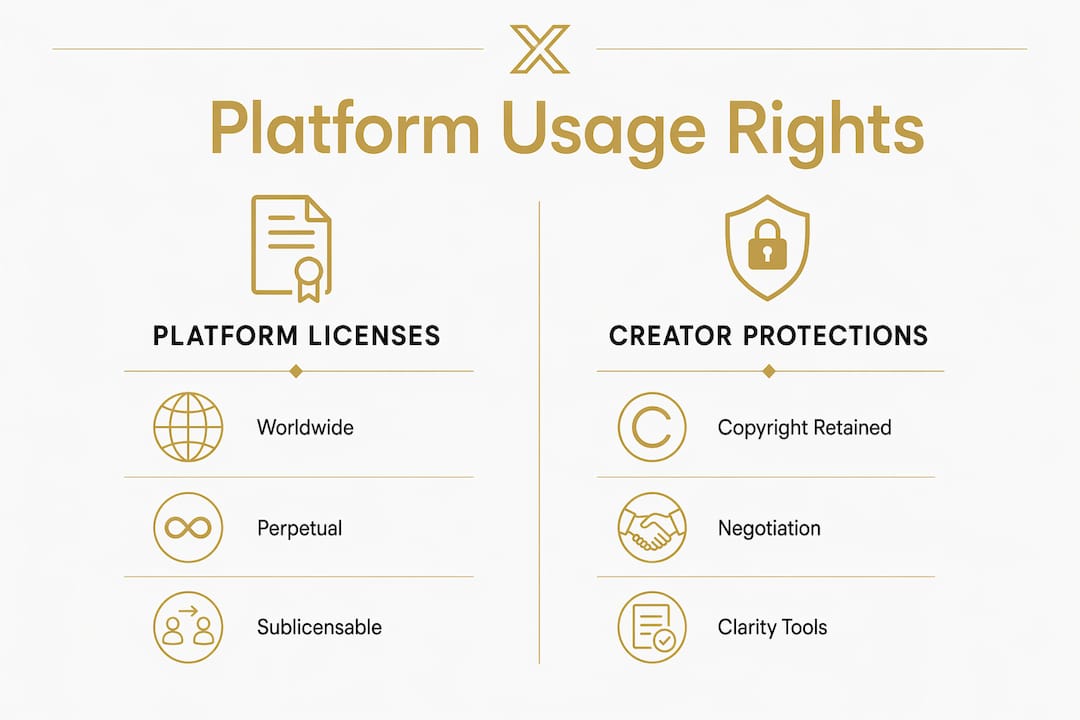
- The license scope language — flag any grant described as worldwide, perpetual, sublicensable, or irrevocable immediately. These four words define how much control you've actually handed over.
That version date matters more than most creators realize. Product Terms documents are versioned rulebooks where the document's version date governs compliance reviews, not the date you first accepted the agreement.
What do platform usage rights actually include?
Platform usage rights are the legal permissions and restrictions in a platform's agreement that govern how users interact with the platform and how the platform may use user-created content and data. Most creators focus on copyright, but the license grant is where the real action is.
Platforms typically acquire four core rights over your content:
- Display and distribute — the right to show your content to any audience, on any surface the platform controls.
- Monetize — the right to run ads against your content, license it to advertisers, or use it in promotional materials.
- Moderate — the right to remove, restrict, or alter your content at the platform's discretion.
- Use your data — the right to harvest behavioral and demographic data for targeted advertising.
The scope of those rights is written in license language. Here's what each term actually means:
| License Term | What It Lets the Platform Do |
|---|---|
| Worldwide | Use your content in any country, with no geographic limit |
| Perpetual | Keep and use your content indefinitely, even after you delete it |
| Sublicensable | License your content to third parties (advertisers, partners, subsidiaries) |
| Transferable | Assign the license to another company (relevant in acquisitions) |
| Irrevocable | You cannot take back the grant once made |
| Royalty-free | No payment owed to you for any use under the license |

A clause like "you grant us a worldwide, perpetual, sublicensable, royalty-free license" is standard boilerplate on most major platforms. Usage rights often specify duration, geographic scope, and media restrictions — and when a grant omits those limits, the platform's rights expand to fill the silence.
Why platform usage rights can hurt creators
Here's the gap most creators miss: retaining copyright does not preserve your reach or your revenue. Creators usually retain underlying copyright while granting platforms broad, worldwide, and often sublicensable permissions to distribute and monetize content. Copyright protects you from someone republishing your work without credit. It does nothing to stop a platform from demonetizing your channel, suppressing your content algorithmically, or sublicensing your videos to an advertiser.
The concrete risks break down like this:
- Account termination — platforms can suspend or delete accounts under vague "violation" clauses, instantly severing your connection to your audience. Platforms function as private regulatory systems with their own penalties, appeals processes, and enforcement mechanisms.
- Loss of algorithmic standing — when an account is terminated, the creator loses algorithmic standing and subscriber relationships instantly, regardless of retained copyright. You can't port a recommendation engine.
- Restricted monetization — revenue-sharing terms can change with little notice, and the creator fund agreement you signed last year may not reflect what the platform pays today.
- Data harvesting — your audience's behavioral data feeds the platform's ad targeting, not yours.
A creator who builds entirely on one platform and never exports their analytics or captures an email list is renting an audience, not owning one. The platform holds the lease.
Pro Tip: Treat platform analytics as borrowed infrastructure. Export your data monthly and build a direct channel (email list, SMS, owned site) so a single policy change doesn't erase your audience relationship.
Where are platform usage rights written, and what should you check?
The controlling documents are usually three layers deep:
- Terms of Service (ToS) — the master agreement every user accepts; contains the core license grant, termination rights, and dispute resolution.
- Platform Agreement — a more detailed contract for professional or monetizing creators; often includes revenue-sharing terms and content ownership clauses.
- Product Terms — versioned documents (sometimes called Product Use Rights) that define how specific features or licensed products may be used. The version date here is the governing date for any compliance review.
Work through these clause checkpoints line by line:
| Clause Type | Red-Flag Language | Plain-Language Impact |
|---|---|---|
| License grant | "irrevocable, perpetual, worldwide" | You can't reclaim the rights, ever |
| Sublicensing | "sublicensable through multiple tiers" | Platform can license your content to anyone |
| Termination | "at our sole discretion, immediately" | No notice, no appeal, no cure period |
| Change notice | "we may update these terms at any time" | Rights can expand without your active consent |
| Data use | "use your data to improve our services" | Broad permission for ad targeting and model training |
Pro Tip: Always note the effective date at the top of the ToS before you start reading. If the platform updates its terms, the new version governs from the date it takes effect, not from when you notice the change. Screenshot the version date alongside the license grant clause.
For a deeper look at how IP ownership interacts with platform licenses, the distinction between copyright and distribution rights is worth understanding before you negotiate anything.
How to protect yourself: negotiation levers and operational steps
Most creators assume platform ToS terms are non-negotiable. For consumer-facing platforms, that's largely true. For brand deals and platform partnership agreements, you often have real leverage. Here's where to focus:
- Limit the license scope — push for a specific territory (United States only, for example) and a defined term (12 months, renewable) rather than a worldwide perpetual grant.
- Remove or narrow sublicensing — ask for "non-sublicensable" language, or at minimum require your written approval before the brand licenses your content to a third party.
- Carve out owned IP and analytics — explicitly state that your trademarks, audience data, and analytics exports remain yours and are not covered by the license grant.
- Require notice and cure periods — ask for at least 30 days' written notice before any material change to payment terms or content restrictions, and a cure period before termination.
Beyond negotiation, operational mitigations matter just as much:
- Maintain local copies of all published content and keep a DMCA-ready archive.
- Export platform analytics monthly and store them outside the platform.
- Build an email list or SMS subscriber base as a direct audience channel.
- Cross-link to owned properties in every piece of platform content.
- Review cross-promotion agreements before signing any multi-platform deal.
Legal scholarship argues that market competition, not IP regulation, often protects creators in platform disputes, which means negotiation and operational steps are usually the practical route rather than waiting for regulatory relief.
When a deal involves significant revenue or an exclusivity clause, escalate to a contracts attorney. AI-assisted contract tools can flag red-flag language and generate counter-proposals in minutes, but they don't replace counsel for high-stakes agreements. For a breakdown of when breach of contract risk becomes a real exposure, the stakes are higher than most creators expect.
Pro Tip: Before signing any brand deal, run the contract through a clause-detection tool first. You'll spot sublicensing and perpetual-use language in seconds rather than missing it buried in paragraph 14.
How contract-intelligence tools help creators manage usage rights
Manually reading every ToS update and brand contract is not a realistic workflow for an active creator. Contract-intelligence tools close that gap by automating the most time-consuming parts of the review process.
Blackx is built specifically for this. As the contract intelligence layer for the creator economy, it gives creators and brands:
- Clause detection — automatically surfaces license grant language, sublicensing provisions, and termination clauses.
- 100-point contract clarity score — a single number that tells you how creator-friendly a contract is before you sign.
- Red-flag alerts — flags perpetual, irrevocable, or worldwide grants the moment they appear.
- Version and effective-date tracking — monitors ToS updates so you know when rights have changed.
- Automated counter-proposal generation — produces negotiation-ready language you can send directly to a brand.
- Black X Verified badge — a trust signal for creators and brands who meet transparency standards.
Here's how it works in practice: a creator receives a brand deal with a sublicensing clause buried in section 8. Blackx flags it as a red-flag item, scores the contract at 54 out of 100, and generates a counter-proposal removing the sublicensing grant and capping the license term at 12 months. The creator sends the counter in the same day instead of spending hours parsing legal language.
Blackx's security and trust infrastructure is documented on the Blackx security page, covering data handling, compliance standards, and platform protections for creators and brands. The Blackx blog also covers platform-specific contract issues, algorithm risk, and IP ownership in depth — all built around the creator economy's real contract problems.
The part of this conversation most guides skip
Most articles about platform usage rights end with "read your ToS carefully." That's true but incomplete. The harder truth is that the ToS is written to be ignored. Platforms count on creators not reading 8,000 words of legal language, and they update those terms knowing most users won't notice.
The version-date problem is the one that actually bites creators. You agreed to one set of rights in 2022. The platform updated its terms in 2024. You never re-read them. The rights in effect today, not the ones you remember agreeing to, are what govern your content. That's not a technicality. It's the mechanism by which platforms quietly expand their rights over time.
The negotiation insight that most guides also miss: you rarely need to rewrite a platform's entire business model to protect yourself. Narrow carve-outs, analytics export rights, a non-sublicensable grant, and a defined license term are achievable asks in brand deals. They don't threaten the platform's core interests, so they're often granted without a fight. The creators who get better terms are usually the ones who ask for specific, limited changes rather than broad rewrites.
Blackx gives creators a clarity score before they sign
Creators who negotiate brand deals regularly need more than a checklist. Blackx delivers a 100-point contract clarity score, automated red-flag detection, and a counter-proposal generator built for the creator economy — so you spend your time on the deal, not on decoding the contract.

Run any brand contract or platform agreement through Blackx and get a scored, flagged report in minutes. The creator platform includes a free tier with clause detection, and paid tiers unlock unlimited deal scoring, the AI negotiation agent, version tracking, and the Black X Verified badge. Brands using Blackx get the same clarity on their side, making deals faster and cleaner for everyone involved.
Start your first clarity scan at blackx.app/creator.
Useful sources and recommended reading
- ContractsCounsel: Platform Agreement Key Terms — plain-language breakdown of what platform agreements contain and how license grants are structured.
- Mailchimp: Usage Rights Guide for Business Owners — covers rights-managed versus open licenses, duration, territory, and media restrictions.
- UC Berkeley Law: IP Rights and Technological Platforms — academic analysis of how IP regulation and market competition interact in platform disputes.
- Creator Economy: Chapter 3 — Platform Ecosystems — detailed breakdown of the four core rights platforms claim and how algorithmic control works.
- Microsoft Product Use Rights Explained — practitioner guide to versioned Product Terms and why the effective date governs compliance.
- Linux Foundation Platform Use Agreement — a real-world example of a platform agreement with explicit license grant, sublicensing, and termination language.
- Blackx Security Page — Blackx's data handling, compliance standards, and platform trust documentation.
- Blackx Blog: Content Creator IP Ownership — deep dive on copyright retention versus platform license grants.
- Amazon royalty scheme for eBook authors — external example of how platform monetization policies signal rights changes to creators.
When doing your own compliance check, always cite the Product Terms or ToS by its version number and effective date, not just the platform name.
FAQ
What is platform usage rights in plain language?
Platform usage rights are the permissions you grant a platform in its Terms of Service to display, distribute, monetize, and use your content and data. You keep your copyright, but the platform gets a license to act on your content within the scope those terms define.
Do creators keep copyright when they post on a platform?
Yes, creators generally retain underlying copyright. The platform receives a license — often worldwide, perpetual, and sublicensable — to use the content, but that license does not transfer ownership of the copyright itself.
What are the biggest red-flag clauses to watch for?
The highest-risk language combines "irrevocable," "perpetual," "worldwide," and "sublicensable" in a single license grant. A termination clause that reads "at our sole discretion, immediately, without notice" is equally dangerous because it removes any appeal or cure period.
Can creators negotiate platform usage rights?
On consumer platforms, ToS terms are generally non-negotiable. In direct brand deals and platform partnership agreements, creators can often limit the license scope, remove sublicensing, and add notice requirements — especially when the deal involves significant revenue.
How does Blackx help with platform usage rights?
Blackx scores any contract on a 100-point clarity scale, flags red-flag clauses like perpetual or sublicensable grants, tracks version and effective dates, and generates counter-proposals automatically, giving creators negotiation-ready language without requiring a law degree.